

Your firm probably uses project management software. Probably financial software too, and a separate time tracking tool. Maybe a spreadsheet or three to tie it all together. A software benchmark found that 60% of firms use project management software, 89% use financial tools, and 69% use time tracking tools. But workflow research still points to integration gaps. If you've ever spent a Friday afternoon copying time entries from one system into another just to send invoices, you already know this.
For many A&E firms, system costs create daily friction. Every manual data transfer between systems, every reconciliation spreadsheet, and every hour spent chasing time entries from last Thursday is unpaid work. It adds up faster than most principals realize.
The Hidden Tax on Every Project
Disconnected business systems create revenue leakage. Handoff risks let hours, costs, and billing details fall through the gaps.
A&E realization rates sit around 95%, based in part on benchmark findings. That means the typical firm loses roughly 5% of potential revenue before it reaches the bank. Lower-performing firms fall much further behind top firms in revenue capture.
Most firms do not lose that revenue because teams are careless. They lose it because the systems were never built to catch what falls between them. The recovery opportunity is measurable. Firms that implement daily time capture recover $2,000 to $3,000 per month in previously lost billable time. For a 12-person firm, that can mean $24,000 to $36,000 a year.
What a Firm Operating System Means
A firm operating system is one connected practice management system for time tracking, project budgets, resource planning, invoicing, and reporting, built around the way A&E firms actually work. Time logged on a Tuesday morning should show up in project profitability, staffing visibility, and invoicing without re-entry or spreadsheet cleanup.
Think of it like a coordinated drawing set. When the structural plan updates, the sections and details follow. A firm operating system does the same thing for business data.
Firms gaining ground tend to integrate existing tools rather than expand their software stack. They extract more value from the platforms they already own. Working with fragmented data stops working once a firm grows past a few people and a few active jobs. Centralized information helps teams make better decisions and run better projects.
The Capabilities That Matter Most
A&E firms need a specific set of capabilities from a unified platform. Generic tools like Asana or Monday.com usually require workarounds that recreate the same fragmentation you're trying to escape.
The core capabilities include:
- Project accounting with phase-level tracking. Firms need to speed up invoicing and payment workflows instead of treating them as end-of-month cleanup.
- Real-time financial visibility. Platforms should provide performance dashboards that let teams drill into performance against KPIs, not just export static reports.
- Resource planning tied to project data. Firms that align staffing, scope, and cash flow make staffing decisions from real utilization data.
- Direct accounting integration. Tech-forward firms build a connected finance backbone that links apps and automates workflows.
A&E work has specific billing structures, phase-based tracking, and consultant coordination that generic tools were never designed to handle. Reducing admin load lets teams spend more time on design, engineering, and client work.
When Fragmented Tools Break Down
Every principal hits this point. The firm grows, and you can no longer manage by walking around. You cannot see activity and know what everyone is working on. Informal financial management stops working.
Practice leaders have found that the 10 to 25 employee range often exposes a familiar set of problems, reflected in growth thresholds:
- Without pipeline visibility and staffing data, firms either miss targets through understaffing or give away work through overstaffing.
- Billing slows down because no one has a single view of unbilled time, and billing delays grow when teams have to pull data from multiple systems.
Survey data indicates that, among 549 A&E firms, technology priorities rose to the top of the list. More firms now treat technology as a practical way to handle growth without adding more administrative drag.
How Monograph Works as a Firm Operating System
Monograph was built by architects who lived these problems firsthand. The company is founder-led and venture-backed, which supports continued product development and customer-driven improvements. The platform connects time tracking, project budgets, resource planning, invoicing, and reporting in one system designed around A&E workflows.
A few capabilities show what that looks like in practice:
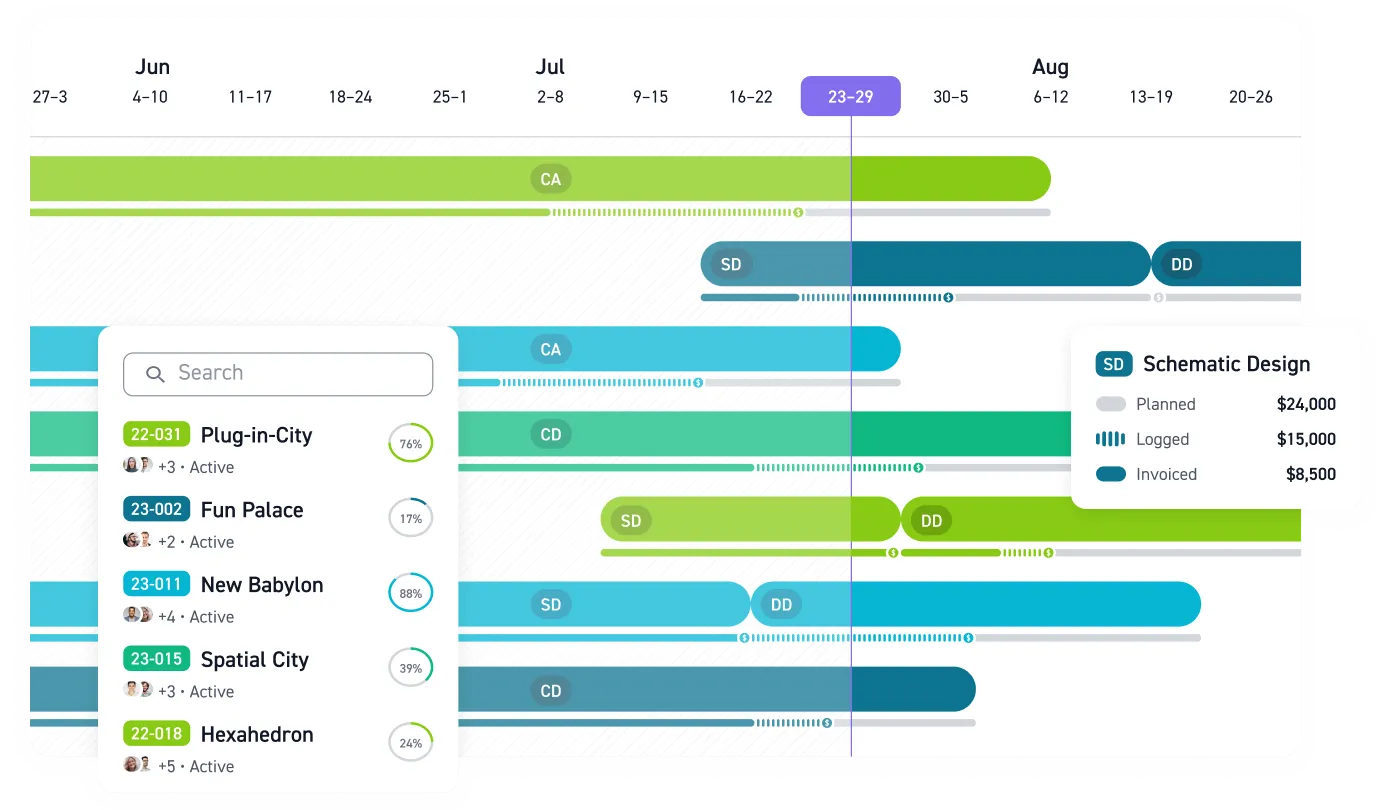
- Monograph's MoneyGantt™ is Monograph's signature feature. It combines timeline visibility with budget-to-cash tracking in one view, so teams can quickly see which projects or phases need attention.
- Time tracking inside the project workspace lets hours logged against a phase flow directly into invoicing workflows.
- Resource dashboards show utilization and burn trends across active projects so teams can adjust staffing earlier, before one team member is overloaded and another is underused.
- QuickBooks sync connects invoices, expenses, consultant bills, and clients between systems, which cuts down on double entry and gives finance teams cleaner records to work from.
Woodhull, a 25-person architecture firm in Maine, reported 66% less admin time, 50% faster billing, and 66% less budget overage after switching from BQE Core to Monograph. Their full case study details how connecting time, budgets, and invoicing in one system produced those results.
Across A&E firms, financial outcomes vary considerably between practices that invoice promptly and those that let billing drift. Tightening collections practices before cash flow problems emerge is one of the clearest differences between high-performing and average firms.
Speed Becomes the Strategy
Operational speed is a competitive advantage in A&E. Firms that respond to leads quickly signal client responsiveness throughout the engagement. Firms that invoice as work is completed collect faster and protect cash flow. Firms that staff projects from real-time utilization data avoid both burnout risk and unnecessary bench time.
Benchmark data shows that automation trends are moving toward a larger share of work being handled without manual intervention. Automation depends on connected data, though. Firms with disconnected systems will struggle to adopt AI workflows that need clean, linked inputs.
For small and mid-size firms, better systems close the gap with larger competitors. They give principals and PMs the clarity to make faster decisions without adding more admin overhead. Monograph was built for growing A&E firms and is used by 13,000+ professionals across 1,800+ firms.
See How It Works in Practice
If you're a principal, operations leader, or PM, start with a simple audit: where does time get entered, where do budgets live, and what has to happen before an invoice goes out? The answer usually reveals the same problem. There are too many handoffs, too many spreadsheets, and too many places for revenue to disappear.
The next step is to look at those workflows in one A&E-specific system. Monograph connects time, budgets, staffing, invoicing, and QuickBooks Online so your team can work from one source of truth instead of stitching together five partial ones.
Disconnected systems do not fix themselves. Book a demo.
Frequently Asked Questions
What is a firm operating system for an A&E firm?
It's a practice management platform that connects the core operational parts of your firm: time tracking, project budgets, staffing, invoicing, reporting, and accounting workflows. Work entered in one place updates the rest of the business automatically.
Do small firms really need a firm operating system?
Often, yes. Small firms feel the pain sooner because there are fewer people to absorb admin work and fewer missed hours required to hurt margin. If your team is still manageable by memory and one spreadsheet, you may not need a full change yet. But once billing gets delayed, time entries go missing, or staffing decisions depend on guesswork, you've outgrown disconnected tools.
Will a firm operating system replace QuickBooks?
Not necessarily. For many firms, the better move is to connect project operations with QuickBooks Online rather than force an accounting change. Monograph handles the A&E workflow, including time, budgets, invoicing, and project visibility, while QuickBooks Online remains the accounting system of record.
How do we know when disconnected tools are costing us real money?
Look for a few patterns: invoices go out late because time isn't complete, PMs can't see budget burn until month-end, finance has to reconcile the same numbers in multiple places, and principals don't trust a single report without checking a spreadsheet. Those are direct signs that revenue, cash flow, and staff time are leaking between systems.
What should we unify first: time, budgets, or invoicing?
Start with time and budgets together. If time capture is inconsistent or disconnected from phase budgets, every downstream number gets weaker, including utilization, profitability, and invoices. Once those two are connected, invoicing gets faster and more accurate because the source data is already clean.