

Ask most A&E firm principals if they know which projects are profitable, and they'll say yes without hesitation. Ask them to pull up real-time data on current project performance, and the confidence evaporates. That gap between what leaders believe and what they can actually see is where margins quietly disappear.
The spreadsheets that once worked stop keeping up as firms grow. Monthly financials arrive too late to fix anything. Staffing calls happen on gut feeling. This is the problem integrated project and financial software solves: connecting the work you do to the money it generates, in a single place.
Why Growth Breaks Spreadsheet-Based Management
The firms that were "good enough" tracking projects in Excel hit a wall as they scale. Principals who once had line of sight into every project lose it, and growth without visibility becomes hope-based financial management. Hope is not a strategy when payroll is due.
Disconnected tools create predictable failures. When project management, time tracking, and accounting live in separate systems, every handoff introduces delay and error:
- Delayed scope creep recognition: By the time you notice a project expanded beyond the original agreement, you've already delivered substantial unbilled services.
- Incomplete labor tracking: Hours get rounded and misallocated, so project costs become fiction and fee decisions rest on flawed history.
- Margins discovered too late: You discover a project went over budget only after you've billed the client and absorbed the loss.
- Stale month-end numbers: Consolidated reports take too long to prepare when accounting has to export, clean, and reconcile data across systems.
Every problem traces back to the same root cause: leaders lack timely, accurate project-level data. Connected software closes that gap before small variances become write-offs.
The Cash Flow Math That Keeps Principals Awake
Your firm runs on a brutal timing mismatch. Payroll arrives on a fixed schedule, but client payments drift in after 81 days on average. With labor accounting for 60 to 70% of firm expenses, that lag forces you to finance your clients' projects out of your own pocket.
The revenue cycle runs labor to work-in-progress to accounts receivable to cash. Manual processes break that chain at every link. Billing driven by delayed timesheets and guesswork slows collections before AR appears on a report. The result: 77% of firms still rely on manual data entry, such as spreadsheets, to manage financial data, and they pay for it in working capital.
Connecting your systems changes the math. Draft invoices pull from approved time entries, subconsultant bills, and phase completion percentages without manual assembly. Even reducing collection time by a modest amount frees working capital you can use to make payroll without reaching for a credit card.
The Metrics That Actually Predict Profit
A strong multiplier can still hide weak profit. One firm with a 3.19 multiplier and high overhead earned very little profit. No single metric tells the full story, which is why connected software earns its keep: it tracks related numbers together rather than in isolation.
The metrics that separate profitable firms from break-even ones include:
- Utilization rate: Top performers run 80 to 90%; substantially lower utilization signals idle capacity that erodes margins.
- Net multiplier: Revenue per dollar of direct labor, with 3.0 the standard and lower numbers approaching break-even.
- Realization rate: The share of billable work that becomes collected revenue, where write-offs and scope absorption show up first.
- Percent complete versus percent spent: When a project is halfway complete but has consumed 70% of budget, real-time tracking lets you correct course before the margin is gone.
Watching these numbers in isolation hides the trade-offs between them. A firm can post a strong multiplier while realization quietly slips, or run high utilization on work that never gets fully billed. Start with utilization rate and project profitability. Together, these metrics surface the operational issues principals need to see first.
Why QuickBooks Alone Isn't Enough
QuickBooks Online handles general ledger and standard invoicing well. It does not support schematic design phases, consultant pass-throughs, or percentage-of-completion billing. Your firm bills by phase, allocates costs across consultants and disciplines, and tracks net multiplier and realization rate. Generic accounting software provides none of that.
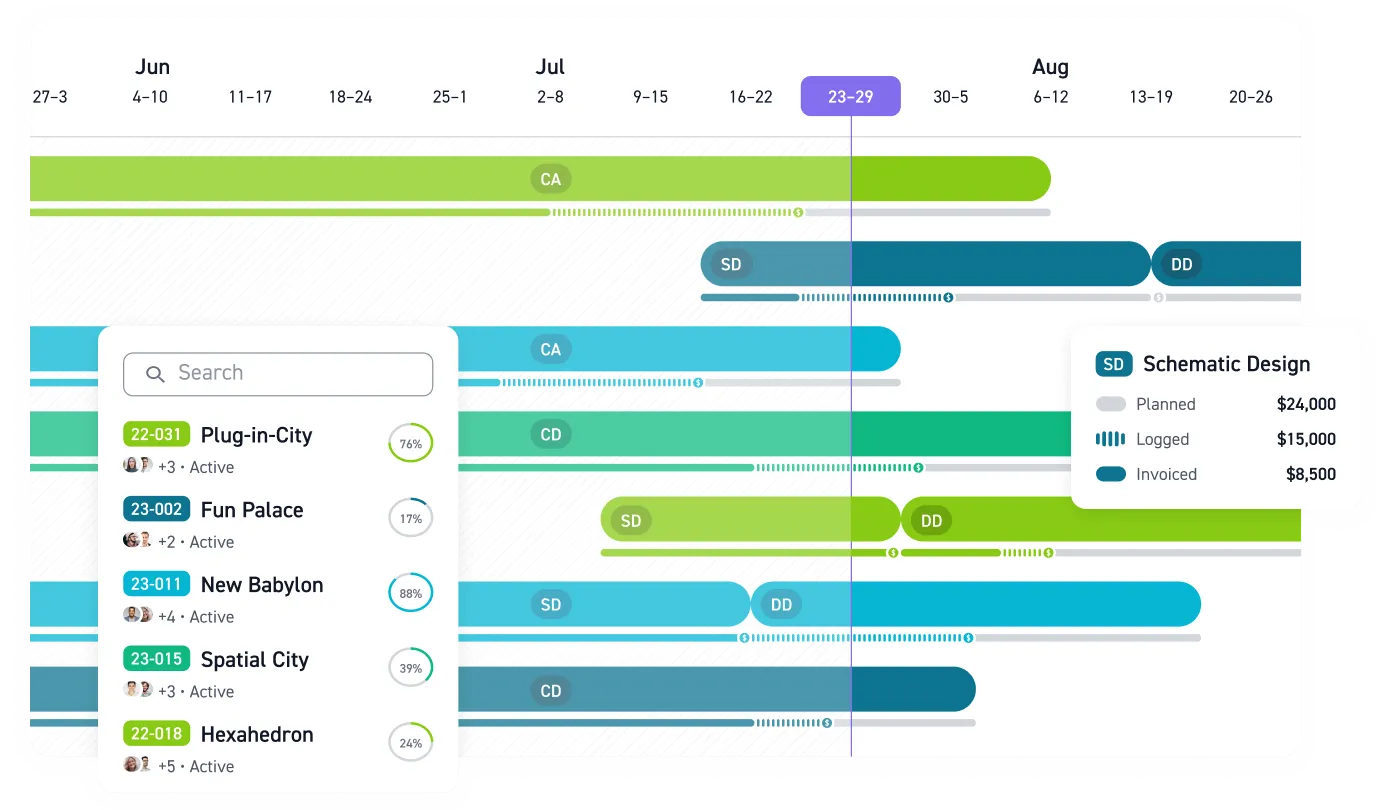
Connecting QuickBooks to a system built for A&E work keeps your general ledger intact while adding the project intelligence it lacks. A real sync updates systems at once, prevents double entry, and keeps project managers and accounting on the same numbers. Monograph's MoneyGantt™ view overlays budget against schedule on a single timeline, so a project manager sees spend outpacing progress before month-end. Structural, MEP, and civil consultant invoices map to specific project phases instead of disappearing into a generic expense account.
The alternative is the reconciliation treadmill: checking whether invoices synced correctly, mapped to the right categories, or created duplicates. Forecasting and integration become practical operating needs as firms grow. The firms still copying data by hand are losing time to work connected systems can handle faster.
What Connecting Your Systems Returns
Administrative drag carries a hidden cost beyond the line item. Architects spend more than half their time on administrative tasks, and in a burnout survey, 64.4% cited inefficient workflows as the root cause. Poor systems create drag, drag drives burnout, and burnout drives the talent loss that forces remaining staff to cover even more coordination work.
Monograph's 2026 Architecture & Engineering Business Benchmarks Report quantifies what better systems return. Firms investing in modern tools logged 100% realization on average, while firms without them averaged 96% and lost four cents on every billable dollar to write-offs and scope creep. Those firms also earned $210K in net revenue per employee versus $190K, and their operations staff hit 84% utilization compared to 74%.
Real firms see these gains in concrete terms. At Garrison Architects, the New York firm reported 1.5x faster billing and 2.5x faster time-to-payment. With project pauses now a baseline condition and significant delays widespread, reforecasting resources and revenue when a project stalls becomes a daily operating need.
Stop Letting Project Data Arrive Too Late
Your margins are moving every day. Watch them in real time. Disconnected project and financial tools make growing firms manage yesterday's numbers. By the time a budget overrun shows up in a spreadsheet or month-end report, the margin is already gone.
Monograph connects projects, time, billing, and your QuickBooks financials in one place. Its signature MoneyGantt™ view overlays budget against schedule on a single timeline, so principals, project managers, and operations leaders can see spend outpacing progress before month-end.
Connect project budgets, time entries, billing, and QuickBooks data before overruns become write-offs. Book a demo with Monograph.
Frequently Asked Questions
When should an A&E firm move beyond spreadsheets?
Move when project answers take too long to find. If budget updates require hunting through spreadsheets, QuickBooks, timesheets, and email, leaders and project managers are managing with stale numbers.
Can QuickBooks handle project financial management by itself?
QuickBooks Online handles general ledger and standard invoicing well. It was not built around A&E project phases, consultant pass-throughs, percentage-of-completion billing, utilization, realization, or net multiplier.
What should we connect first: time tracking, billing, or budgeting?
Start with time tracking and project budgets. Those inputs show whether the work being done matches the fee you sold. Once time, expenses, consultant bills, and phase progress are clean, draft invoices can pull from approved entries.
Will integrated project and financial software create more admin work for project managers?
It should reduce it. The point is to stop forcing project managers to wait on accounting for budget updates, rebuild reports by hand, or discover issues at month-end.
How does better integration improve cash flow?
Clean project data shortens the path from work performed to invoice sent to payment collected. When time entries, subconsultant bills, and phase completion live in connected systems, invoices move faster and errors that trigger disputes are easier to avoid.