


Firm management made easy

If you're spending three hours a day on administrative work like chasing timesheets, updating trackers, and compiling status reports, you're not alone. Project managers report 15 hours weekly consumed by administrative tasks, leaving less time for high-value project leadership and team development.
The frustrating part? Most of this work doesn't require human judgment. It requires data aggregation, deadline tracking, and status updates that systems should handle automatically.
That's where intelligent workflow automation comes in. Not as a buzzword, but as a practical approach to eliminating the administrative bottleneck that keeps project managers from doing what they're actually good at managing projects.
What Intelligent Workflow Automation Actually Means for A&E Firms
For project managers, this translates to systems that handle time tracking reminders, generate draft invoices from approved timesheets, flag budget variances before they become problems, and compile status reports without manual data entry. The technology addresses information transparency issues that prevent PMs from accessing real-time project-level financial data needed to deliver effectively.
Intelligent workflow automation in A&E practices delivers these core capabilities:
- Automated time entry monitoring that replaces manual weekly retrospectives with real-time tracking
- Draft invoice generation based on approved timesheets and contract terms
- Budget variance alerts triggered when projects approach predefined thresholds
- Resource utilization dashboards showing staff allocation across all active projects
These systems integrate with existing industry-standard tools rather than requiring wholesale platform replacement, reducing the implementation barriers that have historically slowed technology adoption in architectural and engineering practices.
The critical distinction for A&E firms is phase-based project delivery. Generic professional services tools don't understand schematic design versus construction documents. They can't track budget consumption across phases or manage the complexity of coordinating multiple consultants per project. Purpose-built automation accounts for these realities, including tracking phase-specific deliverable deadlines, managing consultant coordination across multiple disciplines, and enabling phase-specific profitability analysis, rather than forcing your workflows into a generic template.
The Numbers That Matter
Tech-forward firms don't just work differently. They perform differently. Firms investing in technology achieve a 15 percentage point advantage in reaching 20%+ profit margins compared to tech-static competitors. These same firms report nearly 2x higher project win rates in the 75-100% range.
New York-based Workshop/APD, a 50+ person architecture firm, achieved 50% profit growth and 50% efficiency gains after implementing automated workflows, demonstrating that technology investments translate directly to bottom-line improvements at scale.
Here's why these efficiency gains matter more than they might seem. Benchmarking data shows overhead rates at engineering firms average 173.3%. Every hour saved on administrative tasks doesn't just recover one billable hour. It eliminates the overhead burden carried by that time.
Workflows You Can Automate Today
The practical question isn't whether automation works. It's where to start. Project managers at A&E firms can automate specific administrative workflows that collectively save dozens of hours monthly per team member, with documented 66% reductions in administrative task time:
- Time entry monitoring and reminders: Automated reminders for incomplete timesheets sent before weekly deadlines, replacing manual weekly retrospectives with real-time monitoring
- Budget vs. actual variance monitoring: Continuous tracking of project financials with threshold-based alerts when projects approach budget limits
- Invoice generation: Draft invoices created automatically from approved timesheets and contract terms, reducing billing cycle time from 3-5 days to 1-2 days
- Resource utilization tracking: Real-time calculations of staff allocation across projects, flagging over-utilization risks and identifying available capacity
Beyond these core functions, firms are automating project status dashboard updates, consultant coordination tracking, and KPI report generation. These systems enable project managers to identify issues and course-correct through real-time visibility rather than delayed monthly retrospectives.
Real-Time Visibility Changes How You Manage
The shift from reactive to proactive management depends entirely on information access. Modern platforms enable project managers to catch issues and course-correct early, but only when they have complete, real-time data. Manual budget compilation means working with yesterday's numbers. Real-time project visibility enables PMs to monitor budget consumption continuously, turning budget overruns from inevitable surprises into manageable course corrections.
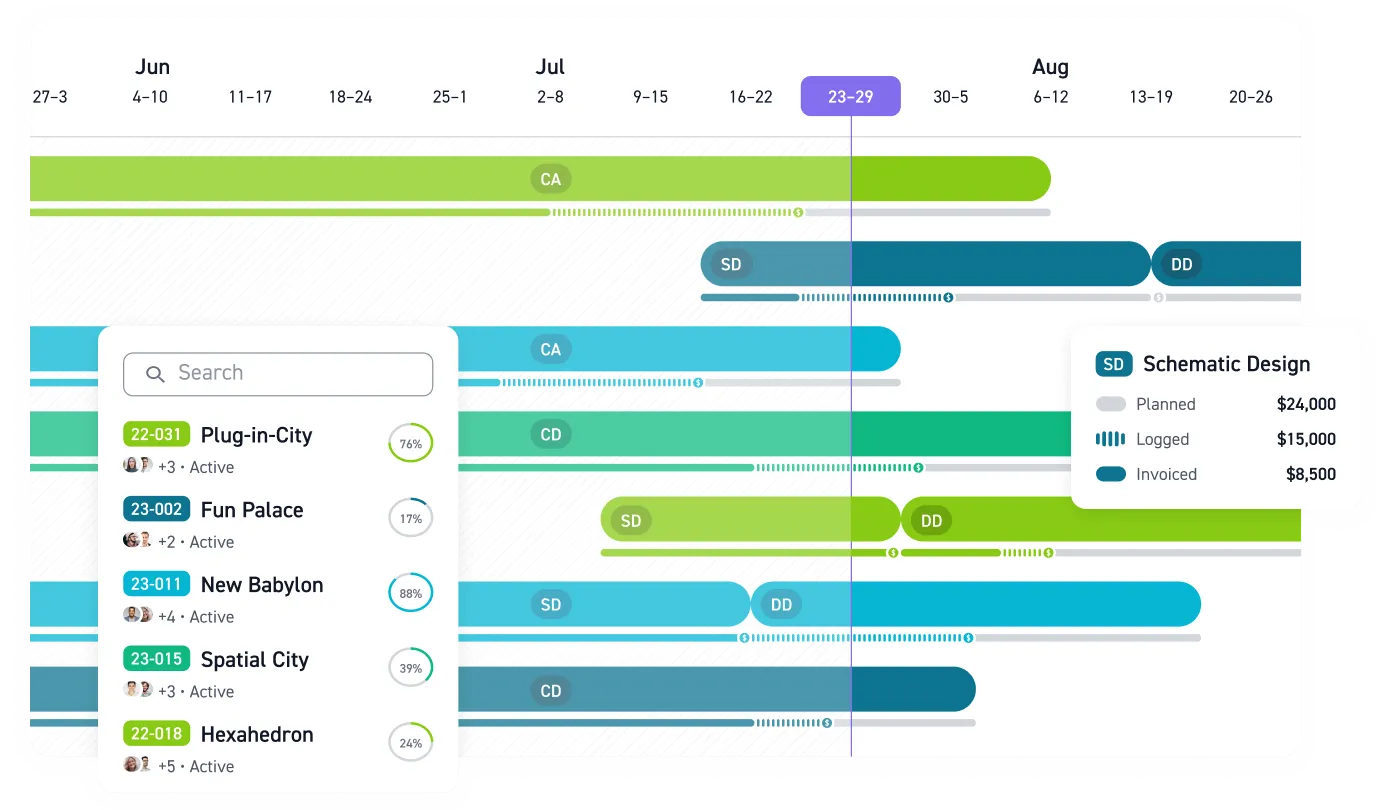
Monograph's MoneyGantt™ provides instant visual intelligence into budget-to-cash progression, transforming complex financial data into simple visual insights. Unlike traditional Gantt charts that only track schedules, Monograph's MoneyGantt™ shows the complete picture. Planned fees, logged time, invoiced amounts, and received payments appear across project phases. This signature feature makes it easy to spot which phases and projects are off-track without mathematical complexity or spreadsheet analysis.
Intelligent workflow automation helps address this in part through centralized data consolidation, alongside other capabilities such as real-time monitoring and predictive analytics. Firms embracing automation experience significant increases in efficiency, cost savings, and project quality by automating processes so teams can ensure greater accuracy and focus on more valuable initiatives.
For multi-project management, this visibility becomes essential. Automated systems provide portfolio-level resource views:
- Staff utilization across all active projects displayed in real-time
- Upcoming resource needs as projects transition between phases
- Resource conflicts when multiple projects compete for specialized staff
- Over-allocated team members approaching burnout risk
This portfolio-level visibility eliminates the need to manually review each project, enabling proactive resource management across the entire firm.
This matters particularly for paused project management. Automation maintains continuous visibility into paused projects by tracking status even during inactive periods, alerting managers to critical dates like permit expirations, and maintaining cost records for restart planning.
Making It Work: Implementation That Sticks
The technology exists. The challenge is adoption. Research found 78% of architects surveyed do want to learn more about AI potential, yet 78% also express concerns about implementation. This simultaneous enthusiasm and apprehension characterizes the industry's current posture toward intelligent workflow automation. Getting from intention to results requires deliberate change management.
Research shows that technical professionals in A&E respond to data-driven reasoning rather than mandates. Successful implementation follows these principles:
- Start with cash flow workflows: Time tracking, budget monitoring, and invoicing deliver rapid ROI. Documented implementations show 4x faster billing processes and 50% billing cycle acceleration that enable measurable returns within 60-90 days.
- Prioritize integration over features: Platforms that connect with QuickBooks Online and existing project management tools eliminate data silos. Disconnected tools perpetuate manual data transfer and erase automation benefits.
- Identify internal champions: Early adopters who demonstrate results and train peers create more sustainable adoption than top-down mandates, as documented in the Northworks Architects case study.
- Measure what matters: Track industry-standard KPIs: utilization rate improvements, administrative time reduction (66% savings documented), and billing cycle acceleration (50% faster billing documented).
Texas-based Able City, a 29-person firm, achieved 15% profit growth and 4x efficiency gains after switching from BQE Core, demonstrating that even firms with existing PM systems can achieve substantial improvements through purpose-built automation.
The integration requirement deserves emphasis. Many A&E firms still rely on disconnected legacy systems that block real-time data sharing. Automating a single workflow while leaving others manual just shifts the bottleneck. Purpose-built platforms with native integrations are essential, as generic tools requiring custom development cannot support the phase-based project structures and consultant coordination that distinguish architectural and engineering practices.
Stop Losing Hours to Manual Workflows
The firms winning projects aren't working longer hours. They've eliminated the administrative chaos that keeps you from focusing on what actually matters: managing projects, developing teams, and building client relationships.
Built by architects who lived these problems. Monograph understands phase-based projects, consultant coordination, and the reality of A&E workflows. Our platform executes complete workflows, from time tracking through automated invoicing to integrated payment processing, without forcing you into generic templates that ignore how you actually work.
Start where it matters most: cash flow and billing. Project managers using Monograph report 66% reductions in administrative time and 50% faster billing cycles. Operations leaders eliminate the manual data entry that delays invoicing for weeks. Principals finally get real-time visibility into which projects are profitable and which teams are overloaded.
Your competitors aren't waiting for perfect conditions. Neither should you. Book a demo.
Frequently Asked Questions
How long does it take to implement workflow automation without disrupting active projects?
Most firms see their first automated workflows operational within 2-4 weeks. Start with time tracking and invoicing, workflows that deliver immediate ROI without touching your design processes. You don't need to pause active projects or migrate everything at once. Monograph integrates with your existing QuickBooks setup and project management tools, so your team keeps working while automation handles the administrative burden in the background. Firms typically achieve measurable returns (faster billing cycles, reduced admin time) within 60-90 days.
Will automation integrate with our existing QuickBooks and project management tools?
Yes. Monograph provides two-way sync with QuickBooks Online. Time entries flow automatically into invoices, payments sync back to update project profitability, and you eliminate double-entry between systems. We connect with your existing project management tools rather than forcing wholesale platform replacement. The goal is integration, not disruption. Your accounting workflows stay intact while automation handles the repetitive coordination work that currently eats up hours each week.
What if our team resists changing from spreadsheets they're comfortable with?
Start with the workflows everyone hates: chasing timesheets, compiling billing reports, hunting for budget variances across disconnected files. A&E professionals respond to data-driven results, not mandates. Identify internal champions who demonstrate the time savings. When project managers see 66% reductions in administrative tasks and operations teams cut billing cycles in half, adoption follows naturally. You're not asking your team to abandon spreadsheets entirely. You're showing them a better way to handle the repetitive work that prevents them from focusing on actual project delivery.
How do we measure ROI on automation investments?
Track the metrics that matter for A&E practices: administrative time reduction (firms document 66% savings), billing cycle acceleration (50% faster documented), utilization rate improvements, and cash flow timing. Most firms see measurable returns within 60-90 days through reduced billing cycle time, decreased administrative overhead, and improved cash flow from faster invoicing and integrated payment processing. The ROI calculation is straightforward: if your project managers spend 15 hours weekly on administrative tasks and automation cuts that to 5 hours, you've just recovered 10 billable hours per week per PM, plus eliminated the overhead burden on that time.
Can we automate workflows gradually or must we switch everything at once?
Start gradually with cash flow workflows (time tracking, budget monitoring, and invoicing) that deliver rapid ROI without disrupting your entire practice. Once those workflows are operational and your team sees the results, expand to resource utilization tracking, consultant coordination, and advanced analytics. Monograph's platform supports gradual adoption because we integrate with your existing systems rather than forcing complete replacement. Many firms begin with automated time reminders and invoice generation, then layer in budget alerts and resource planning as they build confidence. The technology scales with you. No need to boil the ocean on day one.