
You've probably had this moment: a client puts a project on hold, another one delays approval by six weeks, and suddenly the revenue you were counting on for Q3 evaporates. You open your spreadsheet and realize the numbers are already two weeks old.
The AIA/Deltek Architecture Billings Index has recorded sub-50 readings in 35 of the 38 months from October 2022 through late 2025, one of the most prolonged weak periods in its recent history, though not 35 consecutive months below 50. If you're running a 10- or 30-person firm without real-time revenue visibility, you're guessing during the worst possible time to guess.
Project forecasting software built for A&E firms changes that equation. But first, it helps to understand why forecasting is so difficult in this industry, and what it costs when it breaks down.
Why Revenue Forecasting Falls Apart in A&E Firms
A&E firms aren't product companies. Revenue doesn't arrive in predictable monthly installments. It moves through phases, pauses when clients stall, and depends on how efficiently your team converts hours into billable work. Without current project data, you're working from assumptions that no longer reflect reality.
Start with the market itself. Industry sector forecasts document growth rates ranging from -11.6% for single-family residential to +54.9% for manufacturing, a 66.5 percentage point spread across sectors. If your firm touches multiple markets, historical averages won't tell you what's coming next quarter.
Then there's the cost side. A&E profitability benchmarks indicate operating profit on net revenue has dropped to 12.8%, with talent acquisition costs growing nine percentage points year-over-year. When your largest expense line shifts that fast, any forecast built on last year's labor assumptions is already wrong.
And most firms are tracking all of this across disconnected tools. Industry surveys consistently find that most mid-sized A&E firms rely on six to twelve different platforms across delivery, finance, and client management, a reality where teams report needing three hours just to find basic project status. When time tracking lives in one system, accounting in another, and project management in a third, accurate forecasting becomes impossible.
The Cost of Flying Blind
When forecasting breaks down, the consequences compound fast.
Picture a 20-person structural engineering firm with eight active projects. Two clients pause simultaneously: one for budget approvals, another for regulatory review. Without forward-looking visibility, the principal discovers the utilization drop only when monthly financials arrive, weeks after the overhead hit.
This scenario plays out constantly across the industry. For Maine-based Woodhull, a 25-person firm, moving from a legacy system to a real-time platform helped cut scheduling report prep time by 95%, speed up invoicing by 53%, and eliminate retainer billing errors entirely, turning reactive fire drills into proactive financial management.
That delayed awareness turns a manageable disruption into a quarterly loss. The damage cascades across every metric your firm depends on.
- Overhead rate blindness: Your overhead rate is widely considered the most revealing measure of A&E profitability. Without forward-looking visibility, firms over-invest during slow periods and scramble during growth.
- Billing multiple erosion: Your billing multiple (one of the most important A&E KPIs) erodes silently without forecasting. You discover margin loss only after the damage is done.
- Cash flow miscalculation: Dividing cash on hand by monthly burn rate tells you your financial runway. Without forecasting, you don't know how long your firm can absorb payment delays or project stalls.
- Reactive hiring: Annual industry benchmarks found the average time to fill positions is 31-60 days, with 13.2% total industry turnover. You can't staff projects you didn't see coming.
That same industry study reveals that only 46% of firms complete internal project performance evaluations. For a 15-person firm, one project going sideways can wipe out a quarter's profit, and monthly reviews catch problems too late.
What to Look for in Project Forecasting Software
Not all project management tools are built for how A&E firms actually work. Here's what matters most when evaluating project forecasting software for your practice:
- Real-time WIP tracking with weekly reporting: Firms using real-time WIP tracking achieve 44% fewer overruns. Weekly profit visibility catches problems before they become catastrophic.
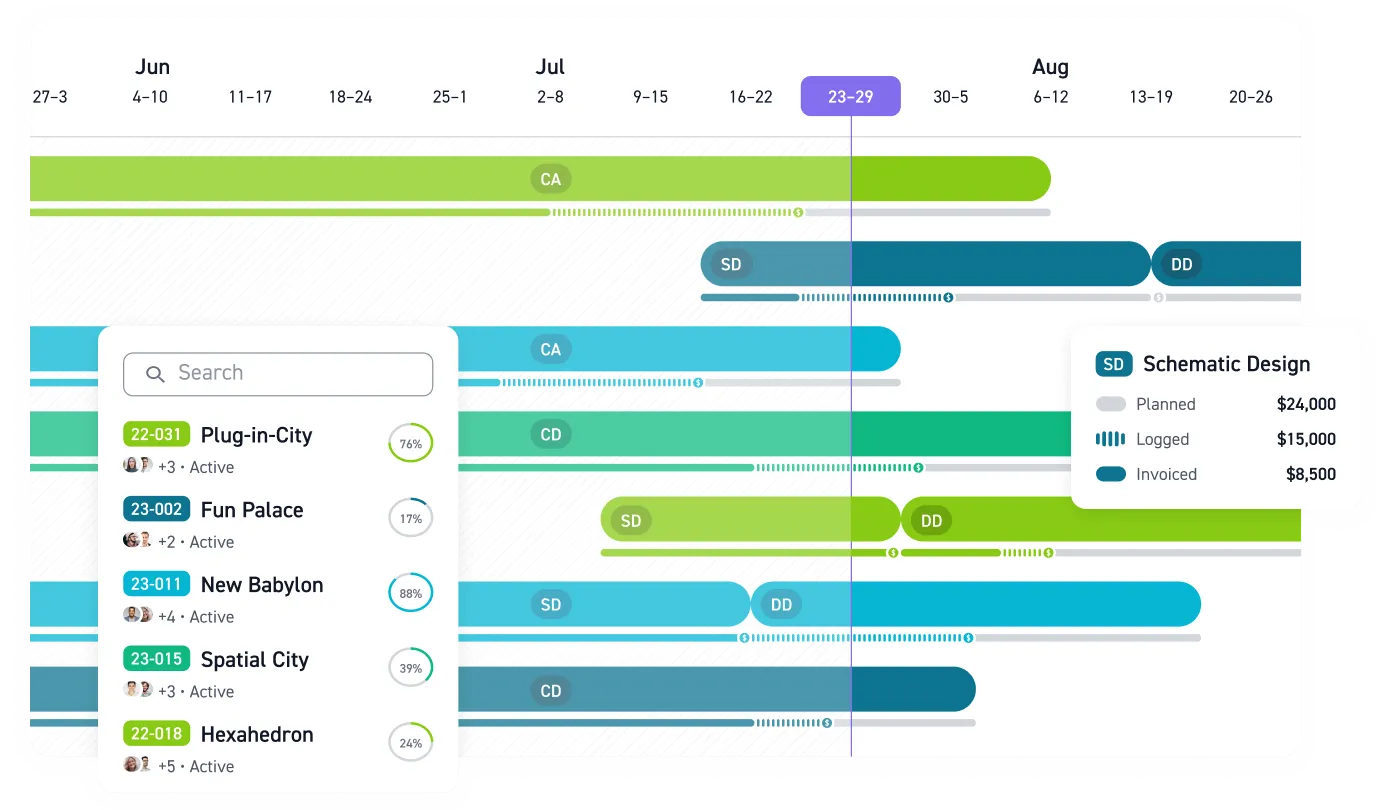
- Phase-based financial tracking: SD, DD, CD: your projects move through phases, not generic task lists. Forecasting software needs to mirror that structure and tie budgets to each phase.
- Resource utilization targeting 80-85%: The average A&E firm bills only about 81% of its staff's time. Effective tools plan for 80-85% utilization with buffer capacity for scope changes, rather than pushing unsustainable targets.
- QuickBooks connection: At the 5-50 employee scale, QuickBooks is your accounting backbone. Two-way sync for invoices, expenses, and consultant bills eliminates the duplicate entry that creates forecasting errors.
These features serve both sides of the A&E house. An engineer tracking hours on a bridge inspection or structural analysis benefits from the same phase-based budget visibility as an architect moving through schematic design. Both need to see burn rates against fee caps in real time.
Cultural adoption matters as much as features. When your team sees how their time data connects to project health and firm profitability, tracking becomes meaningful rather than busywork, and better data drives better forecasts.
The Performance Gap Is Real
The strongest evidence for project forecasting software comes from the A&E industry's leading management consultancy, which partnered with Unanet to benchmark tech-forward firms against their peers. In practice, "tech-forward" means firms using connected practice management platforms with live project visibility instead of spreadsheets.
Their benchmarking data reveals a stark divide:
- 67% of tech-forward firms project 20%+ profit rates in the next 12 months, compared to only 52% of tech-static firms. That's a 15-percentage-point profitability advantage.
- 17% of tech-forward firms report 75-100% win rates, nearly double the 9% of tech-static firms reaching that tier.
- 50% of tech-forward firms rate their project and resource management processes as highly mature, compared to just 20% of tech-static firms.
For your firm, that 15-percentage-point profitability gap is the difference between a comfortable year and a stressful one. At the 5-50 person scale, even a few points of margin improvement fund a new hire or a healthier backlog cushion.
These gaps compound over time. Better forecasting leads to smarter staffing, which improves utilization, which protects margins, which funds growth. The firms investing in visibility today are pulling ahead, and if you're still reconciling spreadsheets monthly, that gap is widening.
How Monograph Approaches A&E Forecasting
Monograph is a founder-led platform built by architects and engineers who lived these problems. It was designed specifically for A&E workflows, and today it's used by 13,000+ architects and engineers across 1,800+ firms.
The platform replaces static budgets with living forecasts that update as project data changes: hours logged, expenses tracked, consultant invoices processed. Rather than discovering overruns at month-end, principals and project managers receive weekly profit emails every Monday morning.
The dedicated Pipeline module applies win-probability weighting to forecast revenue, shows capacity impact role by role and month by month, and helps you make staffing decisions before commitments are made. Because phases align one-to-one with your chart of accounts, the moment a designer logs two hours in SD, you see the burn hit the SD budget line and the project timeline simultaneously.
MoneyGantt™, Monograph's signature visual timeline, shows budget-to-cash progression at a glance so you can see exactly where each project stands financially without digging through reports.
Machine-learning models analyze live project data (time tracking, budget burn rates, consultant invoices) to predict overruns weeks before they happen, giving you runway to course-correct while there's still time.
For a 15-person firm navigating the longest billing downturn in recent memory, that kind of visibility is how you make sure there's still a firm to run next year.
Stop Guessing. Start Forecasting.
You can't navigate a challenging A&E market with a two-week-old spreadsheet. Every day you spend guessing about future revenue is a day you fall further behind firms that have real-time visibility. The gap between guessing and knowing is where profitability is won or lost.
Monograph replaces your static spreadsheets with a living forecast built for A&E workflows. See your project pipeline, fee projections, and staff capacity in one place, updated in real time. Stop reacting to last month's numbers and start making decisions based on what's coming next.
The firms that survive this downturn won't be the ones who guessed right. They'll be the ones who didn't have to guess at all. Book a demo with Monograph.
Frequently Asked Questions
My firm is small. Is dedicated forecasting software overkill?
It's actually the opposite. For a 10-person firm, one delayed project can wipe out a quarter's profit. Forecasting software gives you the same real-time visibility larger firms have so you can make smart decisions about staffing and cash flow before a small problem becomes a crisis. You don't need complex enterprise features to benefit.
We use QuickBooks for our financials. Why do we need another tool for forecasting?
QuickBooks is great for telling you what happened last month. Forecasting software tells you what's likely to happen next month and the month after. It connects your project pipeline, staff utilization, and phase progress to your financials, giving you a forward-looking view that accounting software alone can't provide.
How is this better than a really good project forecasting spreadsheet?
A spreadsheet is static and instantly out of date. It can't automatically pull in real-time hours from timesheets, update project progress, or weigh your pipeline based on win probability. A dedicated platform connects all that live data, eliminating manual updates and giving you a forecast you can actually trust.