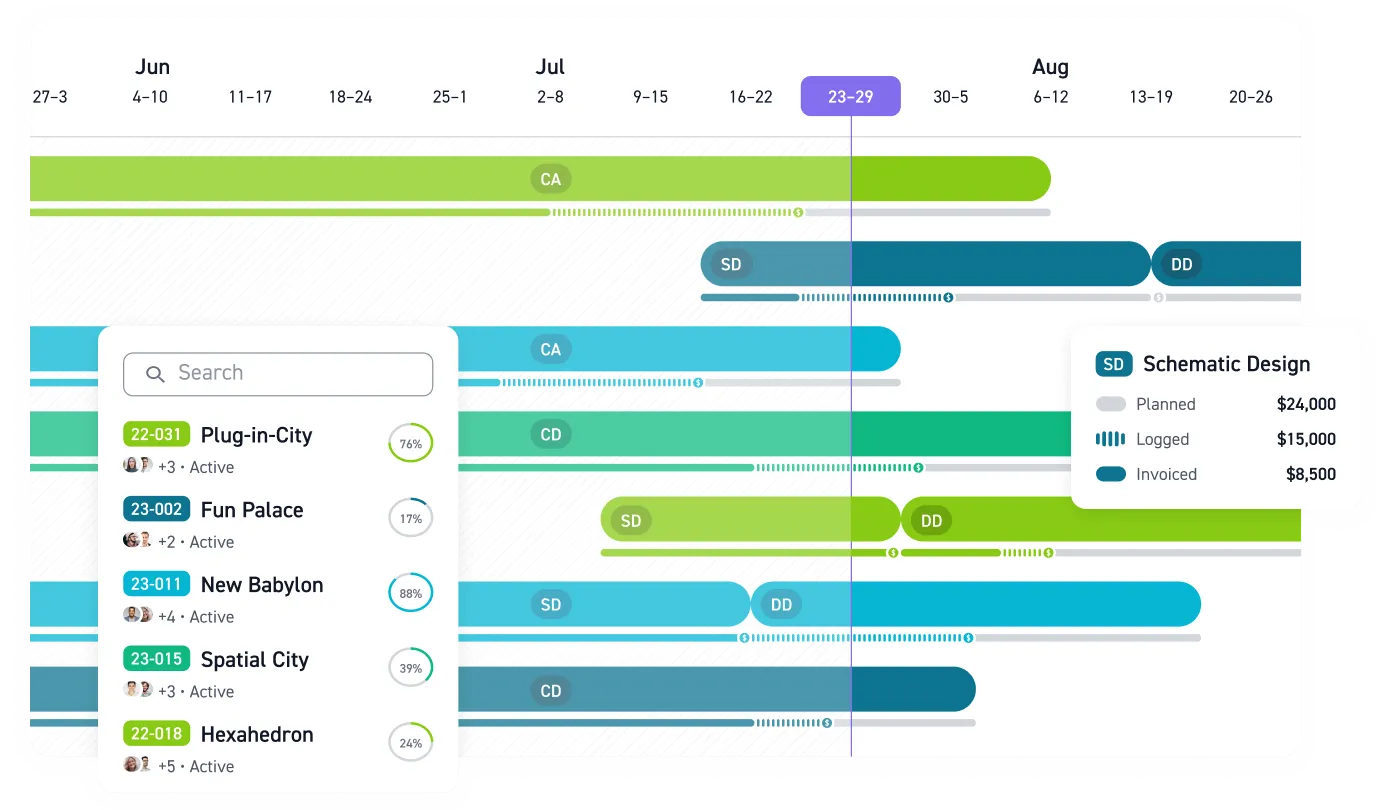


Most A&E firm leaders know their overall billings. They can tell you last quarter's revenue and probably recite their profit margin from memory. But ask them exactly where a specific project stands right now, what percentage of the budget has burned, whether the team is on track for the next milestone, or if that paused residential project will restart next month, and the answer often involves a lot of spreadsheet hunting.
What WIP Management Really Means for A&E Firms
Work in progress management in architecture and engineering goes far beyond tracking unbilled hours. It means systematically monitoring project performance throughout every phase, from schematic design through construction administration. This includes revenue recognition timing, resource utilization across teams, and the financial health of each project in your portfolio.
The competitive advantage of getting this right is substantial and measurable. Approximately two-thirds of tech-forward A&E firms project profit rates of at least 20%, compared to only about half of firms with less mature visibility capabilities. That profitability gap translates directly to the bottom line.
The performance differences extend beyond profit margins. Tech-forward firms are more likely to achieve project win rates in the 75-100% range, with nearly twice as many tech-forward firms reporting these rates compared to tech-static firms. Better visibility doesn't just help you deliver projects profitably. It helps you win more of them in the first place.
The Metrics That Drive Project Success
Effective WIP monitoring requires tracking key metrics at weekly intervals, not monthly, to identify problems early enough for corrective action. Leading A&E firms implement weekly resource reviews and automated profit emails to project managers and principals every Monday, achieving significant reductions in budget overruns compared to monthly review cycles.
Project managers and finance leaders should focus on metrics that provide the earliest warning signals: utilization rate, realization rate (identifying scope creep and fee erosion), project profitability margin, earned-vs-planned revenue variance, and WIP balance management.
The foundation starts with utilization and realization rates. The average A&E firm bills only about 81% of staff time, even when work is steady. That gap represents substantial lost revenue. For a 50-person firm billing $150/hour, we're talking approximately $2.8 million annually in unbilled time value.
Beyond utilization, these metrics form the core of effective project visibility:
- Net Labor Multiplier: According to industry benchmarks, the Billing Multiple sits at approximately 3.20, meaning firms need to bill at 3.20 times direct labor costs to achieve target profitability, while the Breakeven Multiple is around 2.73.
- Work in Progress Balance: High WIP indicates work completed but not billed, an immediate action item signaling the need to accelerate invoicing or resolve client approval delays.
- Earned vs. Planned Revenue Variance: Shows the gap between projections and reality, providing early warning when projects fall behind schedule.
- Project Profitability Margin: Industry benchmarks of approximately $23 profit per direct hour give you a target to measure against.
The Financial Impact of Real-Time Visibility
For finance managers and CFOs, the case for real-time project visibility comes down to three numbers: revenue capture, cash flow, and margins.
The revenue capture problem is straightforward. When firms can't track time accurately in real-time, identify non-billable activities as they occur, or maintain visibility into phase budgets, hours slip through the cracks. According to industry benchmarking reports, the average A&E firm bills only about 81% of its staff's time, representing substantial revenue leakage. For a 50-person firm at $150/hour billing rates, this represents approximately $2.8 million in unbilled time value annually. Closing half of that gap would recover approximately $1.4 million annually for a 50-person firm operating at the same billing rate.
Cash flow improvements follow naturally from better visibility. Research shows firms with real-time tracking achieve significant efficiency gains in collections workflows. One large firm documented a $7 million reduction in overdue accounts receivable within 90 days of implementation.
The margin impact compounds these gains. According to project profitability research, small firms implementing systematic profitability management with real-time tracking often report margin improvements of 15-25% within their first quarter.
Best Practices From High-Performing Firms
The utilization gap between top-performing and average firms is striking. According to industry research analyzing hundreds of architecture firms, top quartile firms achieve over 95% utilization compared to the roughly 82% industry median, a significant advantage that compounds across every project.
How do they get there? Four practices consistently separate high performers from the rest:
- Weekly resource reviews instead of monthly: Firms implementing this cadence report significant reductions in budget overruns and invoicing time. Woodhull, a 25-person architecture firm exemplifies these results. After implementing real-time visibility tools, they achieved substantially less budget overage while cutting their billing process time in half.
- Revenue Factor over blanket utilization targets: Different roles require different utilization levels. Pushing everyone toward 85% can actually harm profitability when principals need time for business development.
- Two-way data synchronization: Time entries flow automatically into budgets and invoices while project costs sync back to update capacity planning.
- Weekly profit emails: Automated weekly reports tracking budget performance create systematic early visibility versus month-end surprises.
Managing Through Uncertainty
According to industry research, the metrics most closely tracked by A&E firms are:
- Firm billings (95% track this)
- Firm profitability (84%)
- Firm backlog (77%)
- Individual project profitability (only 64%)
- Staff chargeability/utilization (56%)
This reveals a significant gap: while most firms monitor overall billings and profitability, only about two-thirds track individual project profitability. This visibility gap becomes especially acute during uncertain periods when projects may pause or slow.
Economic uncertainty transforms visibility from an operational improvement into a survival requirement. Firms that can identify at-risk projects early through phase-level budget tracking, reallocate resources quickly using real-time data, and maintain accurate revenue forecasts will navigate downturns far better than those relying on disconnected spreadsheets.
Moving From Reactive to Proactive
The shift from monthly spreadsheet reviews to real-time integrated tracking isn't just about better technology. It's about moving from reactive management, discovering problems after they've already cost you money, to proactive management where you catch issues while there's still budget and time to fix them.
Platforms built specifically for A&E workflows, like Monograph, address these challenges by connecting phase-based budgeting, time tracking, and financial reporting in a single system. The moment a team member logs time, you see the budget impact. No manual aggregation, no waiting for month-end reconciliation, no surprises.
For project managers drowning in coordination work and finance leaders tired of chasing accurate data, real-time visibility isn't a luxury. It's the foundation everything else depends on.
Stop Managing Projects in the Dark
The profitability gap between tech-forward and tech-static firms is widening. Every day you spend hunting through spreadsheets, your competitors gain ground with real-time project visibility.
You've seen the numbers: substantial revenue leakage from unbilled time, significant reductions in budget overruns with weekly reviews, and margin improvements of 15-25% in the first quarter. The firms closing this gap aren't working harder. They're working with better information.
See your project profitability in real-time. Book a demo with Monograph.
Frequently Asked Questions
How long does it take to implement real-time project tracking?
Most firms are fully operational within 2-4 weeks. The key is choosing software designed for A&E workflows. You shouldn't need to rebuild your processes from scratch. Start with a few active projects to build familiarity before rolling out firm-wide.
Will this integrate with our existing accounting software?
Yes, if you're using QuickBooks Online. Look for two-way sync that eliminates double-entry. Time entries should flow automatically into invoices, and payments should sync back to update project profitability in real-time. The goal is one source of truth, not another disconnected system.
How do we get our team to actually track time consistently?
Start by making it easier than not tracking. Automated staffing plans that pre-assign team members to projects each week remove the friction of manual entry. Mobile apps help capture time in the moment. The bigger shift is cultural: when your team sees how their time data connects to project health and firm profitability, tracking becomes meaningful rather than administrative busywork.
What ROI can small firms expect from better WIP visibility?
Firms typically see results in three areas. First, recovered revenue from billing time that previously slipped through the cracks. Even closing half the utilization gap represents significant annual revenue. Second, faster cash flow from faster invoicing and collections. Third, margin improvements from catching budget problems early. Small firms implementing systematic profitability tracking often report margin improvements of 15-25% within their first quarter.


.png)