

If you're managing projects, budgets, and financial operations across multiple concurrent projects while trying to keep your firm profitable, you've probably wondered whether there's a better way than spreadsheets and disconnected systems. You know the drill. Project budgets live in Excel, time tracking happens on paper timesheets, and your accounting system has no idea which projects are actually profitable until weeks after the fact. ERP systems promise to solve these challenges, but what exactly do they offer architecture and engineering firms?
ERP stands for Enterprise Resource Planning. ERP gives you connected business applications that put your core operations in one place. For A&E firms, this means connecting project management, accounting, resource planning, and workflow automation into one system instead of managing scattered data across multiple spreadsheets and separate software applications.
Understanding ERP Systems for Project-Based Businesses
Disconnected systems prevent complete business insights. Your project manager thinks you're under budget while accounting knows you're already over. This isn't just frustrating. It's costing you money and damaging client relationships. When your project data, financial records, and resource planning all live in separate places, you can't make confident business decisions. You end up reacting to problems weeks after they occur instead of preventing them in the first place.
Instead of waiting weeks to compile reports manually, you see exactly where you stand right now with ERP systems. For firms managing multiple projects with shared resources, this real-time visibility becomes critical for maintaining profitability and cash flow. That's the fundamental challenge ERP systems address for A&E firms.
Core ERP Modules That Matter for A&E Firms
A&E firms need five core modules that actually understand how projects work. Project-based firms require specialized functionality that matches how design and engineering practices actually operate. Generic business software doesn't understand phase-based projects, consultant coordination, or fixed-fee contracts. You need modules built for how A&E firms actually work.
Financial Management and Project Accounting
Financial management finally tracks costs the way you actually work: by project, phase, and task, not just generic categories. Unlike generic accounting software, these systems track costs at the project, phase, and task level. They align with A&E project stages such as Schematic Design, Design Development, Construction Documents, and Construction Administration. You've probably tried tracking this in QuickBooks or Excel and ended up with a mess of custom categories that nobody else understands.
A&E contracts are complicated. These systems actually understand retainage (client payment withholding), multiple concurrent projects with varying payment schedules, and specialized revenue recognition. When a client holds back 10% until project completion, your system needs to know that affects cash flow today even though you've done the work. Standard accounting software treats every invoice the same way.
The module automates cost allocation across project, phase, client, service line, and employee dimensions, providing the granular cost visibility that A&E firms require. Project accounting connects activities with company financials to ensure accurate accounting throughout the project lifecycle. A&E firms require phase-level tracking aligned with design stages, and the system must handle retainage as a distinct accounting category that significantly impacts cash flow management. Without this level of detail, you're flying blind on project profitability.
Resource Management and Time Tracking
These systems track your people and capacity across multiple projects. Professional services platforms include resource tracking and time forecasting capabilities. For A&E firms, this is essential because human capital represents the primary asset and constraint in project delivery. You can't ship your architects to a warehouse. Your only scalable resource is your team's time and expertise.
Key capabilities include Capacity planning to understand available hours across the workforce, Resource allocation based on skills, and utilization analysis monitoring billable versus non-billable time. Every hour your senior architect spends updating spreadsheets is an hour they're not billing clients or designing projects. These systems help you see where time actually goes.
Time tracking components capture hours worked with project, phase, and task-level detail while automatically applying employee billing rates and cost rates. Systems flow data automatically into project accounting and billing modules, ensuring project activities connect with financial reporting without manual re-entry. No more asking your team to enter time in three different places just so you can send one invoice.
Reporting and Analytics
Reporting capabilities help track and analyze activities, time, and output while supporting sophisticated project management. A&E firms need real-time project dashboards, budget versus actual analysis at project and phase levels, and profitability analysis to understand which projects generate the best margins. You need to know which project types make money and which ones drain resources before you commit to more similar work.
The module must enable tracking industry-specific data. A&E firms must track specific metrics including profit margin, cash flow ratio, liquidity ratio, and asset turnover ratio, with direct labor playing a critical role in financial ratio analysis. These aren't generic business metrics. They reflect the unique economics of project-based professional services.
Without proper reporting, you discover problems too late to fix them. You realize a project went over budget only after you've billed the client and absorbed the loss. Real-time analytics let you course-correct while there's still time to save the project margin. That's the difference between reactive and proactive firm management.
Business Benefits for Architecture and Engineering Firms
ERP systems deliver measurable value by addressing operational challenges unique to project-based professional services. Scattered financial data, delayed invoicing impacting cash flow, inadequate project-level cost tracking, and lack of real-time reporting for decision-making create daily chaos in most A&E firms. You've lived this reality. Every principal has stared at spreadsheets wondering which projects are actually profitable.
Real-Time Project Profitability and Cash Flow Management
Project-based ERP systems provide financial management that tracks costs, allocates resources, and manages budgets at the project level.
Firms with billing discipline can convert completed work into cash faster. The timing mismatch between immediate payroll obligations and extended client payment cycles creates artificial cash shortages even when firms complete profitable work. This helps you avoid situations like when payroll is due Friday, but your biggest client invoice won't get paid for another 30 days. This isn't a profitability problem. It's a cash flow problem that can be addressed with proper systems.
Woodhull, a 25-person architecture firm in Maine, reduced budget overages by 66% and cut their billing process time in half after implementing specialized project management software. This directly addresses scattered financial data across multiple systems. And they stopped discovering budget problems months after they occurred.
With real-time visibility into unbilled work, outstanding invoices, and payment schedules, you can predict cash crunches before they happen. You can prioritize which invoices to send first. You can have informed conversations with clients about payment timing. That beats scrambling for a line of credit at the last minute.
Eliminating Data Fragmentation and Administrative Overhead
Your Revit models, project schedules, consultant coordination, and billing all stay disconnected. When a principal asks which projects are profitable, you end up opening QuickBooks, three Excel files, and your project management tool just to get a partial answer. Then you spend an hour reconciling conflicting numbers because nobody's sure which version is current. This is how most A&E firms operate today.
ERP systems provide a single source of truth for financial management, document management, logistics, and complex project tracking from a centralized platform. This consolidation specifically addresses scattered data by unifying project accounting, time tracking, financial reporting, and document management. Everyone looks at the same numbers. When project status changes, every connected system updates automatically.
This helps you manage projects proactively through automated billing workflows, real-time budget visibility, multi-dimensional cost tracking, and immediate access to complete project history. Integrated systems eliminate the administrative burden that keeps your team from doing actual design work. Your senior people stop spending afternoons hunting for data. They stop reconciling contradictory reports from different systems. They get back to the work that actually generates revenue and builds your firm's reputation.
ERP vs. Specialized Project Management Systems
For small-to-mid size A&E firms with 5-50 employees, the choice between traditional ERP systems and specialized project management software (PSA) represents a strategic decision about integration scope rather than a firm size limitation. Implementation costs typically range from $50,000-$150,000 for this firm size, with the optimal choice depending on whether the firm needs project-centric integration or broader enterprise-wide capabilities. You're not choosing between "basic" and "advanced" systems. You're choosing between different integration philosophies.
The strategic decision centers on integration scope. PSA software is designed for professional services organizations, while ERP systems were initially built with manufacturing, supply chain, and inventory in mind. This matters because you're not just buying software. You're buying into an integration philosophy that affects how your firm operates for years. Choose wrong, and you'll spend valuable time and money implementing features you don't need while missing capabilities your projects require daily.
When Specialized A&E Systems Excel
Specialized project management platforms now deliver sophisticated financial and project profitability analysis capabilities that were previously associated only with full enterprise ERP systems. Rather than viewing the choice as between limited capabilities versus complete enterprise systems, the real strategic decision centers on whether to pursue project-centric integration or enterprise-wide integration. The capabilities gap has narrowed dramatically. What specialized systems lack in breadth, they make up for in depth of A&E-specific functionality.
PSA and specialized A&E systems like Monograph excel when firms prioritize project-centric workflows as the dominant business model. These platforms offer rapid implementation with industry-specific templates, purpose-built A&E features like code compliance tracking and submittal management, and lower total cost of ownership for core project-based operations. They understand that your business runs on projects, not inventory or manufacturing capacity.
For firms already using QuickBooks Online, specialized project management platforms like Monograph provide practical alternatives to complete system replacement by extending existing accounting infrastructure with project-level capabilities. By pairing Monograph with QuickBooks Online, A&E firms let each tool focus on what it does best. Monograph powers A&E projects, staff, time, and money while QuickBooks handles general ledger accounting. You avoid the risk and expense of replacing working systems.
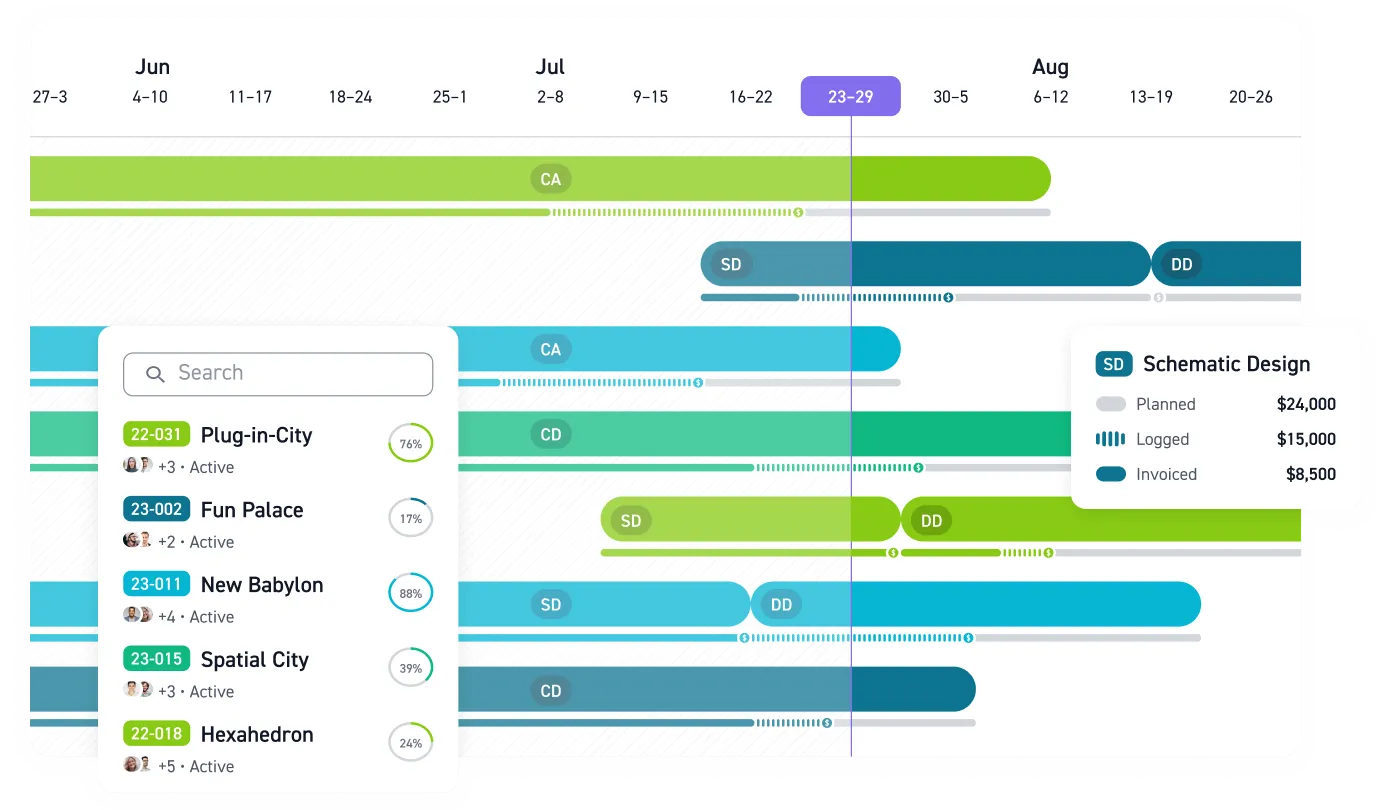
This architectural approach reduces implementation risk while adding ERP-like functionality specifically designed for A&E workflows. Monograph's signature MoneyGantt™ feature represents a proprietary innovation unavailable in generic tools. This trademarked capability transforms complex financial data into simple visual insights by combining traditional timelines with budget-to-cash progression (planned, logged, invoiced, paid). Unlike traditional Gantt charts that only show schedules, MoneyGantt™ provides instant visual intelligence. See which phases and projects are off-track in seconds without mathematical complexity. This signature differentiator is one key reason firms choose Monograph over generic project management tools.
Stop Managing By Spreadsheet, Get Real-Time Project Visibility
You're still piecing together project status from five different systems while your competitors sees everything in one dashboard. They know which projects are profitable before month-end. They catch budget problems while there's still time to fix them. They spend their time on design work instead of hunting for numbers. That's not because they're smarter or better organized. It's because they stopped accepting spreadsheet chaos as normal.
The ERP decision feels overwhelming. Six-figure implementations, months of disruption, and systems built for manufacturers that don't understand how A&E firms actually work. Meanwhile, your project managers are making decisions based on week-old spreadsheets, and you're discovering budget overruns only after invoicing. Every day you wait, you're losing money on projects that could be profitable with better visibility. You're wasting billable hours on administrative tasks that should take minutes.
But you don't need a full enterprise system to get the visibility and control that matters. You just need project-centric tools that understand phase-based workflows, consultant coordination, and the financial realities of fixed-fee A&E projects. You need systems built by people who've actually managed architecture and engineering projects, not generic business consultants.
Your competitors already have real-time project visibility. Book a demo with Monograph to see how specialized A&E practice management delivers ERP-level insights without the enterprise complexity.
Frequently Asked Questions
How long does ERP implementation take for a small A&E firm?
Traditional ERP implementations for 5-50 person firms typically take 3-6 months for basic configurations and 8-12 months for full enterprise deployments. The timeline depends heavily on data migration complexity, customization requirements, and whether you're replacing multiple legacy systems. Specialized A&E platforms like Monograph typically deploy in 2-4 weeks because they're purpose-built for architecture and engineering workflows. If you're evaluating options, consider whether you need complete enterprise integration or focused project management capabilities. That choice determines your timeline more than firm size.
What's the real cost difference between full ERP and specialized systems like Monograph?
Full ERP implementations typically cost $50,000-$150,000 for initial deployment plus $30-$55 per user monthly for mid-tier firms. That doesn't include ongoing IT support, system administration, or quarterly update management. Specialized A&E platforms like Monograph run $25-$45 per user monthly with minimal implementation costs and no dedicated IT requirements. The total cost of ownership over three years for a 15-person firm runs roughly $200,000+ for traditional ERP versus $15,000-$25,000 for specialized systems. The question isn't just upfront cost. It's whether you need enterprise-wide integration or project-centric capabilities that work immediately.
Do I really need full ERP if I already use QuickBooks for accounting?
Probably not. Most small-to-mid size A&E firms don't need to replace QuickBooks. They need to extend it with project-level capabilities QuickBooks wasn't built to handle. If QuickBooks manages your general ledger and vendor payments effectively, adding specialized project management that integrates with QuickBooks often makes more sense than ripping out your entire financial infrastructure. Full ERP makes sense when you need inventory management, manufacturing workflows, or complex multi-entity consolidation. For project-based A&E work, specialized platforms that sync with QuickBooks deliver the project visibility you need without the enterprise complexity you don't.
How do I know if the ERP investment will pay off for my firm size?
Track how much time your team currently spends on three activities: compiling project status reports, processing invoices, and answering "where does this project stand financially" questions. If those activities consume more than 10 hours weekly across your team, you'll see measurable ROI from better systems. For a 15-person firm billing $150/hour average rates, that's $78,000 annually in recoverable capacity. The payback math is straightforward. Will the system cost less than the billable time it recovers? Start by measuring current administrative burden, then evaluate whether specialized project tools or full ERP better addresses your specific bottlenecks.
What happens to our existing project data during ERP implementation?
Data migration is the most underestimated challenge in ERP implementations. Your historical project data, client relationships, and financial records need systematic transfer, not just raw data dumps. Traditional ERP vendors often charge separately for data migration services, and the process can take weeks of mapping spreadsheet structures to new system fields. Specialized A&E platforms typically offer guided migration tools that understand common data sources like Excel project trackers and QuickBooks. The real question is whether you need to migrate complete history, or can you start fresh with active projects while keeping historical data accessible in legacy systems? Most firms overestimate how much historical data they'll actually reference in new systems.


.png)