

Payroll should be straightforward: hours worked, rates applied, money deposited. But for architecture and engineering firms, payroll is anything but simple. Your team members split time across multiple projects. Billing rates vary by client, project type, and role. And every hour needs to flow accurately from timesheets through payroll into project cost reports. Otherwise, you're flying blind on profitability.
If you're managing finance at an A&E firm, payroll is more than just a compliance function. It's the foundation of project accounting. When payroll data doesn't connect to project budgets in real time, you discover cost overruns after they've already eaten your margins. We've seen this challenge across hundreds of A&E practices.
AI-powered payroll systems promise to change this equation. But what does "AI payroll" actually mean for a 20-person architecture firm or a mid-size engineering practice? And more importantly, what capabilities matter most when your business runs on project-based billing?
What AI Payroll Actually Means for A&E Practices
AI payroll goes beyond automating calculations. AI agents can now handle gross-to-net validation, exception processing, and tax documentation, tasks that previously required manual review at every step.
For professional services firms, this automation addresses industry-specific complexity. A&E practices manage billing rates across multiple position levels while navigating fee structures that range from hourly billing to percentage-of-construction-cost arrangements. AI-powered platforms must understand phase-based projects, consultant coordination, and the fee structures that differentiate A&E billing from generic professional services.
The real value comes from intelligent validation and error prevention. Research shows that organizations implementing automated payroll systems experience reductions in error rates ranging from about 60% up to over 90%, depending on the context and measure used, compared to more manual processes. For A&E firms where accurate labor cost allocation directly impacts project profitability, that error reduction translates to better financial decisions.
Automating high-volume administrative tasks like benefits management and payroll helps HR teams resolve employee requests faster while maintaining accuracy through AI-powered validation.
The Integration Imperative
The capabilities that deliver value for A&E firms come from system integration and workflow automation, not AI algorithms alone. ZweigWhite's guide establishes the fundamental requirement: time and expense entries should integrate directly with payroll, and journal entries should flow through without manual entry.
This matters because A&E firms operate differently than other businesses. Your staff splits time across multiple active projects each week. Each project has distinct phases with separate budgets. And clients expect invoices that accurately reflect the work performed on their specific engagement.
The standard workflow operates as:
Time Tracking → Payroll System → Project Accounting Ledger → Client Billing
This automated workflow eliminates duplicate data entry, ensuring that time entries flow directly from project tracking through payroll to project accounting without manual re-entry. Nearly 40% of all payroll errors are caused by manual data entry. By removing handoff points where staff enter time data into timesheets, accounting personnel re-enter the same data for payroll processing, and then manually create journal entries, integrated systems prevent errors while ensuring accurate labor cost allocation.
The same academic study documenting error reduction found that companies implementing integrated payroll systems experienced an average 30-35% time savings. For A&E firms operating with lean administrative teams, that efficiency gain matters.
When you evaluate systems, focus on these integration capabilities:
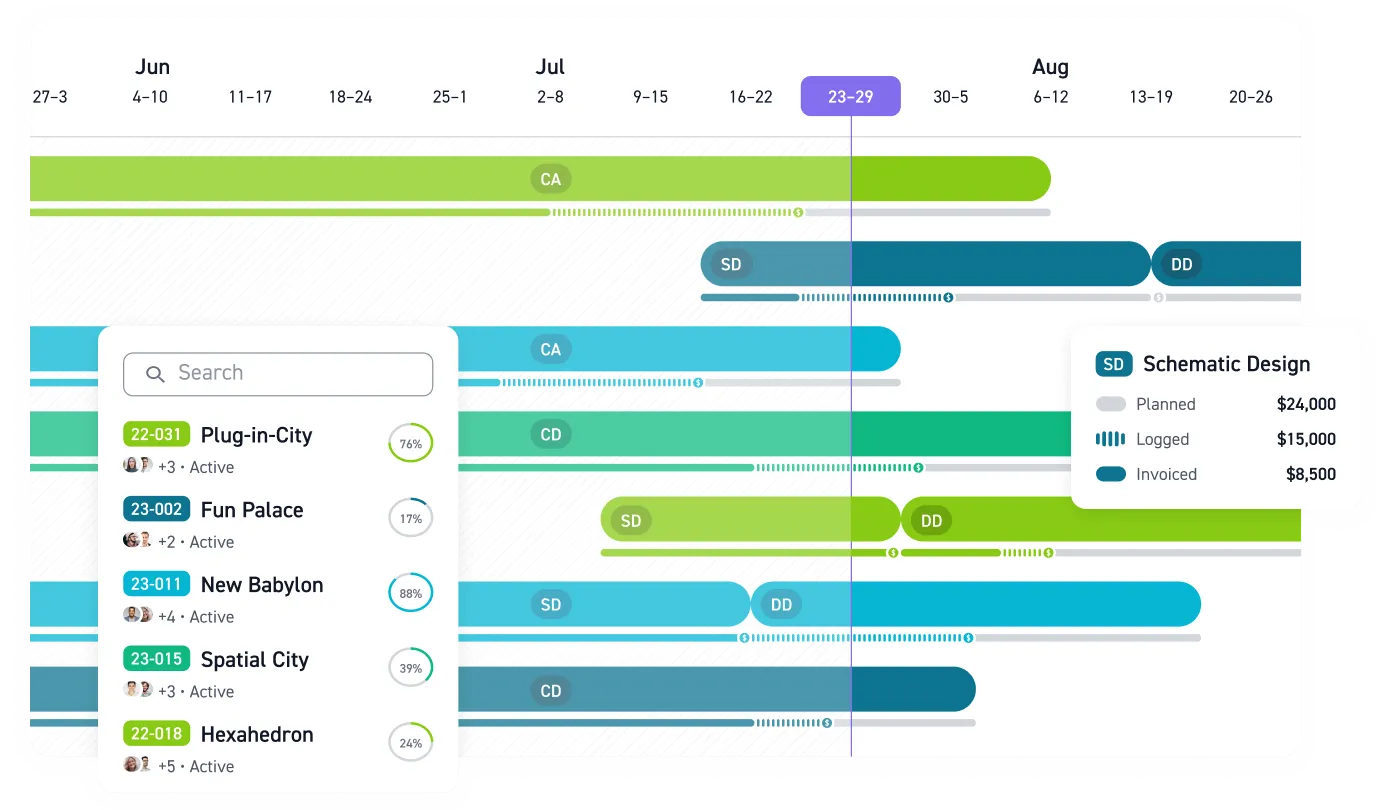
- Phase-level labor cost tracking: Time entries captured at the project phase level (Schematic Design, Design Development, Construction Documents, Construction Administration) rather than just project totals, helping firms track costs against phase-specific budgets
- Direct time and expense integration: A&E firms need platforms where time, expenses, subconsultant bills, and retainers can be seamlessly integrated into invoices and reports, with the general ledger directly linked to project accounting.
- Real-time project budget visibility: Labor costs updating project budgets as hours are logged help A&E firms address the critical challenge: 69% of A&E firms lack real-time budget visibility
- Automated journal entries: Labor costs flow from timesheets through payroll to project accounting without manual re-entry at each step
Prioritizing these capabilities ensures your payroll system functions as a project accounting tool, not just a compliance checkbox.
The Compliance Shift You Can't Ignore
Tax authorities are increasingly using AI to handle complex, trillion-entry data sets. This creates asymmetric risk for firms maintaining manual payroll processes while enforcement agencies deploy machine learning.
For A&E firms structured as partnerships, common for professional liability reasons, this shift carries particular weight. The IRS's Large Partnership Compliance model applies machine learning to partnership returns for audit selection.
Tax authority adoption of AI makes it critical for organizations to use AI in data gathering and analysis. Companies using AI can gather data more consistently, highlight discrepancies before filing, and reduce penalty risk.
Multi-state complexity adds another layer. A&E firms deploying project teams across state lines must navigate these compliance challenges:
- Varying withholding requirements: Each state has different rules for when payroll taxes apply to project-based workers
- Remote work complications: Time spent working from another state creates tax obligations
- Filing deadline variations: Different jurisdictions require filings at different intervals with different forms
- Reciprocity agreements: Some state pairs have agreements that simplify withholding, while others don't
Modern AI-powered payroll systems provide real-time updates on legislative changes, maintaining current knowledge of varying state laws and filing deadlines across every jurisdiction where your team works.
What to Prioritize When Evaluating Systems
In our work with A&E firms, we've found that project-based labor cost allocation should carry 30-40% of your evaluation criteria. This capability separates systems built specifically for A&E practices from generic payroll platforms.
The essential evaluation checklist includes:
- Project-based allocation: Automatically split payroll expenses across multiple projects based on time entries, with real-time visibility into labor budget burn rates by phase
- WIP reporting support: Real-time work-in-progress calculation based on actual labor costs as hours are logged, with support for percentage-of-completion revenue recognition
- Multi-rate management: Distinct cost rates versus billing rates, with automatic calculation using context-appropriate rates and rate change management across active projects
- Existing stack integration: Native connection to your accounting platform (like QuickBooks) and project management tools without requiring wholesale system replacement
Cash flow visibility deserves particular attention. Payroll typically represents 50-65% of operating expenses for professional services firms. Real-time visibility into upcoming payroll obligations by project directly impacts staffing decisions, billing timing, and resource allocation. Evaluating tools against these criteria helps ensure your investment delivers operational value, not just vendor promises.
Stop Discovering Cost Overruns After the Damage Is Done
AI payroll gives your finance team the real-time visibility they need to make better decisions. When labor costs flow automatically from timesheets through payroll to project accounting, you stop flying blind on profitability.
The firms that thrive aren't waiting for perfect conditions. They're implementing integrated systems that connect every hour logged to every dollar billed. Gartner's September 2024 survey found that 58% of finance functions now use AI, up 21 percentage points from 2023. The adoption curve is accelerating, and the gap between firms with real-time visibility and those still piecing together spreadsheets is widening.
Ready to gain real-time visibility into your project costs? Get started with Monograph.
Frequently Asked Questions
Will AI payroll replace our existing accounting staff?
No. AI payroll eliminates repetitive data entry and validation tasks, freeing your finance team to focus on analysis, strategy, and exception handling. The technology handles gross-to-net calculations and error checking while humans make the judgment calls that actually matter. Think of it as giving your team better tools, not replacing them.
How does AI payroll handle multi-state tax compliance for project-based teams?
Modern AI-powered systems maintain real-time updates on state tax requirements, reciprocity agreements, and filing deadlines. When your team works across state lines on different projects, the system automatically applies the correct withholding rules without manual research. This is particularly valuable for A&E firms where staff regularly travel to project sites in multiple jurisdictions.
What's the typical implementation timeline for integrating AI payroll with our existing project management tools?
Most A&E-focused platforms integrate within 2-4 weeks when connecting to existing systems like QuickBooks. The key is choosing software that works with your current workflow rather than forcing wholesale system replacement. Expect to invest time upfront in mapping your phase structures and rate tables, but the ongoing time savings far outweigh the setup effort.
Can AI payroll accurately allocate labor costs across multiple project phases?
Yes. This is where A&E-specific systems excel over generic payroll platforms. Time entries captured at the phase level flow directly into project accounting, automatically splitting payroll expenses across Schematic Design, Design Development, Construction Documents, and Construction Administration without manual reallocation. The accuracy depends on clean time entry data, so firms with strong timesheet discipline see the best results.
How do we measure ROI on AI payroll implementation?
Track three metrics: time spent on payroll processing (expect 30-35% reduction), payroll error rates (expect 60-90% reduction), and days between time entry and accurate project cost reporting. Most firms see measurable improvements within the first billing cycle. The real value shows up in your project profitability reports. When you can catch budget overruns in week two instead of month three, you actually have time to course-correct.


.png)