

You can be profitable right up until the moment you can't make payroll. That's the brutal math of running an A&E firm, where labor accounts for 60-70% of expenses and payroll obligations start the moment work begins. Industry accounting guidance shows the gap plainly: a firm invoicing $130,000 on January 31 and again on February 28 only saw its first payment on March 31, while salaries, taxes, insurance, and rent kept going out.
Time and expense billing is the system that closes that gap. Tight billing gets cash in faster and protects margins. Let it slip, and a delayed schematic-design payment can quietly starve construction-document payroll later. This article is for the finance managers and project managers who live with that pressure every month.
The Inputs That Make or Break Your Billing
Billing depends on project setup, time entry, and expense entry working together throughout the month. Billing is part of timesheet entry, project setup, and project management, and all must be completed to bill clients on time and accurately.
Here's what each input contributes:
- Project setup: Project accountants set up projects from contracts, define billing rates, and assist with timely invoicing. Get rates and phase structure wrong here, and every downstream invoice inherits the error.
- Time entry: Direct labor is recorded at each person's standard pay rate. These costs are incurred regardless of billing, so uncaptured time is money you already spent and will never recover.
- Expense entry: Direct expenses cover non-payroll project costs, from engineering consultants to testing, travel, printing, and shipping. Miss these, and you eat the cost.
Often these inputs live in disconnected places. Project hours sit in one tool, expenses in another, and consultant invoices stay buried in email. Someone has to reconstruct the project just to create the invoice, which is why invoices go out weeks after the work is done.
How Billing Delays Turn Into Cash Flow Crises
The structural problem is simple: you pay labor continuously, but revenue arrives in irregular events tied to milestones. The longer billing lags, the longer that gap stretches.
Watch for these warning signs that unbilled work is becoming a bottleneck:
- Current WIP: Within a normal billing cycle.
- Early delay: Check for missing approvals or documentation.
- Aging WIP: At risk of becoming a financial bottleneck. Follow-ups are critical.
- Long-overdue WIP: Requires immediate action.
Small firms carry the most exposure. They often have less working capital while carrying more unbilled cash per person. That's a hard combination, and it's why faster billing matters most for smaller practices.
Build a Billing Rhythm Your Team Actually Follows
Daily time entry is the foundation. When timesheets are current, approved hours translate into invoice line items with no scramble. When they're not, billing teams reconcile data across systems by hand, introducing errors and delay. A monthly recurring cycle keeps the invoice and the collection from slipping.
Practice leaders have found a few disciplines separate firms that bill fast from those that don't:
- Bill on a fixed schedule. Batch-generating invoices on regular billing days cuts the work-to-invoice lag. Smaller, more frequent invoices are also easier to approve, which gets your money quicker.
- Invoice the moment a deliverable ships. Month-end batching adds delay. When the work goes out, the invoice should follow.
- Move from milestone-only to progress billing where contracts allow, so receivables don't drift too long.
- Format invoices for the client's AP department. Top performers get the client's internal project number on the invoice from the start.
Run a monthly WIP review on top of this. Firms that do typically pull WIP days down within a few months, which flows straight into cash flow.
Why Spreadsheets Can't Keep Up
A mid-sized firm can run many active projects at once, with staff splitting their week across several of them. When your time tracking can't report hours by phase, billing becomes manual reconciliation, and reconciliation is where invoices die. Standalone tools like QuickBooks Time run short the moment you need to connect hours to invoices, budgets, or profitability reports.
Firm management software that connects time, expenses, and invoicing changes the equation. When approved entries flow directly into invoices, hours get the right phase codes and draft invoices generate quickly. Tools that support connected consultant billing and WIP and cash flow visibility reduce the handoffs that slow billing down. Brunton A&E, an 18-person firm, reported 2x faster billing with Monograph.
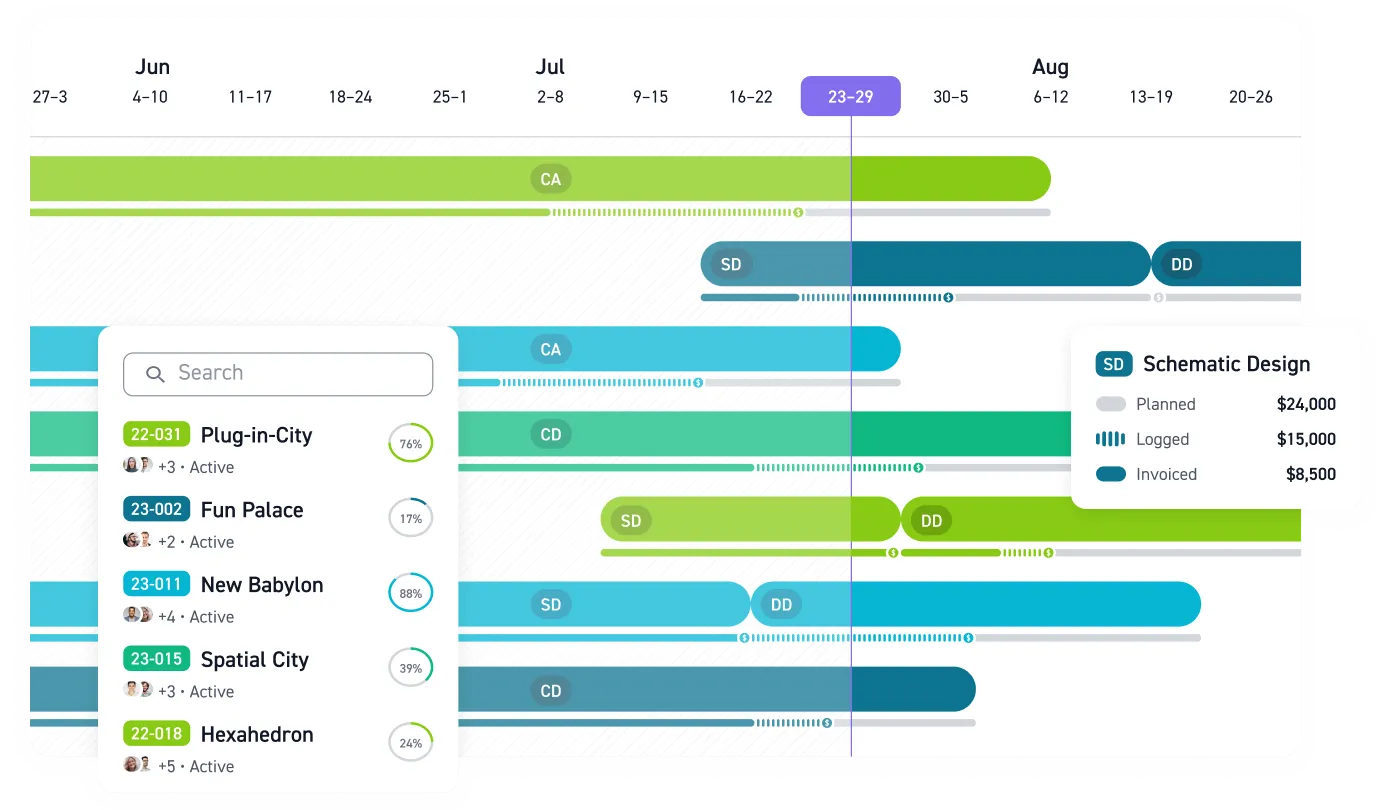
Consultant reconciliation is where generic accounting tools struggle. Structural, MEP, and civil invoices need to map to specific project phases, not a generic expense account. Monograph handles phase-based invoicing so consultant costs land in the right project buckets without manual reconciliation. Unlike a traditional Gantt chart that only tracks schedule, Monograph's MoneyGantt™ shows budget-to-cash progression across each phase as hours get logged. That phase-level view shows burn against budget, so warnings fire before drift becomes a write-off.
Collections Discipline Is What Actually Moves Cash
Faster billing alone won't fix your cash position. Survey data shows A&E firms are billing faster, while the median collection period still climbed from 67 to 72 days. The internal process tightened. Clients kept paying slowly.
Internal speed has to be paired with collections discipline to move cash. Weekly follow-up, clean invoice formatting, and phase-level visibility matter because invoices do not pay themselves.
Realization matters too. Firms with weak realization lose billable value to write-offs and scope creep, while stronger fixed-fee performance comes from completing work efficiently. That money comes from catching budget drift before it becomes a write-off.
Get Paid Before Cash Gets Tight
Billing delays do not stay in the billing folder. They show up as stale WIP, consultant bills waiting in email, project managers making budget calls with old data, and payroll pressure that should have been visible weeks earlier.
Monograph connects time, expenses, consultant bills, invoicing, project budgets, and payments in one workflow built for A&E firms. Your team can see what has been logged, what is ready to bill, what is overdue, and where cash is getting stuck before it becomes a firm-wide problem.
Your next payroll run is already on the calendar. Put the billing system in place before it becomes the constraint. Book a demo.
Frequently Asked Questions
How often should an A&E firm invoice clients?
Bill on a fixed monthly schedule at minimum. If contracts allow it, add deliverable-based invoices and progress billing so revenue does not wait for distant milestones.
What usually causes billing delays in A&E firms?
Billing delays usually start upstream. Weak project setup, late timesheets, missing expense entries, and consultant invoices buried in email force the billing team to reconstruct the project by hand.
How should consultant invoices and reimbursable expenses be handled?
Assign every consultant bill and reimbursable expense to a specific project and phase before approval. Clean expense coding protects margin and keeps client invoices easier to explain.
Does faster invoicing solve cash flow by itself?
No. Faster invoicing only starts the clock. You still need collections discipline: invoices formatted for the client's AP process, the client's internal project number included from day one, and regular follow-up on overdue balances.
Do small A&E firms really need billing software?
If your spreadsheet gives you current time, expenses, WIP, invoice status, and phase-level budget visibility, you may not need to change yet. Most firms outgrow that point once someone has to reconcile hours, consultant bills, and phase budgets by hand every month.