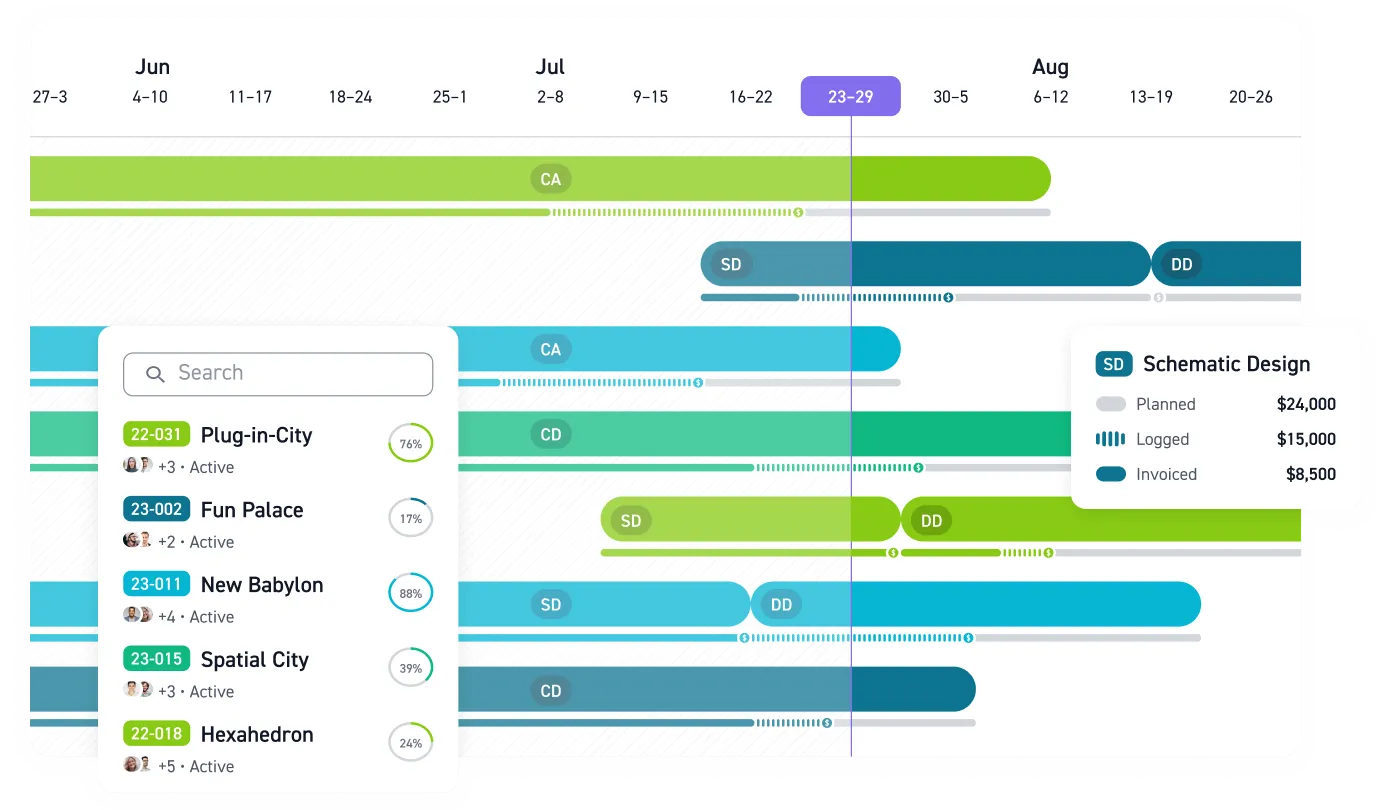


Architecture and engineering firms are labor-driven businesses where time is your primary inventory. Every billable hour must cover direct labor cost plus a share of overhead. This overhead rate influences your planning, staffing, and, ultimately, firm profitability.
But despite its strategic importance, many firms don't consistently track overhead costs. Because they either assume it's a "fixed" annual metric or struggle with manual calculations in spreadsheets or with disconnected tools that separate time tracking, project management, and finances.
So, overhead becomes invisible in daily decisions. Project managers and leaders are expected to protect margins without seeing the true cost structure behind their projects. And, by the time financial reports reveal the gap, it's too late to course-correct.
This guide will explain how to calculate the overhead rate step by step, using A&E-specific formulas and examples. It also shows you how a purpose-built platform can simplify and connect overhead rates to real-world A&E operations and profitability.
What is the Overhead Rate in A&E Firms?
In A&E firms, the overhead rate shows how much indirect cost is added to every dollar of direct labor. It reveals the true cost of delivering billable work and is essential for understanding firm profitability.
In simple terms, A&E costs fall into three categories:
- Direct labor costs include billable design and engineering time tied to projects or phases.
- Indirect labor costs cover non-project-related tasks and the salaries of staff not directly involved in A&E project work. This can include administrative, HR, and leadership roles.
- Non-labor overhead includes operational expenses like rent, software subscriptions, insurance, and IT.
A&E firms use these costs and a simple formula to calculate the overhead rate, which shows you what each hour of project work actually costs.
While all industries track overhead, A&E firms are different because labor is the primary cost driver. Overhead in A&E is allocated based on people's time, not materials or production units, as in construction or manufacturing.
Because of this unique cost structure, the overhead rate drives key operational decisions in A&E. It directly influences billing rates, fee proposals, staffing plans, and profit forecasts. Even small increases in overhead can quickly compress margins, and if the rate is inaccurate, pricing and profitability decisions will be too.
That's why A&E leaders can't rely on outdated manual spreadsheets or annual calculations. They need up-to-date visibility into overhead rates to make confident financial decisions that protect margins.
How to Calculate The Overhead Rate in A&E: A Step-by-Step Guide
Understanding your overhead rate requires accurate financial data and a clear method. Below is a practical, step-by-step approach A&E firms can use to calculate overhead correctly and apply it to real decisions.
Step 1: Calculate Total Indirect (Overhead) Costs
Start by adding up all annual indirect costs, including:
- Indirect salaries (admin, HR, marketing, and leadership, non-billable time)
- Office rent and utilities
- Software subscriptions, including design software (BIM, CAD), project management tools, and more
- IT support and equipment
- Insurance
- Operational and other business expenses
Use annual totals from your financial statements, and be consistent about the time period you're measuring (calendar year or fiscal year).
Step 2: Calculate Total Direct Labor Cost
Next, add up your total annual direct labor cost by including:
- Billable staff wages
- Payroll taxes
- Benefits
Only include compensation associated with billable project work in your total direct costs. Exclude other payments, such as consultant costs or reimbursable expenses.
Since direct and indirect costs serve as the basis for calculating overhead and other important financial A&E metrics, it's crucial for firms to accurately and consistently track time. Partial or inconsistent data will distort your metrics and all the downstream decisions that rely on them.
Step 3: Apply the Formula
Apply this overhead rate formula:
Overhead Rate = Total Overhead Costs ÷ Total Direct Labor Cost
For example, if your overhead is $1.5 million and the direct labor cost is $1 million, your overhead rate is 1.5 or 150%. This means that for every $1 in direct labor, your firm spends $1.50 in overhead.
In general, a lower overhead rate is better because it means your firm runs more efficiently. In the A&E industry, a typical benchmark is 150–175% (1.5–1.75).
If your rate falls within this range, it indicates you have enough billable work to cover indirect costs and still make a profit. A higher overhead rate indicates you need to optimize costs while balancing project expenses and revenue.
Example Overhead Rate Calculation for a Mid-Sized Architecture Firm
Consider an 18-person architecture firm, with:
- Direct labor cost: $1.2 million
- Total indirect expenses: $1.8 million
So, the overhead rate = 1,800,000 ÷ 1,200,000 = 1.5 (150%)
Operationally, this means that for every $100 in direct labor, the firm carries $150 in overhead. This is within the common industry benchmark range. However, whether this rate is healthy ultimately depends on whether the firm's billing rates and utilization are high enough to cover these costs and still generate profit.
To see how this affects real project costs, translate the percentage into an hourly example.
If a designer's direct labor cost is $50 per hour, overhead adds 150%, or $75. That brings the true cost of that designer to $125 per hour, before adding any profit.
This fully burdened cost, not just the base wage, should guide the firm's pricing, fee proposals, and staffing decisions. Even small changes in overhead can significantly affect the true cost of project labor and overall project profitability.
How The Overhead Rate Impacts A&E Firms
The overhead rate directly affects key billing, staffing, and profitability metrics. Here's how:
Billing Multipliers
One of the most important metrics influenced by overhead is your break-even multiplier. This metric shows the minimum revenue required to cover direct and indirect costs. It's calculated by using the formula:
Break-even multiplier = (Direct Labor Cost + Total Overhead) ÷ Direct Labor Cost
Using the earlier example of a 150% or 1.5 overhead rate:
Break-even multiplier = (1.00 + 1.50) ÷ 1.00 = 2.50
This means your firm must bill 2.5 times the direct labor cost just to cover expenses, before making any profit.
But that's just one half of the picture. To understand how much revenue is actually generated by the firm, you can calculate the achieved multiplier or net multiplier, using:
Achieved or Net multiplier = Net Revenue ÷ Direct Labor Cost
So, if the direct labor cost is $1.2 million and net revenue is $3 million, then:
Achieved multiplier = 3,000,000 ÷ 1,200,000 = 2.5
This means the firm earns $2.50 in revenue for every $1 spent on direct labor. To achieve a profit margin, the net multiplier must be higher than the break-even multiplier.
So, if the firm's break-even multiplier is also 2.5, it is only covering its costs and not generating any profit. But if the net multiplier drops below 2.5, the firm is not covering its full costs, which can lead to write-offs and shrinking project margins.
When your overhead rate is calculated incorrectly, your billing and pricing numbers are affected as well. You may think a fee is profitable when it barely covers costs, or worse, loses money.
Utilization and Staffing
The utilization rate measures the percentage of an employee's available work time spent on billable work. Overhead and utilization are deeply interconnected.
Overhead costs are largely fixed in the short term. Regardless of how many projects your firm is working on, costs like rent and utilities often stay the same. But utilization has a direct impact on the overhead each project hour must carry. For example:
- At 70% utilization, more staff hours are billable to projects, keeping the cost per billable hour lower.
- But, at 60% utilization, the same overhead is now spread across fewer hours, increasing the true cost of each project hour.
Despite the significant impact that utilization and overhead rates have on firm finances, many A&E firms treat them as separate metrics. And this lack of alignment between the two rates leads to poor operational and financial decisions and lowered profitability.
Profitability
At its simplest:
Profit = Revenue – (Direct Labor Costs + Overhead Costs)
Using the same numbers as the above examples:
- Revenue = $3 million
- Direct labor costs = $1.2 million
- Total overhead or indirect costs = $1.8 million
So, Profit = 3,000,000 – (1,200,000 + 1,800,000) = 0
In this case, the firm is breaking even. Project revenue covers the full cost of labor and overhead, but no profit is generated.
But, as overhead increases, the break-even point rises. And if billing rates or utilization don't adjust accordingly, firm-wide profitability declines. This impacts three key areas:
- Proposal competitiveness: If your overhead is high, you may need higher billing rates to maintain a margin, which can make bids less competitive.
- Fee planning: Underestimating overhead leads to underpriced proposals.
- Staffing decisions: Overloading workers to maintain profitability leads to burnout and lower employee satisfaction. By contrast, hiring more people increases overhead and shifts profitability thresholds.
In A&E firms, your overhead calculations must also match the phased-based structure of the architectural design process.
If your firm exceeds the budget in the early phases, labor costs quickly add up, hurting the project's profit margin. Even if the later phases stay within hours, it can be hard to recover margins.
This is why managing projects based only on raw hours can be misleading. A phase might appear "on budget" when you look at time alone, but once overhead is applied, the actual cost is much higher.
Firms need connected visibility between project management and overhead at the project and phase level to protect margins.
How to Simplify Overhead Calculations and Protect Profitability
For many A&E firms, the real challenge is that overhead calculations live in spreadsheets or static financial reports that quickly become outdated and disconnected from daily project work. So, they have to manually recalculate overhead repeatedly to keep it relevant to current project scenarios.
Modern firms need a better approach. They need integrated financial data, time tracking, and project management so overhead is easier to calculate, monitor, and keep current. And Monograph is perfect for this because it helps firms:
1. Centralize Your Overhead Rate
Monograph simplifies overhead tracking by centralizing your overhead multiplier in one place, instead of a spreadsheet, and reflecting it instantly across your profit reports.
You set your overhead multiplier once and update it as your cost structure changes; most firms recalculate it quarterly. From that point on, every project and firm-level profit report uses the current multiplier automatically, so you're not manually reapplying it report by report.
This eliminates the need for manual spreadsheet calculations and ensures leaders are always working from the same, current overhead figure.
2. Connect Overhead to Time Tracking
Overhead becomes far more useful as a strategic tool when it's tied directly to project work. And Monograph does this through its time and expense tracking features. As employees log hours, that time flows into cost-per-hour project financial reports using the firm's overhead multiplier, so logged time becomes fully burdened labor cost, not just raw hours.
(For firms connected to QuickBooks Online, project profit reporting instead draws costs directly from your QBO data, including labor costs, rather than applying the overhead multiplier. The two report types can show cost slightly differently depending on your setup.)
This allows project managers and firm owners to see:
- The true cost of project work as it happens, including the cost per hour
- The burn rate within each phase
- How much fee remains compared to the real cost of delivery
This increases alignment between project teams and accounting, enabling them to manage projects and staffing based on actual financial impact.
3. Reporting & Profitability Insight
Once overhead, labor cost, and project data are connected, firms gain much clearer insight into their financial performance. Monograph provides up-to-date reporting through its firm performance dashboard, giving you insights into the metrics that matter most.
Principals and finance teams can track net profit, utilization trends, projected operating profit, and project-level profitability using profit reporting, with your overhead multiplier built into the underlying numbers (or your imported QBO cost data, if you're connected to QuickBooks). You can also see early warning signs when utilization drops or labor costs begin to climb.
With shared visibility across leadership, finance, and project managers, firms can make faster decisions and respond to problems before margins are lost. Instead of reviewing overhead once a year, teams can check in on it as part of their regular reporting cadence.
See the True Financial Picture Behind Every Project with Monograph
The overhead rate is the foundation for pricing, utilization targets, and profit in A&E firms. It determines whether your billing multipliers are realistic, whether your staffing plans make sense, and whether your fees can actually sustain the business.
But calculating overhead once a year isn't enough. The real advantage comes from operationalizing it, and that's where Monograph excels. It brings overhead, time tracking, project financials, and reporting into one connected, A&E-specific platform.
With Monograph, firms can keep an up-to-date overhead figure built into their daily reporting. So, PMs and leaders can make proactive staffing decisions, adjust fees earlier, manage phase performance accurately, and scale sustainably.
FAQs
How are overhead rates determined?
In A&E, overhead rates are determined by dividing the total indirect costs by the total direct labor costs. This rate helps firms understand the real cost of delivering work and guides their pricing and staffing decisions.
How do you calculate the overhead rate?
The basic formula to calculate the overhead rate is:
Overhead Rate = Total Indirect Costs ÷ Total Direct Labor Costs
For A&E firms, this rate is applied to project labor when evaluating budgets, tracking profitability, and setting billing rates.
What are examples of overhead costs?
Common overhead costs include office rent or mortgage, software, administrative and HR salaries, and insurance and legal fees. These costs support the firm's overall operations but cannot be directly tied to a specific project.


