

Even small math errors on a pay application can send the package back and restart the payment clock. AIA billing is progress billing on standardized forms: the contractor bills as work advances, the architect certifies the work, and the owner pays against that certification. The general conditions require contractors to submit AIA Document G702, Application and Certificate for Payment, supported by the G703 Continuation Sheet. For finance managers, the system matters twice: architects certify contractor pay applications during construction administration, and the same progress-billing logic affects your own fees.
How G702 and G703 Work Together
Everything starts with the Schedule of Values, a contractor-prepared line-item cost breakdown of the total contract into line items that must be approved before billing begins. The G703 records progress against each line item; the G702 summarizes that record and certifies it for payment. Per AIA's instructions, the G703 comes first, and its totals transfer to the G702.
The math flows from line-item detail to certified total. Column G adds previous work, this period's work, and stored materials. That total becomes Line 4 on the G702, retainage must match Line 5, and Line 8 is total earned less retainage minus everything previously certified.
If those numbers do not reconcile, the application comes back before the work is evaluated. Prior-period stored materials never carry forward into Column D; once installed, their value moves into the current period's Column E.
Retainage appears on both forms and is usually released after substantial completion. State law controls the ceiling: Texas requires owners to hold 10% on private projects, while New York capped private retainage at 5% in November 2023. Confirm the applicable statute before retainage terms go into any contract.
What Certification Actually Commits You To
Under A201-2017 § 9.4.1, the architect has seven days after receiving a pay application to:
- Certify the full amount requested.
- Certify a lower amount the architect determines is properly due, with notice to contractor and owner explaining the difference.
- Withhold certification entirely, with the reason stated.
Certifying represents to the owner that, to the best of the architect's knowledge, the work has progressed as indicated, its quality conforms to the contract documents, and the contractor is entitled to the amount certified. Certification is not a warranty: it excludes exhaustive site inspections, construction means and methods review, subcontractor requisition verification, and audits of prior payments.
The architect can nullify a previously issued certificate to protect the owner from loss. Certify based on the actual evaluation and document that basis. Without certification, the owner has no contractual duty to release funds, so a rejected application hurts everyone downstream.
Why Pay Applications Bounce
Reviewers do not fix error-filled applications. The package goes back to the contractor and the payment cycle restarts. Common triggers include:
- Overbilled percent complete.
- Summary-to-detail mismatches between the G702 and G703, including carry-forward errors from the prior period.
- Retainage that doesn't match the contract rate or prior approved billing.
- Missing attachments: lien waivers, executed change orders, notary stamps, insurance certificates.
A pre-submission checklist catches most of these. Verify approved change-order values, retainage percentages, and every required attachment before anything goes to the architect.
The Finance View: WIP, Revenue, and Cash
Revenue recognition follows work performed, not invoices sent. Under ASC 606, revenue on long-term projects is recognized over time, most commonly by cost-to-cost. A fixed-fee project that bills heavily at kickoff is overbilled on the books. That gap belongs on your WIP schedule, not in profit assumptions.
Most firms track AR aging but not WIP. The median A&E firm carries 19 days of gross revenue in unbilled work. Fee timing compounds the problem: firms collect only 23% of fees by the end of schematic design and 25% by the end of design development, leaving more than half the fee to arrive when project risk is highest.
Collection speed adds more drag. The average collection period for architecture firms is about 81 days, so invoiced work ties up capital for nearly three months.
Billing Your Own Fees With the Same Discipline
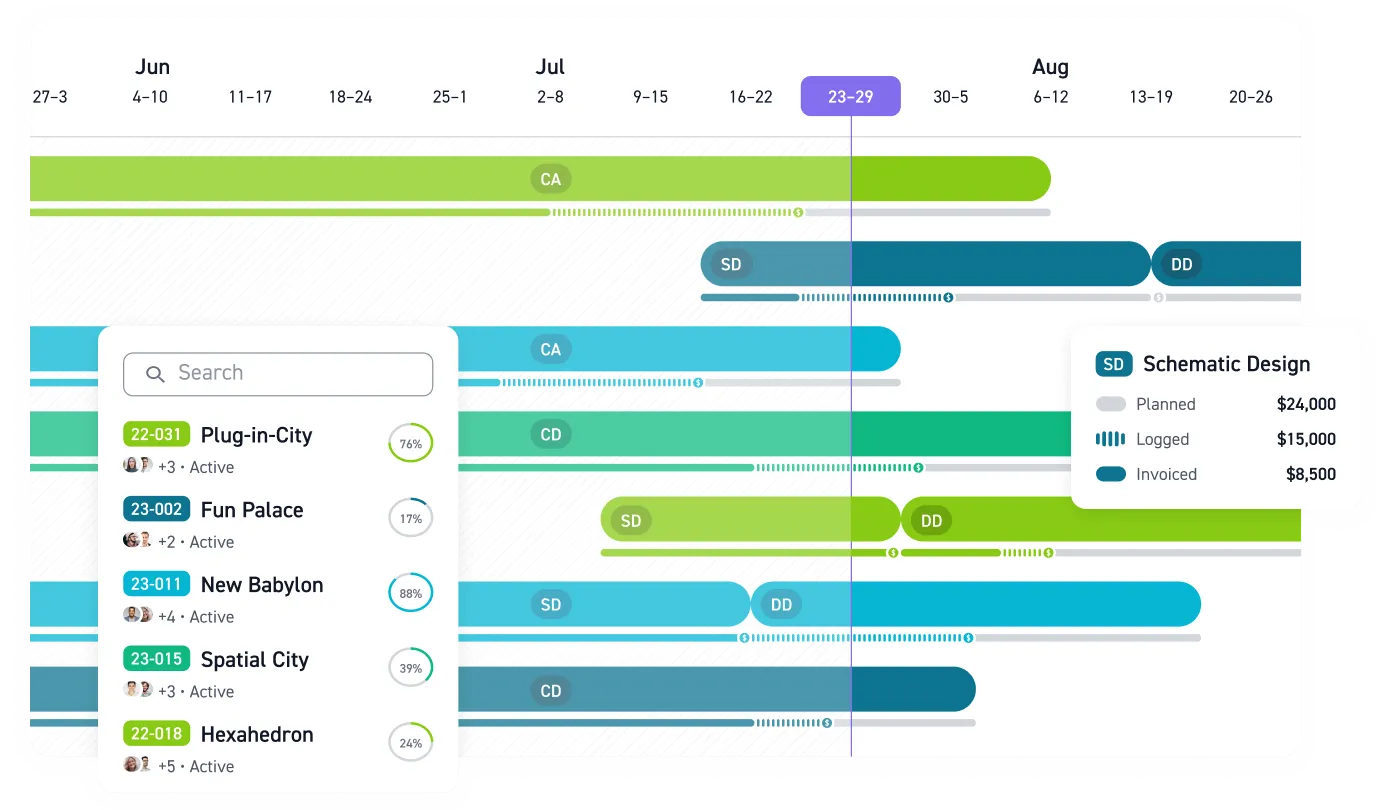
Your firm's fees rarely run through G702 forms, but they follow the same progress logic: schematic design, design development, construction documents, and construction administration are budgeted, tracked, and billed by percent complete. The habits that keep contractor pay apps clean apply directly to design-fee invoicing:
- Bill on delivery. Send the invoice the same day a schematic or DD package ships.
- Split long-running projects into predictable mid-month and month-end draws.
- Run month-end close checks: reconcile timesheets against phase caps, flag change orders early, and compare draft invoices to planned fees.
- Tie time entries to phases so a designer's hours hit the SD budget when they're logged.
That discipline shows up in practice: Workbench reported a 4x faster billing process and 75% less unbilled fees after moving from BQE Core. Monograph fits hourly, lump sum, or retainer billing; it does not produce native G702 or G703 forms, but it connects to QuickBooks Online for accounting workflows so AR stays accurate without double entry. Whether you're certifying a contractor's Line 8 or invoicing your own DD milestone, the invoice that goes out the day the work does is the one that gets paid first.
Get Billing Out the Door Before Cash Gets Stuck
A clean pay application protects the contractor's cash flow. A clean design-fee invoice protects yours. The same discipline applies: track work by phase, catch errors before they reach the reviewer, and send the invoice when the work is ready to bill.
Monograph connects time, budgets, invoices, and payments in one practice management system built around phase-based work. Every billing delay becomes someone else’s interest-free loan. Stop giving that away. Book a demo with Monograph.
Frequently Asked Questions
Do architecture firms need to use AIA G702 and G703 for their own invoices?
Usually, no. G702 and G703 are contractor payment application forms. Architecture firms typically invoice their own fees by phase, milestone, hourly time, or retainer terms.
What is the architect certifying on an AIA pay application?
The architect is certifying that, based on the evaluation performed, the work has progressed as stated, the quality conforms to the contract documents, and the contractor is entitled to the certified amount. It is not a full audit, warranty, or exhaustive inspection.
Why do small errors delay payment so much?
AIA billing depends on totals matching across the G703 detail and G702 summary. If retainage, stored materials, change orders, or prior payments do not reconcile, the reviewer usually sends the package back instead of fixing it.
How can finance managers reduce AIA billing problems during construction administration?
Use a pre-submission checklist. Confirm the approved schedule of values, check that change orders are executed before they appear in billing, verify retainage against the contract and state law, and make sure required attachments are included.
How does AIA billing connect to WIP and revenue recognition?
AIA billing and WIP both depend on progress, but they serve different purposes. A pay application requests cash based on certified work. WIP shows earned revenue that has not yet been billed or explains billing that is ahead of earned work.