



Firm management made easy

Most engineering firms sign whichever contract type the client sends. A state DOT issues cost-plus-fixed-fee with a not-to-exceed limit, a developer issues a lump sum on a two-page scope, and you sign both because the backlog needs the work. The margin on each project is set at that signature, months before the first timesheet lands. We see the consequence at close-out: a lump-sum phase that spent its fee answering RFIs the scope never counted, or a cost-plus job whose audited overhead rate came in below what the firm spent.
The right engineering contract type follows how mature the scope is. Lump sum fits a scope with written assumptions and exclusions. Cost-plus-fixed-fee and time-and-materials with a ceiling fit work that still carries unknowns. Unit price fits quantity-driven work, and a guaranteed maximum price belongs only where you control how complete the design is when the price is set. Your professional liability exposure comes from the indemnity and standard-of-care clauses in the agreement. Warranty clauses add exposure. No carrier or broker in the material behind this guide prices a policy on the compensation method itself.
This guide covers the five domestic types, the FIDIC and NEC4 forms that international and UK clients send, and the SCL Delay and Disruption Protocol. The ACEC, ASCE, NSPE, and insurer evidence supports each recommendation. Each section states the minimum a defensible agreement needs, then the better practice and what it changes in your project margin. The last body section gives you a five-step selection sequence to run on the next proposal on your desk.
Contract types every engineering leader must understand
The five types differ in one thing you control at proposal: how much of the cost-and-scope risk your firm keeps. PSMJ's 2022 survey of A&E firms found 59% of work on fixed-price terms, meaning a lump-sum, fixed-fee, or unit-price basis. The same survey put 23% on T&M or cost-plus with a not-to-exceed ceiling, 12% on T&M or cost-plus with no ceiling, and 6% on a percentage of construction cost. The EJCDC E-500 owner-engineer agreement makes the same point structurally. Its Exhibit A has to state the exact scope of services, and the compensation packet you attach decides who pays when that scope moves.
E-500 offers six compensation packets, and each one maps to a type covered below:
- Lump Sum
- Standard Hourly Rates
- Percentage of Construction Costs
- Direct Labor Costs Times a Factor
- Direct Labor Costs Plus Overhead Plus a Fixed Fee
- Salary Costs Times a Factor
The last three are cost-plus variants that differ only in how overhead is recovered. The practical choice therefore narrows to lump sum, hourly with a ceiling, a cost-plus form, or a percentage basis that federal-aid highway rules bar outright.
Fixed price pays the same fee whether the phase takes 400 hours or 700
Lump sum pays you the same fee whether the phase takes 400 hours or 700. ACEC Research Institute's 2024 lump-sum study, built on interviews with 14 public clients and nine firms, found that a clear scope with explicit assumptions and exclusions is the single factor that decides whether lump sum works, and the clients interviewed named inadequately defined scope as their top problem with the method by a wide margin. The study puts the consultant in full profit-or-loss position and finds that moving to lump sum changes nothing about the standard of care or liability. Lump-sum negotiations took 40 to 60 days on average but produced fewer amendments once the work started.
Fixed price turns dangerous when it travels with design-build. Victor's 2024 design-build report says fixed-price design-build bids produce cost-overrun disputes, and it flags clients who refuse any change order after award.
ACEC's design-build state-of-practice report found lump sum was the most prevalent design-build contract type, 70% of respondents reported widespread uninsurable language in design-build subcontracts, and 35% of design-build projects had claims, disputes, or litigation, rising to 56% on large projects. Engineering News-Record reported in 2023 that design-build teams fix a guaranteed price on 30% to 50% of the owner's design and that large design-build infrastructure projects over the past decade consistently produced losses or overruns for those teams.
The reward side is a margin you keep in full when the hours come in under plan. A summary published by advisory firm Full Sail Partners reports that fixed-price contracts were 57% of A&E revenue in Deltek's 47th Clarity study, so most of your revenue already sits in this position. ASC 605-35 makes you book the entire anticipated loss as soon as it's evident. A lump-sum phase that has used 80% of its budget at 50% completion is a booked loss waiting to be measured, which is why you track the estimate at completion each period instead of waiting for the final invoice.
Cost-plus contracts: predictable revenue with documentation requirements
Cost-plus pays your direct and overhead costs plus a fixed fee, or salaries times a multiplier, or standard billing rates plus expenses. ACEC's Owner's Manual puts the multiplier range at 2.75 to 3.50 and says every cost-based arrangement should carry a maximum that can't be exceeded without owner approval. ACEC's Connecticut chapter draws the scope line plainly: cost-plus-fixed-fee requires a defined project but stays flexible for changes, while lump sum requires a well-defined scope. Revenue tracks allowable reimbursed costs up to the ceiling, while the fee remains fixed.
The documentation burden shows up on public work. 23 CFR 172 updates indirect cost rates annually under federal cost principles, and an agency must accept a rate established by a cognizant-agency audit or a CPA audit with a concurrence letter. The same rule allows a fixed fee above 15% of direct labor and indirect costs only in exceptional circumstances and bars cost-plus-percentage-of-cost and percentage-of-construction-cost outright. FAR 15.404-4 caps A&E public works design at 6% of estimated construction cost, other cost-plus-fixed-fee work at 10%, and research and development at 15%. GAO reports that the FY2024 NDAA raised the statutory A&E fee limit from 6% to 10%, effective 26 August 2024, while the FAR text still reads 6%, so confirm which figure the contracting agency applies.
A firm creates a liability when it certifies an overstated overhead rate. PSMJ notes that most government contracts carry cost certifications, which exposes a firm that overstates its overhead. State DOTs lean on cost-plus-fixed-fee with a not-to-exceed limit, and the ACEC lump-sum interviews describe that arrangement as costly to administer and weak at rewarding efficiency.
CII's guide to reimbursable contracting finds greater transparency and more owner involvement under cost-reimbursable terms. Recalculate the overhead rate from the closed books once a year and again when headcount or utilization moves, because an outdated rate on a certified proposal is the one cost-plus error you can't invoice your way out of.
Time-and-materials: the balanced approach
Time-and-materials bills hours at agreed rates plus expenses, and a not-to-exceed amount turns it into hourly with a ceiling. ASCE's Manual of Practice No. 45 lists hourly-with-ceiling among the cost-based methods suited to work whose scope isn't well defined, and ACEC Oklahoma's QBS manual describes time-plus-expense at a factor of 2 to 3 over hourly rates with a ceiling attached. The ACEC lump-sum research ties projects with unresolved scope and risks to cost-plus T&M, and its design-build report found T&M common for post-design services.
The balance comes from the owner paying for the hours used while your firm recovers cost on every one of them. FMI's work on specialized consultancies finds T&M caps earnings once a firm has replicable delivery and real expertise. You recover cost on every hour and never more than that. Zweig's commentary on fee structures agrees that hourly and fixed-fee contracts both cap the upside and expose the firm when scope shifts. A rate schedule that doesn't recover the firm's required labor multiplier limits margin before the first hour is logged, while Deltek's 47th Clarity study reports a 3.11 net labor multiplier for the industry.
The documentation requirement is lighter than cost-plus but less forgiving of sloppy time entry. Every hour has to land against the right phase for you to know how much of the ceiling remains. A design engineer who logs Construction Administration hours to Design Development makes the ceiling look healthier than it is, and the shortfall appears when the client rejects the invoice that crosses the not-to-exceed amount. Treat the ceiling as a phase budget from day one and reconcile logged hours against it weekly, not at invoice time.
Unit price and guaranteed maximum price options
Unit price pays an extended price equal to the unit rate times actual quantity. EJCDC C-700 defines Unit Price Work that way and states that estimated quantities are not guaranteed, with the Engineer determining actual quantities. FAR 36.207 fits unit pricing to grading, paving, outside utilities, and site preparation, and to quantities such as excavation that can't be estimated confidently enough for lump sum. Cost per unit of work is the equivalent for your own services on federal-aid highway work, one of the four methods 23 CFR 172 permits.
Your exposure on a unit-price construction contract comes through the quantities you estimate and certify. 23 CFR 635.109 triggers an adjustment when a major item runs above 125% or below 75% of the original quantity, and FAR 52.211-18 uses a 15% variation in either direction. EJCDC E-500 makes the Engineer's payment recommendations include final determinations of quantities and classifications, while stating that the Engineer does not guarantee bids or actual construction cost will match opinions of probable cost.
A guaranteed maximum price requires control over design development and pricing, and the numbers argue for caution. GMPs are set at or below 60% construction documents, and a study of 297 completed schools in Oregon and Washington found costs exceeded the GMP in 75% of cases.
AGC's highway CM/GC guidance puts contractor contingency at 5% to 10% depending on complexity, and that contingency isn't available for owner-directed changes. GSA's Inspector General recommends converting to firm-fixed price only after 100% construction documents after estimating one contractor obtained a windfall of nearly $25M. Ames & Gough's 2024 insurer survey found carriers see higher claim potential when design firms issue a GMP, which is the plainest reason to keep your firm out of the price guarantee on any design-build pursuit.
How the five contract types compare on scope, risk, liability, and profit
Read the scope column first. You cannot fill it in for the project in front of you, so the type in that row is not available yet. The client's purchasing template does not change that.
How FIDIC, NEC4, and the SCL Protocol map to these contract types
A UK or international client who sends a FIDIC or NEC form is asking the same scope-and-risk question with different labels. FIDIC's Red and Yellow Books are among the 2017 second editions reprinted in 2022 with amendments. The Silver Book is part of the same group, and the amendments took effect on 1 January 2023. These are the forms you'll see most, with the White Book governing your own services:
- Red Book, Construction: Employer-designed works, paid by measurement against bill-of-quantities rates with a lump-sum option. The closest domestic analog is unit price.
- Yellow Book, Plant and Design-Build: Contractor-designed works with lump-sum interim payments and an Employer-appointed Engineer administering. This is the lump-sum design-build position described above.
- Silver Book, EPC/Turnkey: The contractor takes full design, execution, and ground-condition risk, and there is no Engineer. FIDIC's own selection guidance aims it at sponsors and lenders willing to pay more for price and time certainty.
- Green Book, Short Form: The 2021 second edition, which FIDIC's guidance points to for work under US$500,000, under six months, or simple and repetitive.
- White Book, Client/Consultant Model Services Agreement: The 5th edition from 2017 covers feasibility, detail design, and construction administration. It sets a reasonable skill, care, and diligence standard, limits liability to reasonably foreseeable losses, requires the consultant to hold professional indemnity and public liability insurance, and leaves the liability period and cap amount as blank fields.
The White Book leaves the liability cap blank, the same way Exhibit I of EJCDC E-500 does. The number is yours to negotiate. A client who fills it in before you see the draft has already made that decision for you, and getting it back costs more than setting it would have.
NEC4's Engineering and Construction Contract offers six main Options that run from contractor-held risk in A and B through shared risk in C and D to client-held risk in E and F. Each maps to a domestic type you already price:
Option C is the one you'll meet on major UK infrastructure, and its target mechanism carries a lesson for any GMP. National Highways' Regional Delivery Partnership uses NEC4 Option C, and HS2's main works civils, Thames Tideway and most of Crossrail sit on NEC3 Option C. New Civil Engineer reported in 2018 that HS2's main civils interim costs ran £1bn above the £6.6bn target, with one source putting bids 30% to 40% above individual targets and Ground Engineering noting that target-cost contracts without geotechnical baseline reports can sharply raise delivery costs.
Option E's Disallowed Cost rules read like a US audited cost-plus contract: costs are disallowed when unsupported by records, incurred through failure to give early warning, or outside the procedures in the Scope. RIBA's 2022 report found NEC used most often by 13% of respondents against 59% for JCT, but that sample is building-sector, and ICE describes NEC3 and NEC4 as the UK public sector's contracts of choice.
The SCL Delay and Disruption Protocol is a schedule-and-records discipline rather than a contract. The 2nd edition from February 2017 is current, it has no force unless adopted into a contract, and it sorts every delay into an Employer Risk Event or a Contractor Risk Event. Extension of time is due only to the extent an Employer Risk Event hits the critical path, float belongs to neither party unless the contract says otherwise, and the Protocol discourages waiting to assess delay after the fact. A May 2026 report says work on a third edition is underway. None of the sources behind this guide address its direct application to US engineering contracts, so treat it as the records standard a UK client will expect rather than a term you'll need to sign.
What insurance markets reveal about contract risk
Carriers rate your firm on discipline, services, location, billings, and loss history, and then on the clauses in the contracts you sign. Ames & Gough's 2026 survey of 15 insurers found 80% consider owners' contractual risk-transfer attempts as affecting insurability and rates, with broader indemnity, mandatory arbitration, and expanded standards of care named as the warning signs. The same firm's 2024 survey had carriers asking for defined scope, meaningful limits of liability, and indemnification review. The compensation method on its own appears nowhere in those lists.
The current A&E marketplace is split by risk profile rather than rising across the board. WTW's Insurance Marketplace Realities 2026 outlook for architects and engineers predicts 0% to +5% for favorable risks and +5% to +15% for challenging ones, reports 85% of professional liability carriers noting rising severity, and says some carriers cut capacity to as low as $5M, pushing firms into excess markets at added cost. The Ames & Gough 2026 insurers planned modest single-digit increases at 73% of companies, with 73% targeting adverse-loss accounts and 56% targeting condominiums, residential, and infrastructure. Gallagher's late-2025 update expects flat A&E renewals for most firms, with single-digit increases concentrated on design-build and some accounts facing minimum self-insured retentions of 0.5% of gross revenue.
Severity is the number that should change how you read a contract. Ames & Gough 2026 reports 60% of insurers saw higher claim severity in 2025, 93% flagged rising defense costs, and 82% paid multimillion-dollar claims, with structural engineering named in the top three for severity by 80%, civil by 73%, and architecture by 60%. ACEC's 2024 carrier survey found the average loss on the first $1M of coverage rose from $260,000 in 2019 to $500,000 in 2023, with defense costs up 57% over the decade. Victor and CNA's benchmarking puts the average paid claim just over $200,000 for smaller firms and just over $570,000 for larger ones.
What underwriters worry about is what travels with a fixed price rather than the price itself: design-build exposure, a GMP, warranties, delay damages, uncapped indemnity, and the absence of project-specific professional liability cover. ACEC's design-build report found 50% of respondents reporting rising professional liability costs as project-specific policies became uncommon, with $100M cited as an example threshold above which teams seek one. Victor's design-build report says a standard professional liability policy leaves contractual liability to a design-builder uncovered. A lump-sum owner-engineer agreement on EJCDC terms draws no special underwriting attention, so the contract-type decision and the insurance decision come together at the clause level, which is where the next section starts.
Seven evidence-based decision factors
Four factors get their own sections below because they move the margin most. Three more decide the rest, and each one ties back to a figure already on the table:
- Fee ceilings and audit rules on public cost-plus work: The 23 CFR 172 fixed-fee limit and the FAR percentage caps described under cost-plus set the maximum a public contract can return before you price a single hour.
- Payment terms and collection period: Zweig's 2025 fee and billing report found A&E firms take 54 days to collect on average, and PSMJ's 2025 data puts top-performer collection at 52 days against 62 overall. EJCDC E-500 makes invoices due in 30 days, adds 1.0% per month from day 30, and lets you suspend after seven days' notice. Federal work pays 30 days after a proper invoice with Treasury-rate interest on late payment.
- Revenue recognition method: An hourly contract can use ASC 606's right-to-invoice expedient, recognizing revenue equal to what you're entitled to invoice when a fixed amount per hour corresponds directly to value delivered. A lump sum needs a single progress measure, applied consistently and remeasured each period, which is why phase percent-complete has to be defensible.
The type you choose therefore dictates your billing cycle and cash position. It also dictates how your books measure progress, not only the fee.
Clarity of scope definition
CII’s Project Definition Rating Index was validated on 32 building projects worth about $890 million. Those scoring below 200 points, meaning better-defined scope, came in 1% above budget and 2% behind schedule, with change orders at 7% of budget. Those scoring above 200 came in 6% above budget and 11% behind schedule, with change orders at 11%. These are group averages for 16 projects each, not an overrun frequency. PMI’s 2024 Pulse of the Profession, drawn from 2,246 professionals across industries, reports 30% of projects experiencing scope creep and an average budget loss of 25.7%.
Scope language decides whether a lump sum is available at all. ACEC's Business Insurance Trust contract review checklist says the scope should read "shall consist of" rather than "include but not be limited to," should enumerate exclusions, should treat anything else as Additional Services, and should state the number and scope of site visits. Victor's contract-clarity guidance names the open-ended service phrases that turn undefined duties into uncompensated service: "respond to RFIs," "review submittals," and "observe the work" with no count or limit. Axis Insurance's Rob McLeod, interviewed for ACEC's 2024 carrier survey, describes a clear written scope as the cheapest insurance a firm can buy against scope-creep claims.
The cost of skipping this step shows up as liability, not only lost fee. Engineering News-Record documented a $2,500 assessment followed by remediation costing over $1M and a $600,000 insurer-negotiated payment, where the report and its modification lacked clear scope and disclaimers. Write the deliverable list, the assumptions, the exclusions, and the site-visit count before you price any phase. The phase isn't ready for a lump sum until the client agrees to that list, and hourly with a ceiling is the defensible offer until then.
Risk allocation strategy and owner sophistication
The clauses an owner drafts tell you more about your exposure than the compensation method. ACEC's advocacy position calls broad-form indemnification unfair in design-professional contracts and says indemnity for your own professional negligence is acceptable because insurance covers it. Duty to defend is the clause to strike first. ACEC's white paper cites Crawford v. Weather Shield and UDC v. CH2M-HILL, where courts held a design professional owed a defense even after being found not negligent, and professional liability policies exclude liability assumed by contract. The ACEC BIT checklist's fix is to agree to defend only general liability and auto claims and remove "defend" from professional claims entirely.
Limitation of liability is the clause sophisticated owners accept and unsophisticated ones resist. ASCE's Engineering Agreement Basics says a $50,000 cap has been accepted by many jurisdictions while lower amounts risk rejection as unreasonably low, and a court enforced a $50,000 cap that was 8% of a $665,000 fee. Your subconsultants' caps limit what you can recover. In one Victor case an engineer contributed $500,000 to a settlement and recovered only $25,000 from a geotechnical consultant whose subcontract carried a $25,000 cap. PSMJ's contract guidance warns that public entities almost never agree to a limitation of liability, so on public work the mutual waiver of consequential damages carries more of the load.
Owner sophistication predicts whether the risk you're asked to carry is priced. ACEC's design-build report found 43% of projects where owner risk allocation produced inappropriate risks and 44% where contingencies were insufficient because of price competition. The UK government's pricing guidance note warns of a supplier risk premium or unintended behaviours when risk is transferred, which is the owner-side admission of the same problem. NSPE's 2025 carrier survey lists unilateral indemnity and heightened standards of care as recurring problems. Overly broad scopes keep recurring as well. An owner using EJCDC or AIA forms has already allocated risk the carriers accept, and an owner-drafted form is where every one of those clauses needs a line-by-line read.
Public and private owners fix different parts of the deal before you arrive
Public owners fix the selection method and much of the compensation method before you arrive. The Brooks Act requires federal agencies to select on demonstrated competence and qualification and negotiate at fair and reasonable prices, starting with the top-ranked firm. NSPE counts 46 states with some form of QBS law. 23 CFR 172 bars price from evaluation on federal-aid highway work, requires the agency to prepare an independent estimate before reviewing your cost proposal, and allows lump sum only when scope, complexity, and duration are well established. ACEC's 2022 QBS study found average cost growth of 3% under QBS against a 6% national average, and schedule growth of 7% against 10%.
Private owners pick differently and pay differently. PSMJ's 2022 data shows qualifications-only selection at 37% for government clients and 13% for private clients, with qualifications-plus-price more common privately at 40% against 33%. Private work leans harder on fixed pricing, with lump sum, fixed fee, and unit price at 66% of private work against 52% of government work, while government work runs 32% on T&M or cost-plus with a not-to-exceed value against 19% privately. Zweig's data from 2019 showed revenue growth of 11% at predominantly public-sector firms against 6% at private-sector firms, a dated figure but the only growth comparison by owner type in the research behind this guide.
Client type also moves your claims exposure. Berkley Design Professional's claims data from April 2013 to June 2025 names contractors as the riskiest client type, puts residential condo claims at more than twice the average cost, and finds combination claims are one-third of the count but 45% of the dollars. Put those facts next to the Ames & Gough targeting of condominiums, residential, and infrastructure for rate increases and the pattern is consistent: a lump sum for a developer's condo structural package carries both the full profit-or-loss position and the client type carriers price highest. Price the contingency into the fee or decline the fixed price.
Technology capabilities and modern practice tools
Most A&E firms still run contract tracking in spreadsheets, and the contract types that need the most tracking suffer most for it. Deltek's 47th Clarity study found 83% of firms citing Excel as their primary business intelligence tool and 29% relying on it as their primary accounting tool. ACEC's Q4 2025 business sentiment survey of 710 firms found AI in operations at 25% not implemented, 37% limited, and 26% piloting. FMI's 2026 project management study of contractors found firms with the most forecasting rigor hit profit targets 92% of the time, a process finding from a contractor sample rather than a software finding, but the direction holds for engineering firms we've watched run lump sums on month-old timesheets.
Each contract type demands a specific signal from your tools. A lump sum needs phase budget consumed against percent complete. T&M with a ceiling needs every hour landing in the right phase against the not-to-exceed amount. Cost-plus needs a current overhead rate and consultant bills tied to the project they belong to.
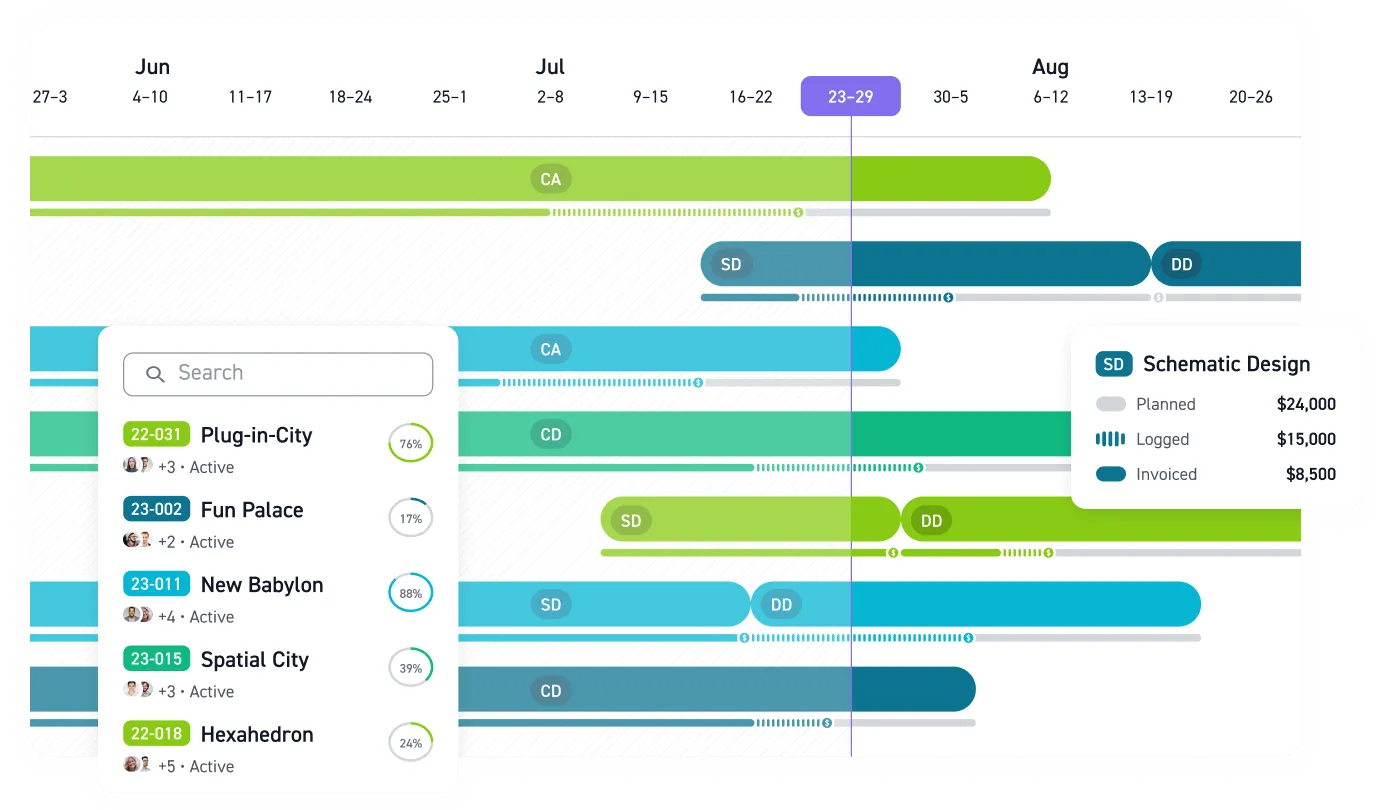
Monograph is built for A&E firms with 5 to 50 employees and supports fixed-fee, hourly, consultant pass-through, and retainer billing within a single project, so a cost-plus study phase and a lump-sum design phase on the same contract don't need two tracking systems. Its MoneyGantt™ view puts the project timeline and the budget-to-cash progression on one screen. A traditional Gantt chart shows dates. MoneyGantt™ shows a phase at 80% of budget and 50% complete while you can still shift staffing. Those project controls and the firm-level project analytics behind them are what turn a contract type decision into a margin you can see while the work is open. Garrison Architects reports a billing cycle twice as fast, a customer-reported outcome rather than an independent benchmark.
Contract setup itself is where Monograph's AI does its first work, and the full set covers the project lifecycle:
- Contract-to-project setup: Upload the signed agreement, and Monograph generates the phases, budgets, and roles for your review.
- Spreadsheet-to-project import: Monograph converts a milestone or deliverable spreadsheet into a phase structure.
- Proposal budget recommendations: Monograph uses historical project data to inform the fee you propose on the next similar scope.
- Staffing recommendations: Monograph uses team availability to suggest assignments across phases.
- Calendar-based time suggestions: Monograph draws candidate entries from calendar activity and places them in the web timesheet for you to confirm or change before they count.
- Natural-language time entry on mobile: Monograph converts a spoken or typed description into a structured, phase-level entry after you confirm it.
Each capability puts work into the phase structure the signed contract set up, and the two time-entry features count nothing until you confirm or change the suggested entry. The benchmark below compares AI-adopting firms with non-adopters across whole firms, using Monograph's own data, and it doesn't measure any single capability above. Monograph's 2026 benchmark found AI-adopting A&E firms earn $210,000 in net revenue per employee against $190,000 for non-adopters. Your tools don't change which contract type a scope supports. They change whether you learn the margin on that type in week three or at the final invoice.
Professional standards that can't be negotiated
The standard of care is fixed by law and by your policy, and no contract clause can raise it without moving the added liability outside coverage. EJCDC E-500 states the ordinary professional care standard, with no warranties, limits indemnity to third-party injury and property damage to the extent of the engineer's negligence, and states there is no defense obligation unless expressly agreed. ASCE's Policy Statement 388 opposes warranty and guarantee clauses in engineering service contracts, recommends disclaiming express and implied warranties, and points to EJCDC agreements as the way to allocate risk.
ACEC's Engineering Inc. explains why: "highest standard of care" and "defect-free design" language is uninsurable because it takes on liability the firm would not otherwise have. Victor's December 2024 guidance and Travelers' 2025 risk trends both confirm that policies exclude contractually assumed duties that exceed the professional standard, and the AIA Trust reports contracts referencing the "best" or "highest" standard are becoming more common.
Beazley's contract guide for brokers gives the editing list. Strike "best services," "highest degree of skill and care," "first-class," and "technical accuracy", delete the duty to defend because it's triggered by mere allegation, and qualify any certification "to the best of Design Professional's knowledge, information, and belief."
Victor adds that labeling your firm a "specialist" or "expert," making it the client's fiduciary, or requiring it to verify owner-provided information all exceed reasonable skill and care. These edits cost nothing in fee and are the same on a lump sum, a cost-plus, or an hourly agreement.
Selection method sits in the same non-negotiable category on public work. ASCE's Policy Statement 304 sets the sequence: select on qualifications without considering fee, confer on scope and schedule, then negotiate the fee on the scope both parties developed. NSPE's position statement, revised July 2024, calls for QBS in all engineering services procurement, and the NSPE Code lets an engineer seek indemnification for other than gross negligence where the engineer's interests can't otherwise be protected. What stays negotiable is the number in the limitation-of-liability clause, which E-500's Exhibit I lets you set at total compensation, insurance proceeds, or a fixed amount, and a contingency clause of the kind Beazley recommends, where the client carries a set percentage of error-and-omission costs and betterment is excluded.
Choose the type the scope actually supports
Start from the fact that no public survey tells you which contract type is most profitable. Deltek, Zweig, PSMJ, and ACEC all report firm-level results only. Deltek's 47th Clarity study put operating profit at 16.7% of net revenue for fiscal 2025, down 4.7 percentage points, at 58.9% utilization. Zweig's 2025 financial performance report put median EBITDA, or earnings before interest, taxes, depreciation, and amortization, at 19.2% of net service revenue with a 3.28 net multiplier, and PSMJ's 2026 benchmark of 320-plus firms reported operating profit of 20.5%, up from 19.0%. The three surveys define profit differently, so don't average them. The one firm-level clue by type comes from a single ACEC interviewee who targets 15% on lump sum and has averaged 16% to 17%, which is one firm's experience and not a benchmark.
Choose the type by scope and risk, then make the type profitable through tracking. Run these five steps on every proposal:
- Write the scope list before you price. Deliverables, assumptions, exclusions, and site-visit count go on paper first. The phase isn't ready for a lump sum until the client agrees to the list.
- Match the method to the phase. ASCE's Manual of Practice No. 45 allows a variable fee for project definition and a lump sum for design on the same contract, and E-505 task orders let a master agreement carry different compensation per task.
- Check the owner's procurement rules. Federal-aid work follows 23 CFR 172 and QBS, state DOTs lean on cost-plus-fixed-fee with a ceiling, and private owners accept the lump sum or hourly offer that fits the scope.
- Strike the uninsurable clauses and add the two protective ones. Remove duty to defend, warranties, and any elevated standard of care, then negotiate the limitation of liability and the mutual waiver of consequential damages.
- Set the tracking before you sign. Phase budgets, a current overhead rate, hours resolving to phases, and an estimate at completion reviewed each period are the minimum for any type that leaves cost risk with your firm.
A proposal that passes all five steps gives you a type you can defend to the client, to your carrier, and to your own partners when the phase report comes in. A proposal that fails step one should go out as hourly with a ceiling, whatever the client's template requested.
Track every contract type on one project with Monograph
Track a lump-sum project through its invoices and a spreadsheet and you learn the margin when the client pays the final invoice. The phases are closed, the hours are spent, and the overrun belongs to the firm by then. The same spreadsheet doesn't show a T&M ceiling against hours by phase, or a cost-plus consultant bill against the budget it belongs to, without someone rebuilding the picture from timesheets, fee proposals, and QuickBooks Online every month.
Monograph connects those records in one place for A&E firms. Phase budgets hold fixed-dollar or percentage-of-fee allocations, timesheets resolve to those phases, and billing runs fixed-fee, hourly, consultant pass-through, and retainer methods within the same project. Monthly draft invoices pull in current expenses and consultant bills, guard against duplicates, and route to your team for review before anything goes out. A two-way sync with QuickBooks Online keeps project and accounting data consistent, so the overhead rate on your next cost-plus proposal comes from the same books your accountant closes. All three co-founders hold architecture degrees and built the platform from running a consulting firm that served architecture practices, and 16,000+ architects and engineers across 2,000+ firms use it today.
Book a demo to see how pipeline, phase budgets, staffing, timesheets, and billing connect on a lump-sum, hourly, or cost-plus project from your own backlog.
Frequently asked questions
Which contract type is most profitable for engineering firms?
There's no published answer, because none of the major surveys break profit out by contract type. Fixed fee gives you the full upside when hours come in under plan and the full loss when they don't. T&M and cost-plus hand you the multiplier on every hour and nothing beyond it. Zweig's commentary cites AIA Work-on-the-Boards data in which nearly half of participating firms considered percentage-of-construction-cost fees the most profitable, but federal-aid highway rules bar that method entirely. Profit comes from scope control and tracking on whichever type the scope supports.
How do professional liability insurance costs vary by contract type?
They don't, as far as any carrier or broker has documented. Victor's premium-rating guidance lists firm type, services, location, coverages, billings, and loss history, and compensation method isn't on it. Applications do ask. The ae-ProNet form requests percentages by contract type and whether you use limitation-of-liability clauses, and Victor's project-specific application asks whether the contract is AIA, AGC, EJCDC, or owner-drafted. ACEC's 2022 survey of 410 firms put the median professional liability premium at $52,358 for 2021. Zweig puts reimbursable expenses at 3% to 5% of revenue and says they carry no professional liability exposure, so pass-throughs shouldn't inflate your rating basis.
What's the biggest mistake engineering firms make in contract selection?
Pricing a lump sum on a scope that still reads "and all other services as reasonably required." NSPE's risk management guidance says to define the services and expressly exclude the ones you aren't providing, including site visits, meetings, and as-built drawings. Canadian Consulting Engineer's review of scope-creep disputes finds catchall language is what breeds the additional-services fight. The second mistake is signing the owner's duty-to-defend clause because the fee looked good. That one isn't insurable under most policies, and the fee never covers it.
How can technology influence contract type decisions?
Technology can't make a vague scope ready for a lump sum, but your ability to read current project data determines which types you can run profitably. You need phase burn against percent complete while a lump-sum phase is open. T&M with a ceiling requires every hour to land in the right phase against the not-to-exceed amount during the week your team works it. Public cost-plus work also requires a current, auditable overhead rate. Tools that provide those signals let you price the owner's preferred type instead of accepting its risk blind.
Should engineering firms diversify across multiple contract types?
Yes, by phase and by scope maturity rather than by a target mix. The ACEC lump-sum study found firms running anywhere from 20% to 80% of their work on lump sum, and the same contract can carry hourly for a definition phase and lump sum for design. Government clients will push you toward cost-plus with a ceiling, private clients toward fixed price, so a firm serving both ends up diversified without deciding to be. What matters is that each phase is on the type its scope supports, and that your billing and tracking can handle all of them on one project.