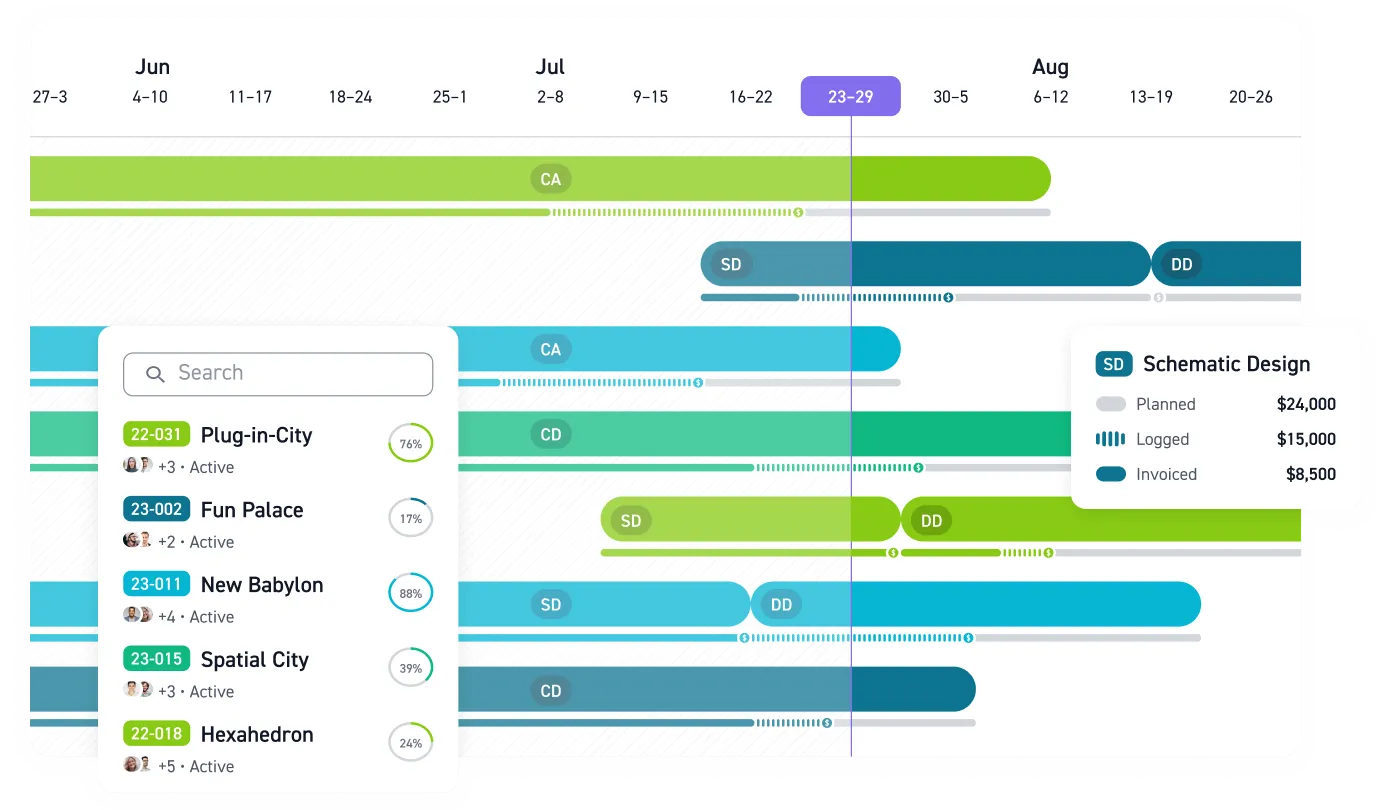


A project that is 90% finished can still eat a disproportionate share of its total labor and cost in its final 10%, especially when no earned value tracking is in place. Closeout captures the project's full financial record: actual hours by phase, absorbed scope, and the real multiplier earned. Firms that record it price the next proposal from evidence; firms that don't repeat last year's assumptions.
One Closeout Process Beats Twenty PM Habits
If every project manager closes projects their own way, your firm has one habit per PM and no closeout process. Put closeout in the project plan from day one, run it from a checklist, and assign one person to maintain the master version. Add it to the project template alongside the phase budget. When hours, budgets, and invoices live on one project record, PMs can answer financial questions without rebuilding a spreadsheet.
A complete A&E closeout covers:
- Final invoicing and collection, including reimbursables and outstanding change orders
- Client feedback, gathered directly rather than assumed
- Consultant closeout: deliverables, warranties, and completion sign-offs by discipline
- Contract-required documentation: record drawings, completion certificates for substantial and final completion, and warranties forwarded to the owner
- Project archiving with a defined file system and retention window matched to your state's statute of repose, which runs 6 to 15 years
- Lessons learned and project write-ups
- Staff evaluations and a deliberate demobilization plan so the team doesn't drift to the next job
Put one discipline lead on each consultant's sign-off line before the prime issues final billing. A subconsultant invoice that arrives after the job closes can come out of your margin. You can seal record drawings prepared under your direction; you cannot seal the contractor's as-builts. Decide which you are signing before final completion.
Close the Financial Loop Before the Team Scatters
Final invoicing sits first because aged work-in-progress gets harder to collect. Convert WIP promptly after milestone completion, including the final milestone. Record realization at close while every write-off, absorbed scope item, and billing delay is still traceable to a phase.
Check three leaks before the books close:
- Aged work-in-progress left unconverted to an invoice
- Unbilled reimbursables such as travel, printing, permit fees, and consultant costs
- Outstanding change orders never invoiced
Before the last deliverable goes out, reconcile remaining fee against remaining scope and review each leak line by line. Put every uncollected invoice and unbilled reimbursable on one list with an owner and date. Review it weekly until the balance is zero. The Workbench team reported a 4x faster billing process and 75% fewer unbilled fees after adopting Monograph, showing how unified project and billing records can tighten closeout.
Turn Project Actuals Into Fee Data
The most accurate fee proposals combine current costs with historical performance, and closeout is when that history gets recorded or lost. AIA guidance recommends tracking fee as a percentage of construction cost, hours per square foot, and project multiplier as historical input. For engineering work, use hours per phase and net multiplier by project type. Consistent fixed-fee underbidding signals a pricing system that needs rebuilding.
Four measures deserve a permanent record:
- Percent complete vs. percent spent vs. percent billed. This shows where fee outran deliverables and where income sat uninvoiced.
- Actual vs. budgeted hours by phase. Variance during construction documents leaves little room to correct.
- Net multiplier against break-even. Break-even equals your overhead rate plus 1.00. A project below that line didn't cover its share of overhead.
- Project profit margin, so scope creep, discounting, and mis-staffing show up in one number.
Say a civil team closes its third site-development project of the year, and survey coordination has run about 40 hours over budget on all three. Phase-level actuals reveal the pattern. Rebuild the fee template around what comparable projects consumed, then reprice the services that overran.
Run a Lessons Learned Session That Survives the Project
Lessons are often captured at project end but never stored or reused. For engineering firms, formal programs exist in only about a third of practices, making reuse the real problem. Without a reusable record, the same coordination and fee mistakes return on the next job.
Schedule a focused session in the project's last week with the delivery team, PM, and internal client lead. Have someone other than the PM lead it. Ask what worked, what didn't, why, whether the project made money, and what must change. Log every lesson with an owner, action, and due date.
Lessons are worthless unless someone owns the job of feeding them into fee templates, checklists, and training. At the next kickoff, check those entries against the new project's fee assumptions and phase hours. Close the loop by confirming that each assigned action made it into the firm's working process.
The Last Interaction Sets Up the Next Fee
Closeout is a business development event. Repeat clients account for 72% of gross revenue at A&E firms, so the final deliverable, invoice, and conversation carry outsized weight. Treat that conversation with the same care as a final design review.
Ask what went well, what could have been better, and what the client would change next time. Have the principal or PM who ran the job lead the client debrief. Write the answers into the pursuit file or client record while details remain attached to names and dates.
Then ask for a referral on the client's letterhead, signed by the most senior manager you can reach. Store the signed letter in the pursuit file. Bring it forward when the next comparable opportunity appears.
Make Every Closeout Improve the Next Project
Build the checklist into your project template and run it on the next job that closes. Have the PM complete it, the operations leader maintain it, and the principal review actuals before approving the next comparable fee proposal. That review closes the loop between project delivery and future pricing.
Monograph keeps phase budgets, hours, consultant costs, invoices, and project actuals on one record, giving your team closeout evidence without another spreadsheet.
Put the record in place before the team scatters, then book a demo with Monograph to see the workflow.
Frequently Asked Questions
Who should own project closeout?
The PM should own the project checklist. An operations leader maintains the master template, discipline leads sign off on consultant items, and a principal reviews financial actuals.
When should project closeout begin?
Start at kickoff by adding the checklist to the project plan and assigning owners. Reconcile finances before the final deliverable and hold the lessons learned session during the project's last week.
Do small engineering projects need the same closeout checklist?
Yes, but scale the effort. Small projects still need final invoicing, consultant reconciliation, required documentation, archiving, client feedback, and a record of actual hours and margin.
What if a consultant's final invoice is still outstanding?
Assign a discipline lead, track the missing invoice with an owner and date, and confirm the remaining cost against the project fee. Review it weekly until it arrives so an unrecorded cost does not become a margin loss.