

When an A&E firm calculates an overhead rate once a year, then prices every proposal on that number until the next budget cycle, chargeability drifts, a senior hire lands, the lease renews, and by summer January's fixed fees sit below break-even. Overhead allocation spreads indirect costs across projects so each fee carries its share.
The mechanics take five steps:
- Total your indirect costs for the period, every dollar not charged to a project.
- Pick an allocation base, usually direct labor cost or direct labor hours.
- Divide pool by base. For example, assume $400,000 of overhead over 20,000 direct labor hours, which is $20 per hour.
- Apply the result to every project and every fee you quote.
- Review at least quarterly and after any cost shock.
Step two and step five cost firms the most money.
What Overhead Allocation Means for an A&E Firm
The AIA defines indirect expenses, or overhead, as costs of running the business that cannot be charged to a specific project. The cost pool and the allocation base do the work; government auditors define pool and base as the expenses to be allocated and the activity that caused them. Most of that pool is fixed in the short term, so a chargeability dip raises your rate with no new spending. For A&E firms the base is almost always direct labor cost: raw wages for hours coded to client projects. The standard definition excludes PTO and bonuses from that figure.
Overhead rate = total indirect expenses ÷ total direct labor cost. Both figures go in dollars, not hours; the formula is overhead over labor. Add 1.0 for the break-even multiplier, the minimum you must bill per dollar of direct labor before profit.
Three categories feed the numerator:
- Indirect labor: the largest single component of overhead. Admin salaries, principal time on firm management and business development, PTO, training.
- Payroll-related expenses: employer FICA, unemployment insurance, health and retirement contributions.
- Other indirect expenses: rent, utilities, software subscriptions, E&O insurance, licenses, marketing.
Monograph's 2026 Architecture & Engineering Business Benchmarks Report found that non-labor overhead runs 27% of budget at architecture firms and 26% at engineering firms, measured across 423 QuickBooks-connected firms. Architects put 17% of budget into consultants versus 5% for engineers, with operations spend nearly identical.
Choosing the Base for Allocating Overhead Costs
Your allocation base decides which projects eat the overhead. Most firms inherit that choice from whoever set up QuickBooks and never revisit it. Firms doing state DOT work don't get a choice: the FAR/AASHTO rate for A&E work is allowable indirect costs over a direct labor base, and the AASHTO guide requires an annual update. Every other firm has three options.
- Direct labor cost. The industry standard. For example, at 150%, a $50/hour designer carries $75 of overhead for a loaded cost of $125; a $100/hour senior engineer carries $150, landing at $250.
- Direct labor hours. Divide the pool by total project hours. For example, assume a $300,000 pool over 6,000 hours, which gives $50/hour, so the senior engineer's overhead drops to 50% of wages while the designer's holds at 100%.
- Total direct cost. Spreads overhead across labor, subconsultants, and reimbursables. Federal transit guidance accepts this for the G&A pool, rarely for the overhead pool.
Under the hours base, senior-heavy projects look cheap relative to their labor cost; under the cost base, expensive. Pick the base that tracks what drives your overhead and apply it the same way every year; auditors compare the documented method to practice.
A small studio with one salary band can stay on a single direct labor cost base. A firm with architecture, MEP, and civil groups gets more from departmental pools. Subconsultant-heavy firms should keep pass-throughs out of both pool and base.
Keep consultant fees and reimbursables out of the numerator and the denominator. The AIA classifies them as direct expenses; that 17% consultant share at architecture firms inflates gross revenue and makes a healthy rate look bloated.
Three Overhead Allocation Methods, Worked Through
Three cost allocation techniques cover nearly every A&E firm. Consider a hypothetical 18-person firm with $1,200,000 in direct labor and $1,800,000 in indirect expenses. A single firm-wide pool gives a 150% overhead rate and a 2.5 break-even multiplier: every project pays 150% on its labor, so $100,000 in direct labor absorbs $150,000. This aligns with FAR audit expectations and holds up for a homogeneous project mix.
Departmental or phase pools split that $1,800,000 by where the firm consumes it. In this hypothetical, the same firm might carry business development at 150%, project execution at 125%, and QA/QC and closeout at 225%, blending back to 150% overall. Multidisciplinary firms running architecture, MEP, and civil get the most from this structure.
Activity-based costing, introduced in 1988 by Cooper and Kaplan, assigns pools to activities like proposals and QA sessions. In a hypothetical four-activity-pool model, a large institutional project lands at an effective 91.5% rate, while a small residential job that needed five proposals lands at 137.5%. The single pool charged both 150%, overcharging both examples, but by different amounts; the small job still consumed far more business development cost per dollar of labor. ABC costs the most to maintain, and pays off where project types vary widely.
Where Your Rate Should Land
Benchmark data clusters around 160% to 170%. PSMJ's 2026 survey of 320+ firms put the operating overhead rate at 167.6% before bonuses. Monograph's KPI guidance treats anything above 175% as a trigger for corrective action.
Firms under $5M in revenue typically run overhead rates 20 to 30 percentage points higher than firms above $20M, and architecture-heavy firms tend to run lower than engineering-heavy ones. Your own trend line matters more than a national median. A rate carried over from last year's spreadsheet tells you less than four quarters of your own numbers.
Chargeability drives the denominator, so a drop in chargeability raises the rate on its own. A PSMJ case study of a 65-person firm at a 210% overhead rate traced the problem to 59% chargeability against 64% at top performers; the firm cleared a 3.19 multiplier and still netted only 5% profit.
Putting the Rate to Work in Proposals and Forecasts
For example, at 150% overhead the chain runs: break-even 2.5, target multiplier 2.5 ÷ 0.80 = 3.13 for 20% profit, and a $57/hour salary bills at roughly $178/hour. Move the rate to 175% and the same person bills near $196.
Annual recalculation can't protect fixed-fee work. Recalculate quarterly, and off-cycle when any of these hits:
- A material staffing change, such as multiple hires or departures in a single quarter
- A lease renewal or major software cost change
- A principal compensation change
- A discipline shift, such as adding interiors or dropping an outdoor-design discipline
Each event changes either the indirect-cost pool or the direct-labor base enough to justify a fresh pricing assumption.
Put Your Current Overhead Rate Into Every Project
Validate the indirect-cost pool, confirm the allocation base, and recalculate the rate using current direct labor before the next proposal goes out. Principals and owners set the pricing expectation, operations and finance leaders maintain the rate, and project managers watch phase budgets against that assumption.
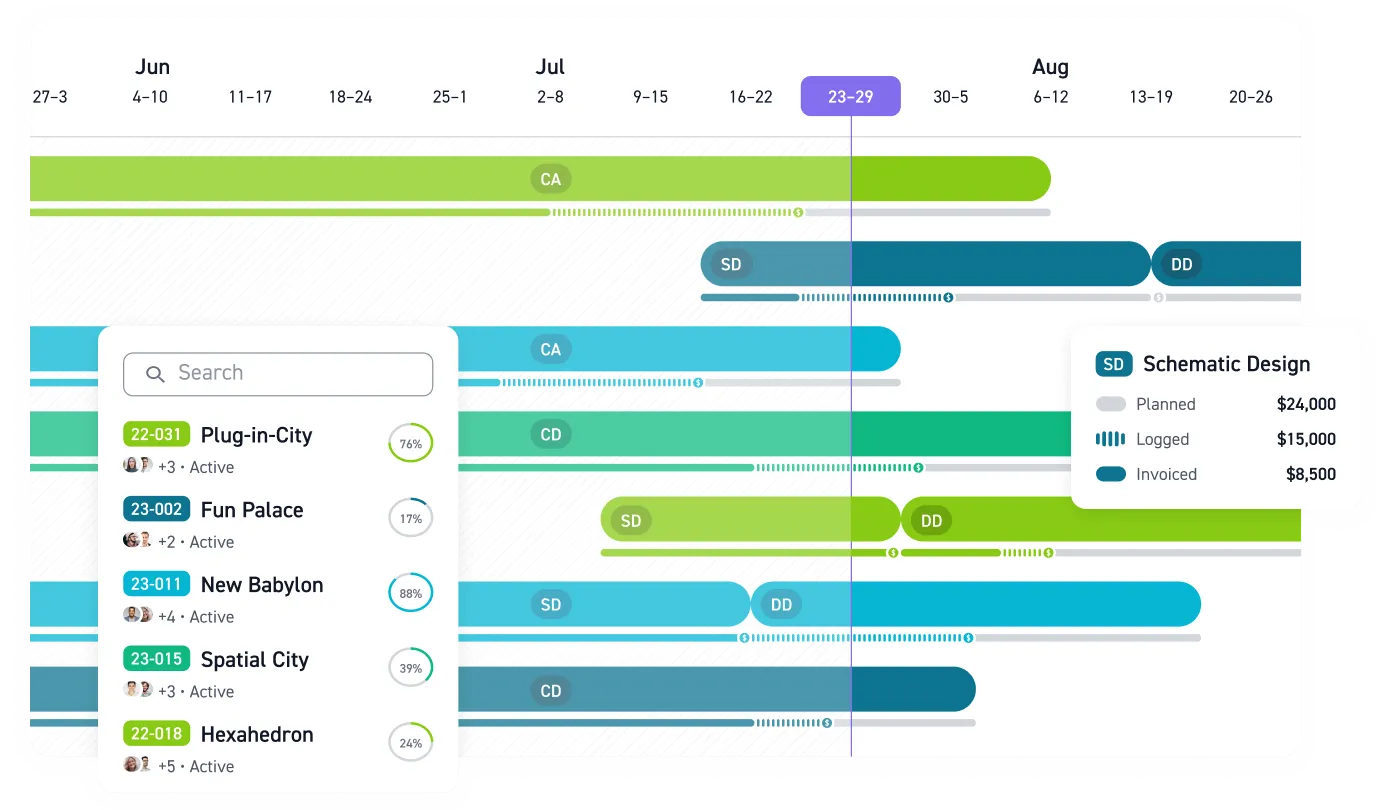
Monograph's signature MoneyGantt™ feature combines planned, logged, invoiced, and paid dollars for each phase on one visual timeline, helping teams spot off-track phases quickly. Phase-based time tracking feeds current project data into the platform, and budget alerts help a finance manager see budget or margin pressure early. After adopting Monograph, Woodhull cut administrative time by 66%, made billing 50% faster, and reduced budget overages by 66%.
An outdated rate can already be costing you. See how current time data, visibility into chargeable hours, and live phase budgets can keep pricing assumptions connected to project performance. Book a Monograph demo.
Frequently Asked Questions
Does a small A&E firm need departmental overhead pools?
Usually not. Add departmental pools when architecture, MEP, civil, or other groups consume overhead in materially different ways.
Can we change our overhead allocation method?
Yes, but the new base should track what actually drives overhead, and the documented method must match practice. Apply it consistently every year. Firms doing state DOT work must follow the applicable FAR/AASHTO direct labor requirements.
How often should we recalculate the overhead rate?
Recalculate quarterly rather than relying on one annual number. Run an off-cycle calculation after a major staffing change, lease renewal, software cost change, principal compensation change, or discipline shift.
Should subconsultants and reimbursables be included in the overhead base?
Keep consultant fees and reimbursables out of both the numerator and denominator when they are direct project expenses. Subconsultant-heavy firms should also keep those pass-through costs out of the overhead pool and base so they do not distort the rate.
Data was collected as of April 2026.