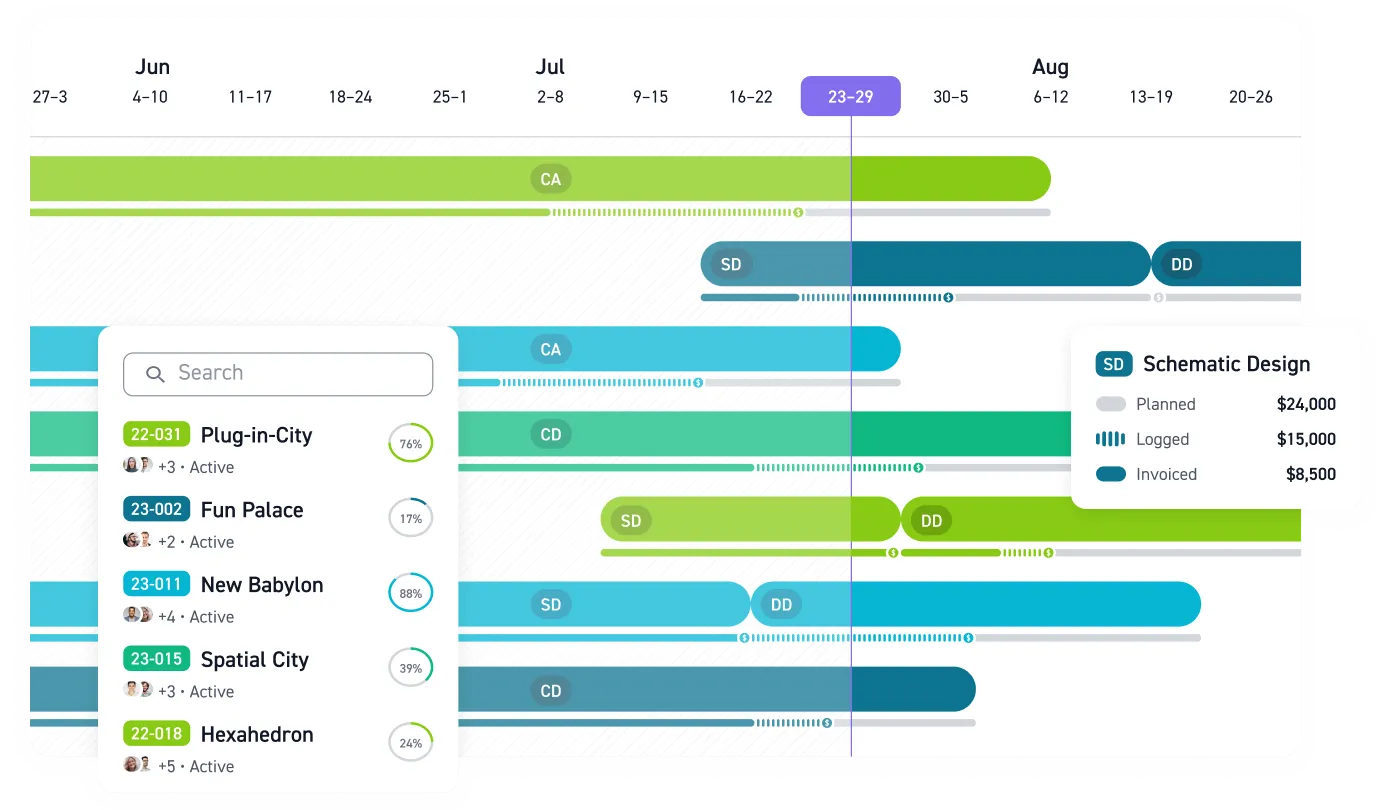


Fixed fees can look predictable on paper and still create cash-flow swings. Progress billing turns those fixed fees into monthly cash by invoicing for the percentage of each phase completed to date instead of waiting for a milestone or project completion. At month-end, it answers whether the firm actually earned what it spent. For a finance manager, it is the difference between predictable monthly revenue and a cash position that swings with the project schedule.
How Progress Billing Works Under AIA B101
AIA B101–2017 sets the default terms: unless otherwise agreed, payments for services are made monthly in proportion to services performed, due on presentation of the invoice. Section 11.5 allocates the total fee across the five basic services phases but leaves the percentages blank for negotiation. Before invoicing, break the fee down by phase.
The traditional distribution most firms start from:
- Schematic Design: 15%
- Design Development: 20%
- Construction Documents: 40%
- Bidding and Negotiation: 5%
- Construction Administration: 20%
A sample phase allocation assigns 20% to SD, 25% to DD, 35% to CDs, 2% to procurement, 15% to CA, and 3% to closeout. Once set, monthly billing works within it: if schematic design is partly complete at period-end, you invoice completed predesign work and the documented share of SD. When compensation is percentage-based, B101 also protects previous progress payments from adjustment if the owner's budget changes later.
Fixed Fees Still Need Progress Billing
Progress billing applies to any fee structure, including fixed fees. Percentage-of-completion is a recognized invoicing method for stipulated sum fees, and on lump sum engineering contracts most clients and firms tie payment to milestones or percent complete, with a progress report accompanying each invoice.
Monthly progress billing also beats milestone-only billing for cash flow. If a milestone slips while payroll and rent hit on schedule, you know why. Milestones shift, while fixed costs arrive every month. Breaking fees into smaller monthly increments also makes invoices easier for clients to approve, which gets you paid faster.
Percent Complete vs. Percent Spent
Percent complete measures work delivered. Percent spent measures budget consumed. The two feed different decisions:
- Percent complete drives earned value (% complete × budget), which is what you should bill against.
- Percent spent drives burn rate and your estimate at completion.
- When percent spent runs ahead of percent complete, the project is eating fee faster than it earns it.
Using much of a task's budgeted time does not mean finishing the same share of the work. A project manager who walks the actual drawings at month-end might find construction documents are far behind the hours budget. That gap is the warning. On a fixed-fee contract it lands directly on your margin, so project managers should estimate physical completion independently each period rather than dividing hours spent by hours budgeted.
What Goes on a Progress Invoice
A progress invoice has to show the client exactly where their money stands against the contract. At minimum, include:
- The original contract amount and the current invoice amount
- Cumulative billed to date and percent complete by phase, using the standard SD, DD, CD, CA labels
- Consultant fees as a separate line, with any contract-specific markup shown clearly
- Reimbursable expenses listed separately and coded to a phase, not just the project
- Any retainer credit; the AIA advises sizing the retainer to cover services from kickoff until the first invoice is paid
Two rules keep these invoices clean. Partial payments within a phase must never exceed that phase's total allocation, and each invoice should restate the payment terms so the due date is clear.
What Disciplined Progress Billing Is Worth
The payoff shows up in collection speed. Monograph's 2026 Architecture & Engineering Business Benchmarks Report found that top firms collect payment in 22 days, the average firm in 34 days, and low performers in 42 days. Top firms get paid well before low performers, while payroll and rent do not wait.
The same benchmark ties realization to billing discipline. Realization is the share of performed work that turns into billable revenue, and firms in the AI-adopting cohort average 100% realization against a 96% baseline for the rest. Monthly invoices tied to documented percent complete surface under-billed phases before they turn into write-offs. Workbench billing results include a 4x faster billing process and 75% less unbilled fees after moving from BQE Core to Monograph.
Running Progress Billing in Monograph
Monograph's invoice builder works phase by phase. Enter a completion percentage for Schematic Design and the "Current Due" field updates to that share of the planned phase fee, with logged time and previously invoiced amounts visible. Fixed fee, hourly, and not-to-exceed phases can live in the same project, and consultant fees stay separate from direct labor with markups tracked.
Monograph's MoneyGantt™ overlays budget-to-cash progression on the project timeline, showing planned, logged, invoiced, and paid amounts by phase so you can spot margin pressure before approving the next invoice. Approved invoices then sync to QuickBooks Online, while consultant/vendor data stays connected so accounting and billing stay aligned.
Open the invoice templates on your next phase close and compare your collection cycle to that 22-day top-firm benchmark.
Turn Progress Billing Into Predictable Cash Flow
Month-end billing should not require hunting through spreadsheets, guessing percent complete, or rebuilding phase totals by hand. When progress billing lives next to budgets, time, consultant fees, and invoices, your team can bill earned work before it turns into unbilled fee.
Monograph helps A&E firms manage progress billing phase by phase. Project managers can compare percent complete against percent spent, operations leaders can prepare cleaner invoices, and principals can see whether fixed-fee work is protecting margin or draining it.
Cash flow gets tighter when billing waits. Book a demo.
Frequently Asked Questions
Can we use progress billing on a fixed-fee contract?
Yes. Progress billing applies to fixed fees, including stipulated sum and lump sum contracts. Break the total fee into phase allocations before the first invoice, so each monthly invoice ties back to completed work by phase.
Should percent complete match the percentage of budget spent?
No. Percent complete should reflect work delivered, not hours burned. If a phase is far more spent than complete, that gap is a margin warning. Treat it as a project management checkpoint before the phase absorbs the rest of the fee.
How detailed should a progress invoice be?
The client should see the original contract amount, current invoice amount, cumulative billed total, percent complete by phase, consultant fees, reimbursables, and any retainer credit. Keep consultant fees and reimbursable expenses separate, and code reimbursables to a phase.
Is monthly progress billing worth the administrative effort?
Yes, especially when payroll, rent, and consultant bills arrive monthly. Monthly billing keeps cash flow steadier than milestone-only billing, surfaces under-billed phases earlier, and helps project managers compare earned value against budget spent.
Data was collected as of April 2026.