

Managing a professional engineering or architecture services firm is much like being the architect of a complex structure. Each project and team member is a crucial pillar in the edifice of your business. Effective resource scheduling is the keystone that holds these pillars in balance, ensuring the stability and harmony of the entire structure.
Now think like this: you had a helping hand in this building, a tool that understands the intricacy of your projects. That's where Monograph steps in. It's like having a maestro conducting the flow of information, integrating and visualizing the essential data points that keep your projects in harmony.
There are three main areas to focus on when scheduling resources: allocation, budget, and scope. With Monograph, decision-making across all three becomes more intuitive.
1. Understanding the Importance of Allocation Data
First things first, let's talk about allocation. This involves understanding your total cost and how utilized your team needs to be to meet a revenue potential that covers the cost and makes you profitable.
It also involves understanding the total capacity of your team members and how many hours they are. Here is a more detailed view of these aspects below:
Balancing Costs and Utilization for Profitability
For AE firms, managing the economics of team efforts involves balancing the cost of labor against the revenue generated by their work. To ensure profitability, it's essential to define clear utilization targets that match or exceed the baseline needed to cover costs and generate a profit margin.
Maximizing Team Capacity without Overloading
Capacity management is critical in preventing employee burnout and ensuring quality output.
Knowing each team member's maximum capacity and optimal workload helps in achieving a balance where staff are neither underworked (leading to lost revenue opportunities) nor overworked (which can compromise project quality and employee satisfaction).
Efficient Scheduling within Capacity Constraints
Effective scheduling is all about placing the right person on the right job at the right time. It requires a deep understanding of individual capacity limits and existing workload.
2. Budget Management
Detailed Tracking of Budget Allocation Across Project Phases
Managing a project's budget involves careful planning and monitoring across various stages of the project lifecycle. If you are not careful, you will see budget overruns and inefficient use of financial resources.
Aligning Time Management with Budget Constraints
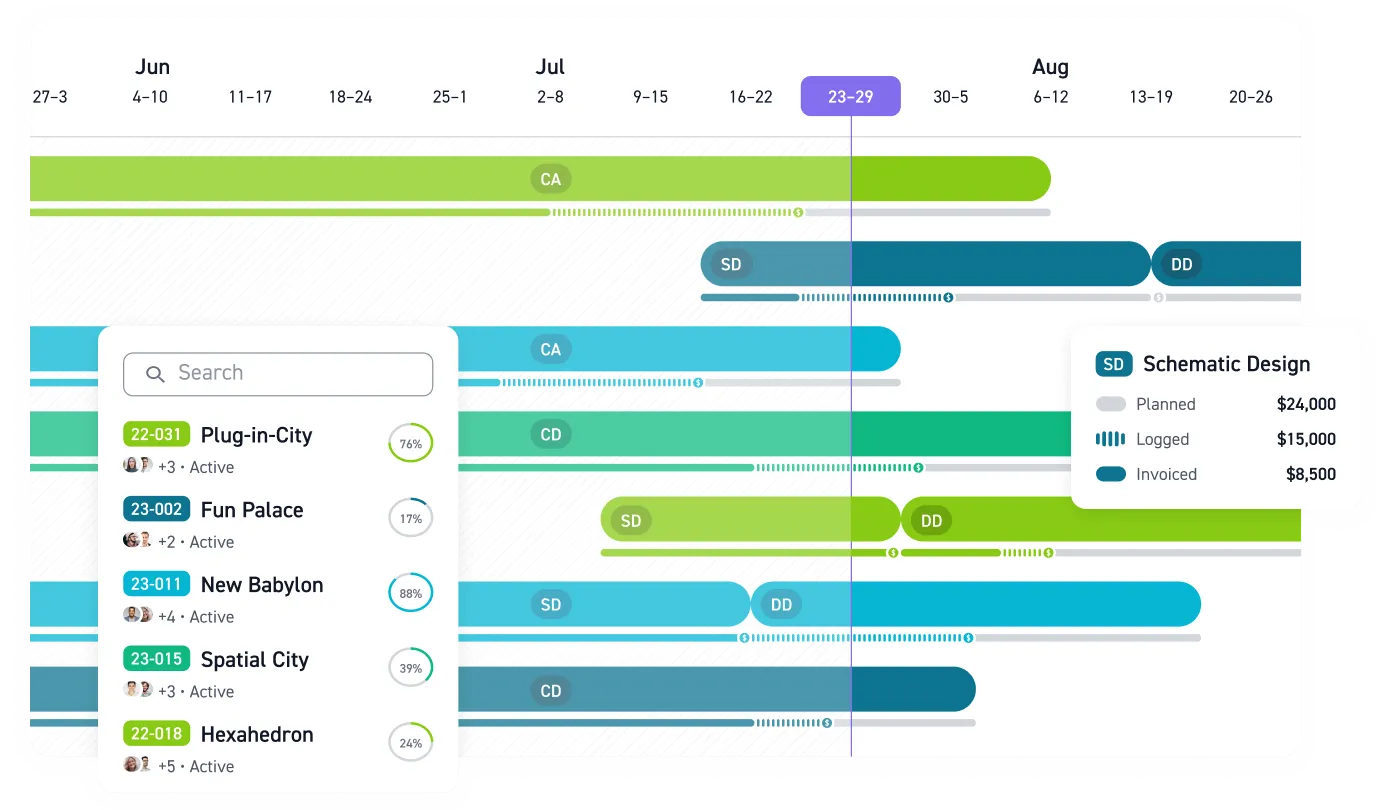
A critical aspect of staying within budget is managing the relationship between logged time, scheduled future time, and the budget for each project phase.
Monograph connects time tracking to phase budgets, so actual hours and costs are visible against the budget by phase, helping you catch a phase that's burning through its budget too quickly before it impacts the project's financial health.
3. Scope Management Strategies
Clarifying and Delivering on Scope Expectations
The scope of a project defines what needs to be accomplished. Accurate scope definition, broken down into manageable parts with assigned times, is essential for scheduling.
Monograph's project planning tools support this kind of phase-by-phase breakdown, with milestones and Gantt charts to define and schedule each part of the work.
Time Estimations and Real-time Scope Tracking
For projects to remain on schedule, it's crucial to link time estimations directly to scope elements. As phases and milestones are planned in Monograph, automation helps keep linked phase dates updated as schedules change, so the plan reflects the latest timeline rather than the original one.
Monitoring Progress and Adjusting Resources
As projects progress, tracking what has been completed versus what remains is essential for dynamic resource adjustment.
Monograph's staffing view lets you adjust hours per person per phase directly as plans change, so managers can reallocate resources to address delays or scope changes without rebuilding the schedule from scratch.
Ensuring Sufficient Scheduling for Remaining Tasks
Ensuring that scheduled hours are sufficient to cover the remaining scope is fundamental to keeping projects on track.
Monograph's Staffing, People view compares planned hours against team availability, with over/under-allocation highlighted directly, helping you spot over-allocation before it affects a milestone or delivery date.
Leveraging Monograph for Holistic Management
Monograph provides a unified platform where all these aspects can be monitored and adjusted. It simplifies resource management by allowing you to:
- View and assign hours directly linked to project phases and budgets.
- Monitor up-to-date data on team utilization, budget consumption, and phase progress.
- Make informed adjustments to ensure projects stay on track in terms of time, budget, and scope.
By connecting these pieces in one platform, firms can move from reactive to proactive management, anticipating challenges and adjusting resources dynamically to meet project demands efficiently and effectively.
Conclusion
Effective resource management in professional services is about more than just tracking hours; it's about strategic planning and execution that aligns team capacity with project budgets and scope requirements.
By understanding the crucial aspects of allocation, budget, and scope, and utilizing comprehensive tools like Monograph, firms can ensure they not only meet but exceed their operational and financial goals.
FAQs
Is resource scheduling different from project scheduling?
They're related but not the same question. Project scheduling asks when the work happens, phases, milestones, deadlines. Resource scheduling asks who does it and whether they have the hours to. A project schedule can look perfectly reasonable on a Gantt chart and still be unworkable if the people it depends on are already booked on three other things that week. Firms that treat these as one exercise tend to build schedules that are accurate on paper and wrong in practice.
What's the most common resource scheduling mistake firms make?
Scheduling to the project instead of the person. It's natural to plan phase by phase, project by project, because that's how the work is sold and billed. But a team member doesn't experience their week as one project; they experience it as everything on their plate at once. A firm can staff every project responsibly in isolation and still overload half the team, because no one looked at the aggregate. The fix isn't more planning per project, it's a single view of every person's total commitment across all of them.
How far ahead should firms schedule resources?
Far enough to see a staffing problem coming, not so far that the plan is fiction. For most A&E firms, that's somewhere between six and twelve weeks of real detail, with a rougher look further out for hiring and capacity decisions. Scheduling a year of billable hours down to the day is usually wasted effort since scope changes and new work will rewrite most of it anyway. The goal isn't precision that far out, it's visibility into where the next crunch is likely to hit.
Does better resource scheduling actually improve profitability, or is it just about avoiding burnout?
Both, and they're more connected than firms usually treat them. Overloading people doesn't just risk burnout; it also quietly erodes margin, because rushed work generates more rework, more non-billable cleanup time, and more scope creep from missed details. Underloading is its own profitability problem in the other direction: paid hours with no billable work behind them. Resource scheduling done well is really a profitability lever wearing a staffing hat.
Should resource scheduling live in the same system as project budgets and time tracking, or is a dedicated scheduling tool enough?
A dedicated scheduling tool can tell you who's free. It can't tell you whether staffing someone on a phase will blow the phase budget, or whether the hours you're planning match what's actually being logged. Those are budget and time-tracking questions, and a schedule that's disconnected from them is really just a well-organized guess.
The firms with the clearest picture are the ones where staffing, budget, and time tracking are reading from the same data, not three systems that get reconciled after the fact. That's the idea behind pairing Monograph's Staffing, People view, which shows who's free, with its phase budget tracking, so availability and budget impact aren't two separate lookups.