
There are so many interconnected aspects of a project that need managed: budgets, timelines, tasks, resources. To do so effectively across a portfolio of many projects, your firm needs an effective and consistent process. The best way to start formulating or improving this process is by identifying the information about each of those subjects that will be tracked and then determining how often they should be reported. Think of it like an inventory of sorts.
What and How Often: Developing Consistency
Take a look at the following representation of the project lifecycle. Isolate one section at a time and for each stage of the lifecycle, answer the following questions:
Questions to Ask:
- What information should be tracked?
- When is that information first known?
- Who enters it and where?
- How often will it be updated?
- What is our process for escalating issues?
If you find that your firm does not currently have consistent standards in place, take a phased approach to adjustment. Don't try to do too many things at one time. Pick a few things to change, do those things for a period, and then evaluate. Did everyone follow the process? Did it benefit the firm? Will you continue to do it? What's next? Going through this process will allow your project management process to evolve over time and avoid overwhelming your project management team.
The inventory activity and follow-up conversations about action and impact should involve open input from your project management team. This will help ensure buy-in and make sure that the correct processes are being implemented. You should not underestimate the difficulty of this step. Lack of buy-in and failure to follow process is one of the most common reasons firms fail to properly manage their projects.
Before you get started, here are a few process areas that we recommend you inspect closely and some thoughts on which direction to steer them if your team is looking for targeted improvement.
Visualizing Your Budget
Understanding the status of your project budgets should be the first goal of establishing your project management process. The frequency of this process will vary depending on the type of project. Hourly projects where you bill time and materials will need less oversight than those with a "not to exceed" estimate. Of course, lump sum/fixed fee and hourly "not to exceed" projects must be tracked carefully to reduce the risk of project overages and lost profitability.
Having a central place that shows the budget status of each project is an important step in managing project budgets. It is important to be able to see the following:
- How much of the budget is spent
- How much of the budget is invoiced
- Whether the project is over budget
- How the spent amount of budget compares to the actual completion of the project
- Which way the project is trending
Once you have visibility into the information above at a high level, being able to drill in and see this same information at a phase level can provide valuable insight into your projects.
Discuss this with your team; can you quickly see these valuable metrics for your projects? If so, how easy is it to dig in to figure out why the number is what it is?
If the answer to either of those items is no, this is the first place you should start to create standardization and consistency, as many of the topics below build on or become more valuable when working from an established budget.
Setting Timelines
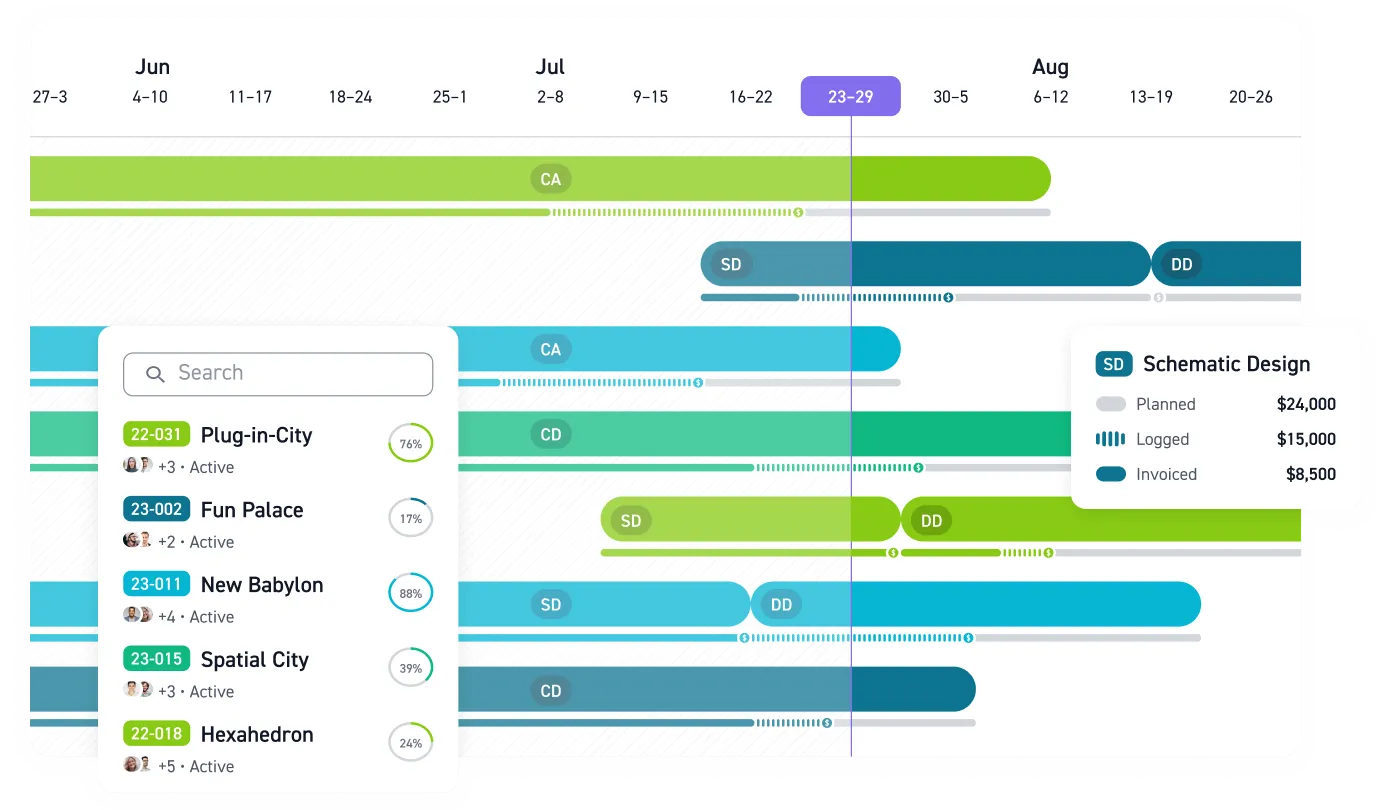
Setting project timelines and creating a method for visualizing those timelines across your projects/phases provides several important benefits, including the following:
- Allows you to see the current phase of each of your projects
- Allows you to more accurately communicate timeline information to your clients
- Allows you to visualize where your work pipeline drops off
- Assists in resource planning and hiring decisions
- Provides an understanding of when new projects can be started
- Allows you to forecast future revenue
Your firm should have a central place where this information can be easily viewed by anybody who needs to act on it. It should also be simple for a project manager to also view this information just for their projects. Monograph's project planning tools are built around this: phased plans that both firm leadership and individual PMs can view at the level of detail they need.
Project schedules become powerful firm management tools when combined with project budget information. Once these two things are input for each project, you can both clearly visualize where the project is at and forecast the monthly revenue of the firm (Monograph's Revenue Schedule lets you refine how each phase's fee spreads across months, so the forecast reflects your actual timeline rather than an even split). Even if your timelines are rough, we encourage you to make this next in priority after tracking budget estimates and spent amounts. While you're at it, consider including regular updates to timelines from project managers a part of your process, since the forecast is only as accurate as the schedule behind it.
Tracking Actual Completion
"Fixed fee" or "lump sum" projects are common in the architecture industry. The hope is always that you'll be able to complete the work on track or ahead of estimates and still charge the full amount, but the obvious risk is that more value might go into the project than what is allowed by the budget. In this case, it is important to know as soon as possible that things may be going sideways.
Being able to see this requires a comparison of the work that has been completed vs. the budget that has been consumed. Having the project manager evaluate and report the percentage complete on a consistent basis provides the opportunity to make this information visible to the management team so they can act accordingly.
Tracking the actual work completed can also provide the framework for consistency by ensuring that all projects are being reviewed on a standard time frame. It is a good first step if your firm needs better management of fixed fee/lump sum projects. Once this is put in place and followed consistently, other project management procedures can be built around it.
Another benefit of tracking actual completion is that it can simplify the invoicing process. A common practice for architecture firms is to invoice the completion percentage for each phase of a project, or to invoice those phases at key completion milestones (e.g., 30% Construction Documents). If your project management process already requires project managers to report this information as the project progresses, it can make it much easier to know what can be invoiced and reduce back and forth required to bill fixed fee projects.
Scheduling and Managing Resources
How well your firm manages the resources you have available drives the overall profitability of your firm. Properly balancing the workloads of your firm's staff not only ensures work can be performed but also impacts the satisfaction of your team. It is important to keep team members fully utilized but not overload them. Schedule too little work and your firm's profitability will suffer. Over-schedule your staff and you might end up with high turnover.
You should start by looking at your team and deciding the percentage of their time that should be spent on client-related work. This may be less than 100% for staff that help with internal admin items or sales-related activity. It is important that you consider these items, so you do not over-estimate your team's availability.
PTO and holidays can also complicate the process of accurate resource planning. Incorporating this information into your scheduling will also allow the entire team to see when staff will be unavailable and see potential bottlenecks that might occur if too many people are out of the office at one time.
Most of the topics above deal with setting an estimate and reporting what happens in terms of spending as time elapses. Scheduling is your opportunity to influence how the spending goes or right the ship when things don't go as planned.
To that end, you should be able to quickly look at the resources scheduled to each project or all the projects scheduled to a particular person and understand whether you are planned to spend your remaining budget appropriately. Monograph's staffing management is built for exactly this kind of two-way view, by project or by person. If things still end up sideways, it's critical to be able to look back and compare what was scheduled vs. what the employee actually worked on.
Project Management Impact on Billing
Invoicing is one of the most critical activities in any firm, the one that turns all your planning and work from earned value to actual revenue. Slow billing cycles severely impact efficiency and cash flow. The impact of project management on invoicing is often overlooked. Firms that have long billing cycles typically have an underlying project management problem that causes the delays. This occurs because the information that is required for billing is not up-to-date, so billing is delayed while the information is collected inconsistently from project managers or stuck in communication loops between office managers, project managers, or even owners and billable staff.
When project management standards are put in place and consistency followed, invoices can be sent much quicker. The overall effort spent on the process by the office manager/billing manager and project manager is also reduced. Loops that get created by faulty information being passed back and forth for review and revision are straightened out into a smooth workflow. This ultimately also reduces the number of errors that occur on the invoices and makes for happier customers and faster payments.
How Monograph Brings Together Budgets and Project Management
Monograph connects people, projects, and invoicing for architecture and engineering firms. The system lets you set up your project budget, then create a plan based on that budget. As time and expenses are logged to the project, tracking progress becomes a transparent and simple activity so that A&E invoicing can be performed with ease.
Struggling with where to make improvements to your current project management workflow? Explore Monograph's project management tools or get a demo.
FAQs
How long does it actually take to build a consistent PM process?
Longer than the kickoff meeting makes it feel, and that's fine. Most firms can define what should be tracked and who owns it in a week or two. What takes months is the part nobody puts on the roadmap: getting every PM to actually do it the same way on a Tuesday afternoon when they're behind on three other things. Treat the first quarter as a pilot, not a rollout. A process nobody follows isn't a process, it's a document.
Should every project follow the exact same process, or is some flexibility okay?
The inputs should be consistent; the judgment calls don't have to be. What information gets tracked, who enters it, and how often it's updated, that's worth standardizing across every project, because that's the data everyone downstream depends on. How a PM handles a tricky client conversation or an unusual phase structure is a different kind of decision, and forcing that into a rigid script usually just teaches people to work around the process instead of with it.
What's the most common reason standardization efforts stall out?
Nobody closes the loop. Firms are good at announcing a new process and bad at coming back a month later to ask whether anyone actually used it, and why or why not. Without that check-in, the process quietly reverts to whatever each PM was doing before, and by the time leadership notices, it looks like the standardization "didn't work" rather than "was never actually adopted." Build the follow-up conversation into the rollout from day one, not as an afterthought.
Where should a firm start if this feels overwhelming?
Budget visibility, almost always. It's the one thing every other process area eventually depends on, timelines, invoicing, resource decisions all get more accurate once there's a reliable answer to "where does this project actually stand financially." Firms that try to standardize scheduling or resourcing first, before budget tracking is solid, tend to end up standardizing on top of bad data.
How do you know if a new PM process is actually working, versus just looking tidier on paper?
Watch the exceptions, not the averages. A process is working if issues get caught and escalated earlier than they used to, not just if the dashboard looks fuller. If your team can now say "this phase is at risk" three weeks before it would have shown up as a budget overage, that's the signal. A tidier spreadsheet with the same number of last-minute surprises means the process changed the paperwork, not the outcome. That's part of why keeping budget status, timelines, and invoicing connected in one place, rather than as three processes reconciled after the fact, matters more than any individual template: the earlier warning only shows up if the underlying data is actually current.