
You run QuickBooks Online and a time tracker. You keep a folder of spreadsheets to reconcile the two. The spreadsheets are free but they cost you every Friday afternoon. You want a credible number before you give a vendor an hour for a demo. But sticker prices can be misleading. Firm management software for a 5–100 person firm depends on the pricing model the vendor uses and how many people need to log time, bill, and read reports.
Harvest, BigTime, BQE Core, and Deltek Ajera would price the same 15-person firm four different ways. BigTime's $20 per user per month leaves out the Premier tier where project budgeting lives. Build an estimate you can trust from the pricing model and seat count. Add the capabilities your firm turns on in the first month.
Pricing Depends on the Model and Your Firm Size
Vendors set the price before any feature matters, based on how they charge and how many people you put inside the system. Four pricing models cover every vendor on an A&E shortlist. Each one behaves differently as the firm grows. Read them against your own headcount plan rather than your current headcount:
- Per seat per month: Vendors charge a flat rate for each user.
- Per user per module: Vendors charge each user again for every capability you add.
- Firm-level tiers: Vendors sell access in a fixed band with a user ceiling.
- Quote-only: Vendors publish nothing and price the deal in a sales call.
Sticker prices rarely compare cleanly because each vendor publishes a different slice of the total. Harvest publishes every plan with monthly and annual rates. BigTime publishes one figure on BigTime’s pricing page, Essentials at $20 per user per month, and shows “Request Demo” for Advanced and Premier. Enterprise has a “Speak with an Expert” button. BQE’s pricing page promises per-user pricing and lists four add-on modules without a dollar amount on any of them. Deltek’s Ajera page offers a demo and a sales contact, with no price and no tier names.
You then compare the models against your firm’s headcount. A 10-person firm on per-seat pricing pays ten times the rate and feels each new hire the month they start. A firm on a firm-level tier hits the user ceiling and jumps a band with one hire. A quote-only vendor prices the firm it sees in the demo, so the vendor adjusts the number for headcount and modules. The years of project history you ask them to migrate also affect the quote.
Published Prices and Models Compared Side by Side
The five vendors below cover the main pricing models a 5–100 person A&E firm will meet, with Harvest standing in for the time-tracker-plus-QuickBooks setup you run today. Monograph’s plans and inclusions sit on its pricing page. Every other figure comes from the vendor’s own pricing page:
Prices checked October 13, 2026, on each vendor’s own pricing page.
Only Harvest publishes a full price grid. BigTime publishes one tier, and the two A&E-specialist incumbents publish nothing. That split means a side-by-side table gets you to the first demo and no further. The row that matters for a firm planning phase budgets is the one where that feature lives, and for BigTime that row has no vendor price.
The baseline you already pay sits underneath every row. Intuit’s QuickBooks plans run $38 to $340 per month at regular price across Simple Start, Essentials, Plus, and Advanced, and Plus at $140 is the first plan that tracks project profitability. Keep the QuickBooks Online line in your estimate unless the new system replaces your accounting.
Price the feature set, then the tier. Write down whether you need phase budgets, progress billing, consultant tracking, and profitability by project. Match each item to the tier or module that carries it in the table. The seat count times that tier is your first estimate.
Four Pricing Models Change What You Actually Pay
Vendors using per-seat and per-module pricing charge more with every hire, so the cheapest model at eight people can be the most expensive at forty. Vendors using firm-level bands and quote-only deals change the price in steps when you exceed a user ceiling or add a module, and they can revise the whole price at renewal.
Per seat per month scales with headcount
Per-seat pricing ties your bill to your org chart. Harvest charges $9 per seat per month on annual billing for Teams and $14 for Enterprise. BigTime charges $20 per user per month for Essentials. A new drafter costs the same seat as a principal, and the bill rises the month the hire starts.
The model stays simple until a feature you need moves up a tier. Harvest puts profitability reporting and timesheet approvals on Enterprise, so a firm that wants to see margin by project pays $14 instead of $9 for every seat. BigTime’s pricing page puts project budgeting and custom cost and rate management on Premier, which carries no published price. Firms that outgrow BigTime’s tiers can compare the BigTime alternatives built around phase budgets. The $20 you saw is a floor, and the budgeting tier is the number the demo reveals.
Seat terms set the other floor. Harvest states no minimum seat count, lets you add seats anytime on a prorated basis, and blocks seat removal mid-cycle, so a summer intern’s seat stays on the invoice until renewal. Per-seat pricing suits a 5–15 person firm with stable headcount that bills hourly and reconciles fees in QuickBooks Online.
Per user per module adds cost as you turn on features
Vendors using per-user-per-module pricing charge you twice: once for each person and again for each module that person touches. BQE Core is the clearest example. BQE sells a Foundations base with time and expense, billing and invoicing, project management, reporting, and support, then prices Accounting, customer relationship management (CRM), human resources (HR), and Payroll as separate add-ons. BQE quotes each add-on per user.
You pay more with each module you add. A 20-person firm that starts on Foundations and adds Accounting takes on another quoted per-user charge. A firm that adds CRM for proposals and Payroll takes on two more charges without adding a seat. BQE also sells an Insights add-on that it describes as an add-on to CORE rather than a standalone product, and its pricing page shows Resource Planning in navigation without placing it in the base or the add-on list. The modules you’ll want in year two belong in the year-one quote.
The model suits a firm that wants accounting, HR, and project work in one database and has a finance manager to run it. Firms that want the Foundations scope without module stacking can compare the BQE Core alternatives for A&E firms, then ask BQE for the per-user rate of every module on the quote, not the blended total.
Firm-level tiers bundle access at a fixed band
Vendors using firm-level tiers charge one price for a band of users and a bundle of features. None of the five vendors on this shortlist sells firm management software that way. QuickBooks Online does, and you already pay for it. Intuit prices Simple Start at $38, Essentials at $85, Plus at $140, and Advanced at $340. Its plan comparison chart lists the respective limits as one user, up to three, up to five, and up to 25. Intuit charges the same price when you add a second user inside Essentials, but you pay 65% more when you move to Plus to accommodate a fourth user.
You move up a band when you need more users or a feature on a higher tier. You can reach the user ceiling quickly in firm management software because everyone logs time. Intuit’s pricing page lists project profitability tracking on Plus and advanced project financials on Advanced. You pay the same band price until you need more access or features, then the whole firm pays the next band.
A 30-person firm needs 30 people logging hours against phases, so a banded accounting tool caps out long before the firm does. The band ceiling matters more than the band price, because hitting it forces the whole firm onto the next tier at once. Read the ceiling first, then price the band against the headcount you expect in two years.
Quote-only pricing requires a sales conversation
Quote-only vendors publish no number because the number depends on the deal. BQE’s pricing overview says pricing varies with the modules you require and the number of users, and its quote route is a request form or a phone call. Deltek’s own Ajera pages list a demo request and a sales contact and nothing else.
Quote-only prices are not worth estimating. Don’t carry a third-party guess into a partner meeting. Review sites show editorial ranges for Ajera that Deltek has never confirmed, and several listings display prices that belong to other products on the same page. A quote-only vendor also prices services into the contract. Deltek’s professional services page lists Quick Launch, Power Launch, tailored implementations, data migration, and consulting without a dollar amount on any of them. Firms that want published pricing instead of the Deltek sales cycle can start with the Ajera alternatives built for A&E firms.
The sales conversation goes faster with your numbers ready. Bring headcount by role, the modules you’d turn on in month one, the years of project history you want migrated, and the QuickBooks Online plan you run. Ask for renewal terms in writing, since BQE’s subscription agreement makes fees subject to change at renewal and all charges non-refundable unless the agreement states otherwise.
Hidden Costs Push the Real Number Higher
The sticker price is the one cost that shows up on a pricing page. Zweig Group’s guidance on technology upgrades says firms spend a tremendous amount of time switching accounting software and face high risk. Accounting modules require special training and higher subscription costs. PSMJ’s 2026 guidance on enterprise resource planning transition strategies describes a firm whose late request to migrate several years of history caused a two-month delay and thousands of dollars in rework. You incur those costs after you sign.
Six line items sit beyond the sticker price of an A&E deal. Each one has a vendor example you can check before the demo. Add them to your estimate in this order:
- Add-on modules: BQE Core quotes Accounting, CRM, HR, and Payroll per user on top of Foundations. BigTime’s help center says Quotes, Resource Management, and Data Hub are billed separately from your package, with pricing through a Customer Success Manager. Deltek lists Ajera Payments: AR Automation as an add-on with no price.
- Seat minimums: Harvest publishes no minimum. BQE’s help center requires the first subscription to start with Foundations without stating a user count. A tool with a five-seat floor charges a three-person firm for two empty chairs.
- Annual vs. monthly billing: Harvest Teams costs $9 per seat on annual billing and $11 month to month, which its pricing page labels a 20% discount. Fifteen seats pay $1,620 a year on the annual plan and $1,980 on monthly billing. BigTime’s $20 figure doesn’t say which billing term it assumes.
- Implementation and data migration: BQE publishes a budgeting and forecasting consulting package: $2,000 for setup and workflow, $2,500 for management strategy, or $4,000 combined. BigTime’s implementation guide calls data migration an opt-in additional service and limits legacy timesheet import to that add-on. Deltek publishes no Ajera implementation fee.
- Training: BQE includes unlimited public group training and one-on-one onboarding, then sells a new-hire package at $1,500 for four hours. BigTime’s guide says training is included for all new clients. The unpriced training cost is your team’s time, and Zweig Group names time lost to inefficient tools and processes as a firm’s largest hidden cost.
- Connections such as QuickBooks Online: Harvest’s connection requires a paid plan, starting at $9 per seat. A Simple Start firm moves to Essentials at $85 per month before BQE Core’s connection works. BigTime includes the connection on Essentials.
Implementation and migration carry the largest unpriced numbers, and cost and difficulty are among the barriers firms cite. The American Institute of Architects (AIA) found in its 2021 AIA technology culture report that 29% of firms cited cost as too high and 24% cited implementation as too difficult. Monograph’s pricing page lists onboarding among what you get, which removes one blank from the estimate. Put every other line item in your estimate as a dollar figure or as “quote pending,” so the demo fills blanks instead of adding surprises.
Firm Size Changes the Math From 5 to 100 People
Headcount changes which cost dominates. The subscription is small under 15 people and your time is the expense. Feature gates and modules take over between 15 and 50. The contract, the migration, and the renewal terms outweigh the per-seat rate above 50. Each band has its own evidence:
- 5–15 people: A 10-person firm on Harvest Teams and QuickBooks Online Plus pays $2,760 a year on published rates. The 44th Deltek Clarity study found 51% of small firms ranking lack of time to learn as a top concern and 29% ranking rising technology costs first. A separate tracker and a separate accounting tool add up faster than either invoice suggests. Zweig Group’s software guide priced one 10-employee firm’s proposed stack at $50K a year in software fees before the information technology resource to run it. The small-firm software guide compares tools built around phase budgets at this scale.
- 15–50 people: The budgeting tier and the module list set the price. BigTime’s project budgeting sits on unpriced Premier, and BQE’s Accounting, CRM, HR, and Payroll each add a per-user line. Quote-only vendors enter the shortlist here, so implementation and migration become contract line items rather than afterthoughts.
- 50–100 people: The American Council of Engineering Companies 2026 technology study puts the median technology budget at 2 to under 3% of net revenue, with 28% of firms at 51–200 employees spending 4% or more against 16% of firms at 50 or fewer. Only 48% of firms with 50 or fewer employees have any dedicated technology staff. At this size the renewal clause and the migration scope move more dollars than the seat rate.
Take a 15-person firm that keeps QuickBooks Online Plus at $140 a month and compares the published per-seat options over three years, with Harvest at annual rates and BigTime at its published starting rate, checked October 13, 2026.
Harvest Teams at $9 per seat comes to $4,860 over three years. Harvest Enterprise with profitability reporting at $14 per seat comes to $7,560. BigTime Essentials at $20 per user comes to $3,600 a year, or $10,800 over three years.
QuickBooks Online Plus adds $5,040 over the same period at the checked regular rate. That total excludes the three-month 50% promotion. Intuit raised renewal prices on August 1, 2026. Confirm with the vendor whether the rate on your renewal notice already carries the increase.
The $10,800 BigTime figure buys time tracking, invoicing, expenses, and payments. Project budgeting and custom cost and rate management sit on Premier, which is quote-only, so its per-seat rate is the number to ask for in the demo.
BQE Core and Deltek Ajera stay out of this arithmetic because neither publishes a price, and Monograph’s plan details sit on its own pricing page. The published range for a 15-person firm therefore runs from $9,900 over three years on Harvest Teams plus QuickBooks Online Plus to $15,840 on BigTime Essentials plus QuickBooks Online Plus. Neither total includes phase budgeting. The three-year number worth asking every vendor for is the budgeting tier times your seats, plus migration.
Architecture and Engineering Firms Pay for Different Things
Architecture and engineering firms share the subscription math and diverge on what the system has to hold. Architecture firms divide fees by phase. Engineering firms bill across contract types and depend on utilization for revenue. Vendors charge for the tier or module that supports those needs.
Architecture firms need phase-based fees. The AIA’s B101-2017 owner-architect agreement defines five basic-services phases, schematic design through construction, and its compensation article divides the fee by phase percentage. AIA Best Practices cites the long-standing 10/25/40/5/20 split, aligned with the Architect’s Handbook of Professional Practice.
You pay for the capability to budget a $100,000 fee as $10,000 in Schematic Design and $40,000 in Construction Documents, then bill by percent complete in each phase. BigTime places custom invoice templates on Advanced and project budgeting on Premier, and Harvest bills from hours with no phase budget at any tier. Monograph’s data model starts from the phase, which is why the fee split and the budget share the same structure.
Engineering firms need multiple contract types and utilization. PSMJ’s fee-basis data shows firms with 1 to 20 staff billing 76% lump sum, 15% time and materials or cost-plus with a not-to-exceed ceiling, and 7% time and materials with no ceiling. Prime engineering firms bill 49% lump sum, 32% time and materials or cost-plus with a not-to-exceed ceiling, and 18% without a ceiling. A system that holds one billing method pushes the rest back into spreadsheets.
Utilization is the other number, and it is sitting low: Deltek’s 47th Clarity study reports a median of 58.9%, and PSMJ’s 2026 benchmark reports 57.5% utilization. Harvest gates profitability reporting to Enterprise, so an engineering firm that wants profitability reporting pays the $14 seat. The cost section of the engineering software guide works through the same math for mechanical, electrical, and plumbing (MEP), structural, and civil firms. Monograph supports fixed-fee, hourly, consultant pass-through, and retainer billing on one project.
Both disciplines pay for subconsultant tracking. BQE’s Foundations base lists pay-when-paid vendor bill management, and the other three pricing pages don’t name consultant billing at all. Monograph tracks consultant bills and pays subconsultants through Stripe. An MEP firm carrying four subconsultants on a single fixed-fee project is pricing that capability whether or not the vendor lists it.
Price Your Phase Budgets Before You Price the Seats With Monograph
You can choose a pricing model before you talk to a vendor. Compare the models against the variables you already know: headcount, fee structure, contract mix, and finance staffing. Three profiles show how the models fit firms between 5 and 100 people:
- Stable 5–15 person firm billing hourly: Per seat per month on a tracker plus QuickBooks Online is the lowest published number, $2,760 a year at 10 people. You keep the spreadsheets that reconcile hours to fees, and you keep the Friday afternoons.
- Growing 15–50 person firm with phase-based fees: Price the tier where phase budgeting lives, not the entry tier. Count every module you’d switch on in year one, and treat a five-seat floor as a non-issue at this size.
- 50–100 person firm with mixed contract types and a finance manager: Quote-only vendors are in play. Put implementation, migration, training, and the renewal escalation clause into the contract before you compare it with a per-seat total.
Spreadsheets and disconnected time trackers hide the relationship between project work and firm finances. You record hours in one tool and fees in QuickBooks Online. You keep the phase budget in a workbook nobody opens after month two.
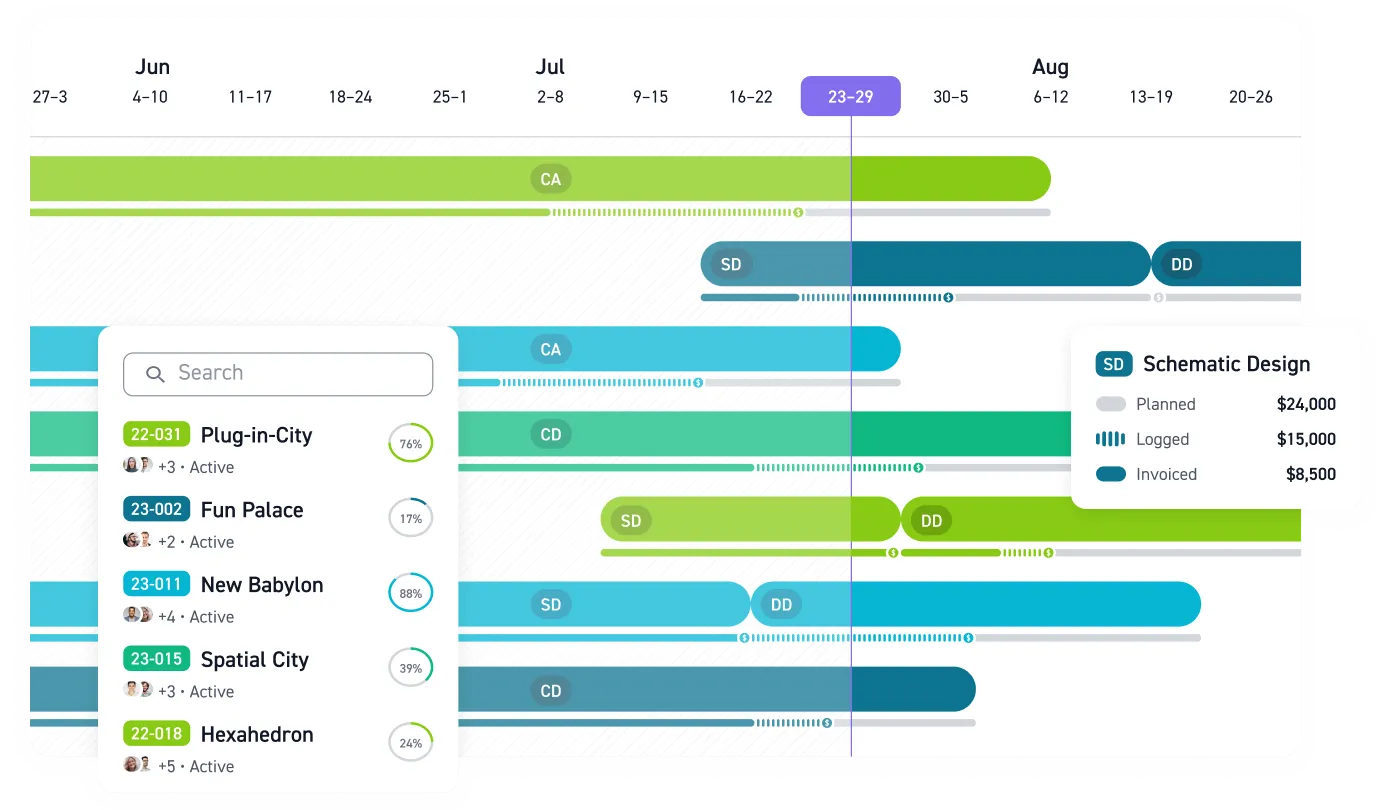
Monograph connects pipeline, phase budgets, staffing, timesheets, and billing in one data model built around the phase. MoneyGantt™ is its signature view, drawing budget against schedule on a single phase timeline, so a phase that has used 80% of its budget at 50% complete shows as a signal rather than a reconciliation exercise.
Monograph is trusted by 16,000+ architects and engineers across 2,000+ firms, serves firms of 5 to 100 people, and holds a 4.5/5 rating on G2 and a 4.5/5 rating on Capterra. Garrison Architects reports a billing cycle twice as fast with Monograph. Book a demo.
Frequently Asked Questions
How much does firm management software cost for a small or mid-sized architecture firm?
A 15-person studio pays $4,860 over three years for Harvest Teams or $10,800 for BigTime Essentials, plus QuickBooks Online Plus on top of either. Neither figure includes phase budgeting. BigTime prices that on Premier with no public rate, BQE Core and Deltek Ajera are quote-only. An architecture firm’s number is the budgeting tier times its seats, because the fee splits by phase and the system has to hold that split.
How much does firm management software cost for a small or mid-sized engineering firm?
The same per-seat ranges apply, and vendors charge more for higher-tier features. Profitability reporting on Harvest means the $14 Enterprise seat instead of $9. PSMJ’s prime engineering category reports 49% lump sum, fixed fee, or unit price, 32% time and materials or cost-plus with a not-to-exceed ceiling, and 18% without a ceiling. Price support for those billing methods across your projects rather than assuming an entry tier covers them. Utilization reporting is the capability to price first, since Deltek Clarity’s median sits at 58.9%.
How much does firm management software cost for a small or mid-sized architecture or engineering firm?
Per-seat tools start under $2,000 a year at 15 seats. Module-based and quote-only systems have no published floor, and services such as BQE’s $4,000 combined budgeting and forecasting consulting package or BigTime’s opt-in migration add on top. QuickBooks Online stays in the budget at $38 to $340 a month unless the new system replaces your accounting. Build the estimate from the model, the seat count, the budgeting tier, and the services line, and you’ll walk into the demo knowing which number to ask for.