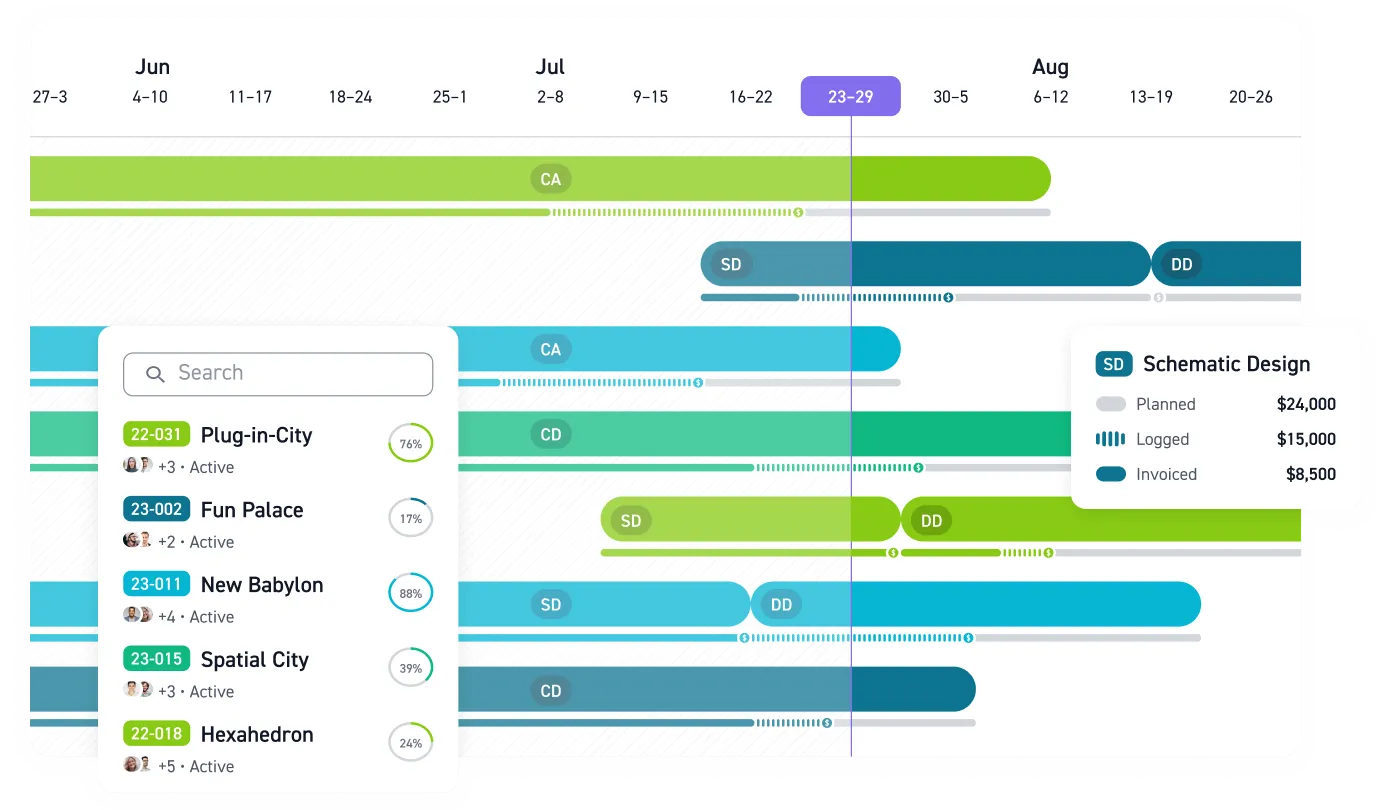


Smartsheet can hold your project list, but it can't tell you whether design development is burning through its fee. It lacks native time tracking and billing, and treats phases, rates, and consultant pass-throughs as things you build with formulas. For A&E project managers, that means rebuilding the financial layer every billing cycle. The strongest Smartsheet alternatives put phase budgeting, multi-rate billing, and accounting integration inside the product.
Where Smartsheet Breaks Down for A&E Work
Independent A&E software comparisons catalog what Smartsheet leaves for firms to construct:
- No billing engine and no automated invoice assembly, so invoices get rebuilt outside the system
- Retainers must be tracked manually, and not-to-exceed limits require custom formulas
- No native QuickBooks connection; the QBO connector in Smartsheet's marketplace is a third-party product built by SoftwareX
- Deep resource forecasting often requires a paid add-on beyond the cheaper plans
Building reports, spreadsheets, and separate QuickBooks import steps is the job a purpose-built platform does natively.
What a Real Alternative Has to Handle
A&E work is structured around phases, and your software should be too. Basic A&E services split into five sequential design phases, each with its own fee: 15% schematic design, 20% design development, 40% construction documents, 5% procurement, and 20% construction. Beyond phase-level budgeting and invoicing, four capabilities separate real contenders from task trackers:
- Percent spent vs. percent complete. These diverge on fixed-fee work, and when they do, the firm keeps working after the fee is effectively consumed.
- Multi-rate billing. A&E firms track different billing rates, and those rates must carry through to invoices automatically.
- Time-to-invoice flow. Approved hours should become draft invoices without export steps.
- Utilization visibility. Billable versus bench time, by person, without a spreadsheet compile.
On utilization, Monograph's 2026 Architecture & Engineering Business Benchmarks Report puts the sweet spot at 75-90%, while firms below 60% carry significant unfilled capacity. Any platform you evaluate should show where each person falls in that range without manual assembly.
Monograph: Phase-Based Financials Built for A&E Firms
Monograph is built exclusively for architecture and engineering firms, serving 13,000+ architects and engineers across 1,800+ firms. Every time entry flows into profitability calculations, billing, staffing, and reports, with support for fixed-fee, hourly, and hybrid structures at the phase level. Approved time moves directly into draft invoices through QuickBooks Online sync, so Monograph handles project accounting while QBO keeps the general ledger. No double entry. No importer tools.
Monograph's MoneyGantt™ has no equivalent in Smartsheet. Unlike a traditional Gantt chart, Monograph's MoneyGantt™ overlays real-time budget status directly on the project schedule, pulling live timesheet data to display scope, schedule, and cash in a single visual. A project manager can see whether a phase is burning hours too fast or drifting past its fee before the invoice goes out.
Plans start at $25 per user per month. Workbench, a 30-person California firm, replaced BQE Core, Excel, and Smartsheet with Monograph. The firm's reported outcomes include 8x faster staffing, 4x faster billing, and 75% fewer unbilled fees.
Other A&E Alternatives Worth Evaluating
The right fit tracks to headcount and where your general ledger lives. BQE Core suits firms that want project accounting plus A/R and A/P in one accounting-first platform.
Deltek Ajera brings forecasting and reporting depth for firms ready to replace more of their accounting stack. It positions itself as a QuickBooks replacement rather than an integration partner, a larger migration if your books live in QBO today. Deltek Vantagepoint targets larger firms with heavy compliance needs; third-party cost comparisons place it in a different implementation category than lighter practice management tools. BigTime covers time tracking, phase-based budgeting, invoicing, and QuickBooks integration for professional services firms, priced from $20 per user monthly.
Generic tools sit below these for A&E work. Asana starts at $10.99 per user and Monday.com at $9 per seat, but practitioners describe them as strong on task delegation and weak on fee tracking and forecasting for architecture.
Making the Switch Without Losing the Team
Adoption decides whether a Smartsheet migration works. Firms that make the move successfully tend to follow the same playbook:
- Explain the why first. Clear communication about the reason for the switch, required skills, and rollout process reduces resistance, especially when senior managers lead the change.
- Set a firm go-live date and keep old spreadsheets in read-only mode so staff can reference history while the new system becomes the official record.
- Start small rather than migrating every workflow at once.
- Track adoption after launch: who logs in and how often.
The biggest behavioral shift is daily time logging. The payoff shows up in cash: benchmark data shows top firms collect payment in about 22 days, while low performers stretch to 42 days.
Stop Rebuilding Project Financials by Hand
If your team is rebuilding invoices, fee burn, and utilization in spreadsheets, replace the financial layer first. Compare your current Smartsheet workflow against the basics A&E firms need: phase budgeting, approved time that turns into invoices, utilization visibility, and a clean QuickBooks Online connection.
Monograph connects project phases, live timesheets, staffing plans, invoices, and QuickBooks Online in one system built for architecture and engineering firms. Monograph's MoneyGantt™ gives principals, operations leaders, and project managers a real-time view of scope, schedule, and fee burn so they can catch problems early.
Get the financial layer Smartsheet leaves you to build yourself. Book a demo.
Frequently Asked Questions
Is Smartsheet enough for a small A&E firm?
It can work as a task tracker when project finances are simple. Problems appear when fixed-fee phases, multiple billing rates, consultant costs, and monthly invoicing all need to connect. If your project manager rebuilds fee burn or invoice data in Excel every billing cycle, Smartsheet is not carrying the full job.
When should an A&E firm move from Smartsheet to practice management software?
Move when spreadsheet work starts hiding project risk. Common signs include late invoices, unclear percent spent by phase, manual retainer tracking, inconsistent time logging, and profitability updates that take hours to assemble. A better system should make those answers visible before the fee is gone.
Do we need to replace QuickBooks Online to leave Smartsheet?
No. Many A&E firms keep QuickBooks Online as the general ledger and use practice management software for project accounting, time tracking, staffing, and invoicing. That setup works when approved time and invoices move into QBO without duplicate entry.
How should we compare Monograph, BQE Core, Ajera, and BigTime?
Start with firm size, accounting setup, and tolerance for change. If you want to keep QuickBooks Online and need phase-level visibility, compare Monograph and BigTime. If you want an accounting-first system or a QuickBooks replacement, compare BQE Core and Ajera.
How do we keep the team from falling back into Smartsheet?
Set one official system of record, keep old sheets read-only, and start with the workflows that hurt most: time tracking, project budgets, staffing, and invoicing. Adoption improves when staff see that cleaner time and phase data prevents budget surprises, not just another report.
Data was collected as of April 2026.