


Firm management made easy

Principals who squeeze billing in between design reviews treat invoicing as the last chore of the month: export the hours, attach them to a PDF, send. That works for a pure hourly contract. It fails on the contract most architecture firms hold: a B101 stipulated sum billed by percent complete per phase. Hourly Additional Services and consultant fees go on top of that. Getting the invoice right starts with an accurate timesheet, kept daily for weeks before anyone opens the invoice builder.
What an Architecture Progress Invoice Contains
A B101 progress invoice bills fixed-fee phases, Additional Services, consultant fees, and reimbursables. B101-2017 splits Basic Services into five phases: Schematic Design (SD), Design Development (DD), Construction Documents (CD), Procurement, and Construction. Under § 11.5 the owner and architect give each phase a share of the fee, totaling 100%. The American Institute of Architects (AIA) publishes no fee guidelines for architect compensation, so the split is a negotiation.
You calculate each line type on the owner-facing invoice differently:
- Fixed-fee phases. Earned to date is the phase fee times cumulative percent complete, and the amount due is earned to date minus prior billings. For percentage of completion billing, you roll task progress up into a single percentage per phase.
- Additional Services. These come up after the agreement is signed. For the services listed in § 4.2.1, the architect may not proceed without the owner's written authorization.
- Consultant fees. Under § 11.4, consultant work outside the base fee bills at the amount the consultant invoiced the architect plus a percentage.
- Reimbursables. Under § 11.8.2, reimbursables bill at cost plus a markup percentage the parties fill in.
To see the fixed-fee math in dollars, take a hypothetical $500,000 fee split 15/20/40/5/20 across SD, DD, CD, Procurement, and Construction. On invoice two, DD at 80% complete has earned $80,000. Less the $30,000 billed on invoice one, $50,000 is due. CD at 25% bills $50,000, and SD, already billed at 100%, shows $0. The AIA billing guide covers the same earned-minus-prior math on the G702 pay applications contractors submit.
DD's 80% should come from the project manager (PM) reviewing deliverables. In the AIA's earned-value example, a construction documents assignment has burned 40% of its hours and 60% of its schedule. A sheet-by-sheet review by the PM and project architect puts it at about 26% complete. Firms that set percent complete from hours, or from Monograph's % Logged figure, put any mis-coded hour straight onto the invoice.
Where Money Leaks Between Time Tracking and Invoicing
Money leaks at four handoffs between the timesheet and the invoice, and three of them start at the timesheet.
- Hours never logged. Unlogged time can't appear on an hourly line and vanishes from phase cost. Require daily timesheet entry, because nobody can reconstruct last Friday in precise increments.
- Hours logged to the wrong phase. By the phase-spend test, a phase at 50% spend should be about 50% complete. A mis-coded hour works like a wrong sheet index: every downstream reference points to the wrong page. The test comes out wrong for both phases. Your next fee proposal gets priced on that bad history too.
- Additional Services logged to the base fee. When staff code extra work to a base-fee phase, the hours never reach an Additional Services line, and the firm gives that work away. Time parked on hold for approval gets harder to collect with every week the approval slips.
- Consultant bills paid and never rebilled. A monthly reconciliation of consultant costs by project catches a structural engineer's invoice paid from the firm's cash and never placed on the owner's invoice.
Leaked work shows up on the books as a write-off or as scope creep. Monograph's 2026 Architecture & Engineering Business Benchmarks Report found baseline firms average 96% realization, losing 4 cents on every dollar of billable time. Low performers realize 83% and top firms 107%, a 24-point spread worth $24K on $100K of billable time. Realization above 100% comes from fixed-fee projects finished in fewer hours than budgeted.
The Timesheet Has to Be Done on Invoice Day
Billing on a fixed date only works if the timesheet is complete and correctly coded by that date. Pick the date anyway: bill at least monthly, and twice a month if you can. If you've spent the first days of a month chasing missing hours, you know how often the timesheet isn't ready.
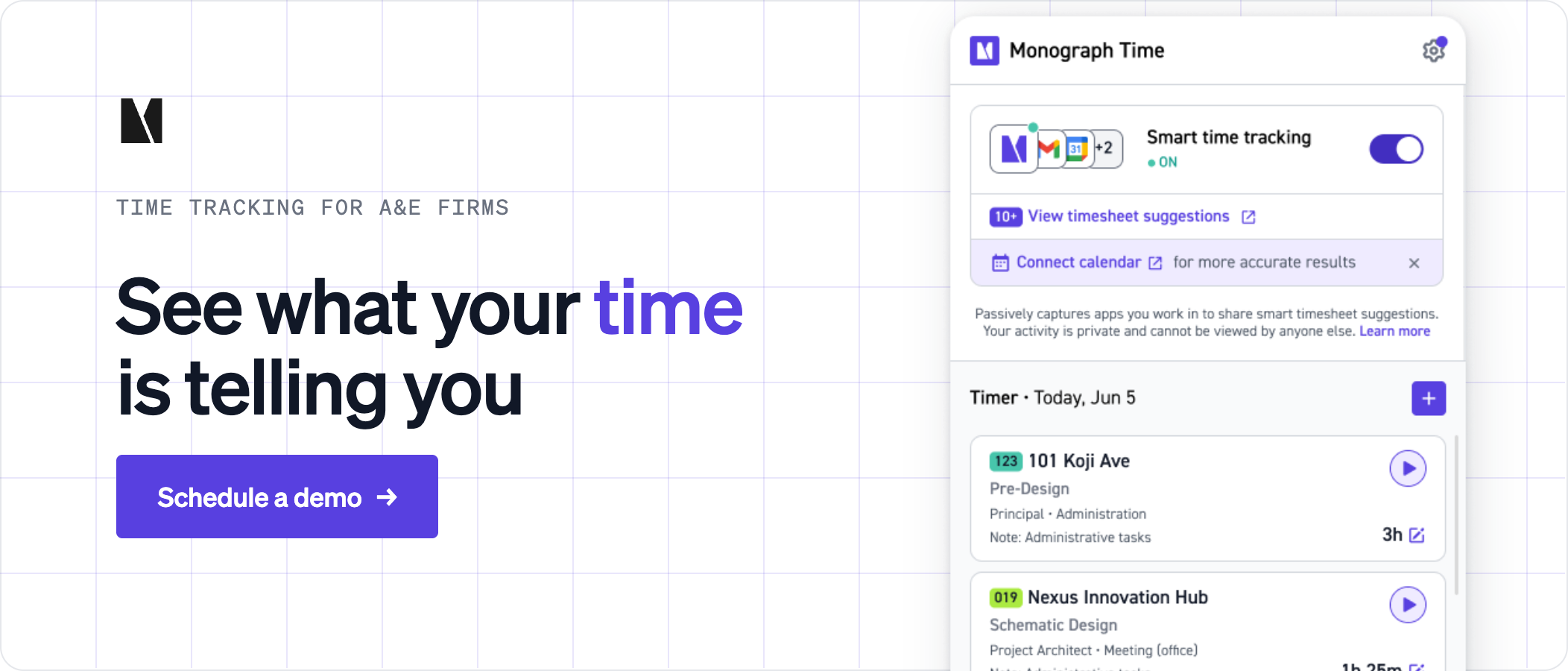
Monograph's Smart Time Suggestions, part of its time tracking tools, draft entries from a connected Google or Microsoft 365 calendar. Each suggestion arrives pre-filled with whatever the event supports: project, phase, activity, suggested hours, and a note on why Monograph created it. Nothing posts until the person accepts it. Where Monograph can't identify the phase with confidence, the person picks it before accepting the entry.
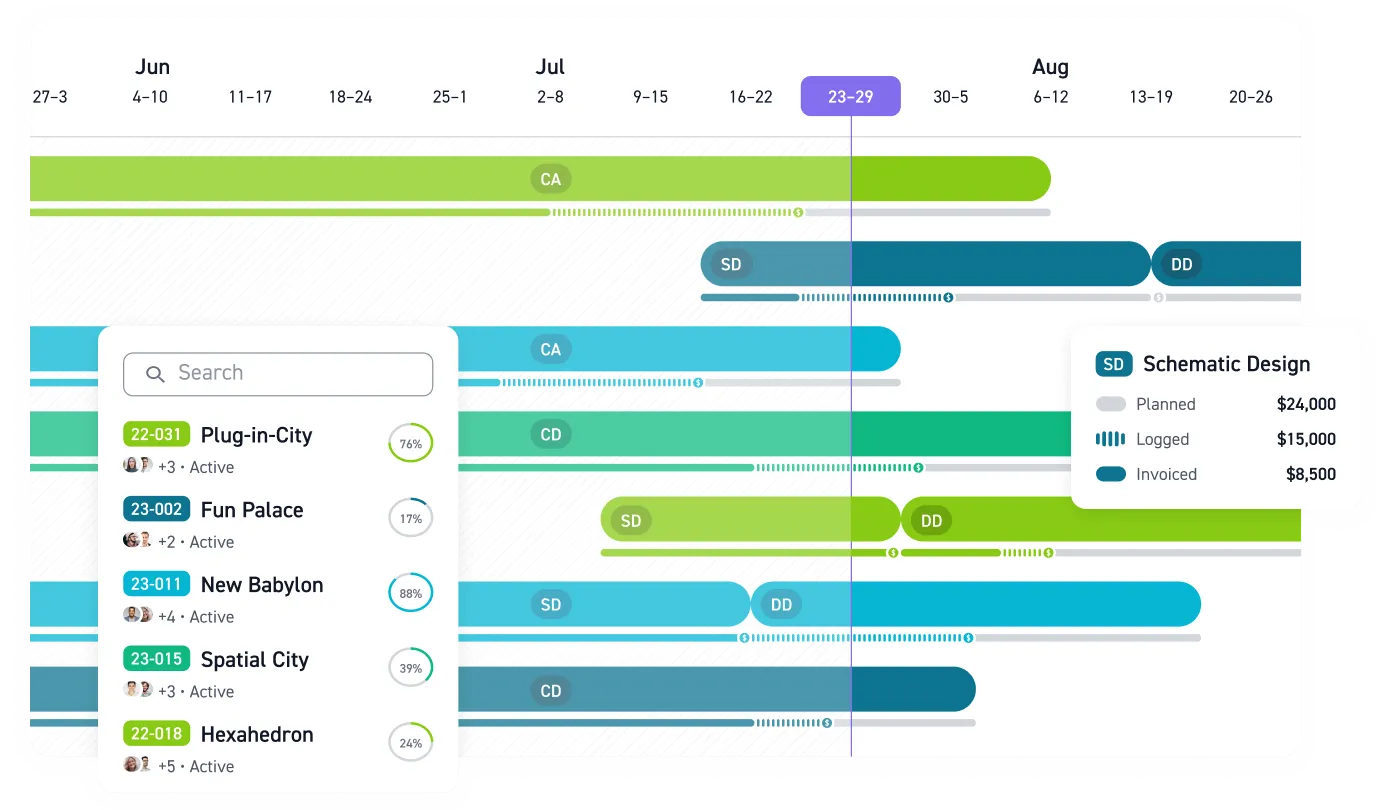
The desktop app adds a second signal when Smart Tracking is on: the apps and window titles a person works in. Because the phase is set at entry, accepted hours flow straight into phase burn and into draft invoices with phase breakdowns. Monograph's MoneyGantt™ shows a project's budget-to-cash progression, from planned to logged to invoiced to paid.
When a PM assigns staff to phases in Staffing, those phases appear on the assigned person's weekly timesheet with the staffed hours shown as a guide. Before billing, PMs can filter the time log by phase, person, or project category to check entries across projects and overhead. The dashboard's Team Work Insights section flags phases already over budget and phases trending over once staffed hours are counted.
From Approved Hours to a Sent Invoice
With the timesheet locked, a PM can batch-create drafts for several projects at once from the Unbilled report. Billable hours come into the invoice builder from the time log with no re-entry. Drafts start the day after the last invoice's Services Through date, and Monograph warns you before a date range overlaps an existing draft.
Hourly phases with no logged hours and no prior billing stay off the draft. Hours a PM decides not to charge can be written off before the draft runs. You'll see write-offs on the Unbilled report, in Project Financials, and in the invoice builder.
One draft can mix fixed-fee phases billed by percentage, hourly services, consultant fees with markup, and reimbursables. Consultant lines come in from budgeted consultants and uploaded bills, and the middle column is labeled Planned + Markup. In the invoice template's Consultant Display setting, you choose how the owner sees them:
- Grouped in a separate Consultant Services section
- Itemized under the phase each consultant works on
- Hidden in the fixed phase fees, an option for phase consultants only
Pick the display the owner expects and keep it from one invoice to the next. Consultants make up 17% of architecture firm costs across the 423 QuickBooks-connected firms in the 2026 Benchmarks Report. At engineering firms, the share is 5%.
Clients can pay from a Pay Now button on the invoice when your firm uses Monograph Payments. Automated payment reminders go out on the schedule you set before, on, or after the due date. Invoices sync to QuickBooks Online (QBO), and on QBO Plus or Advanced a payment recorded in either system marks the invoice paid in both.
Make Invoice Day Predictable
Treat the day before invoice day as the deadline. Lock timesheets that afternoon, and give PMs the next morning to fix wrong-phase entries and confirm percent complete against the drawings. Your operations lead reconciles consultant bills and Additional Services approvals the same morning, before anyone creates a draft.
Monograph connects phase-coded time and consultant costs to mixed fixed-fee and hourly invoices in one A&E workflow. The team gets a repeatable billing routine without replacing the PM's judgment about deliverables and percent complete.
If your team still rebuilds invoices from timesheets, spreadsheets, and consultant emails, try the routine on one project first. Put this routine in place before your next billing cycle. Book a demo.
Frequently Asked Questions
Should fixed-fee percent complete match the percentage of hours spent?
No. Bill the percent complete the deliverables support, and treat a gap with hours spent as a budget warning. If DD is 70% spent and only 50% complete, the phase is on course to overrun its fee. Raise it with the principal while there's time to rescope or restaff the remaining DD work.
What should we do when staff log time to the wrong project phase?
Fix it before the drafts run. Use bulk edit to move a batch of entries to another project or phase at once. Recode before you add write-offs, because editing a phase's time entries reverts any write-offs already on that phase.
Can we bill Additional Services before receiving written authorization?
Not for the services listed in B101 § 4.2.1. That section requires the architect to notify the owner promptly and explain why the extra work is needed, then wait for written authorization. While approval is pending, set the proposed service up as its own phase so the first authorized hour gets coded to the right line.
How do we keep consultant fees from falling through the cracks?
Start with intake. Monograph can email collaborating consultants a monthly reminder to upload their invoices. Set it a few days ahead of your billing date so each bill is filed in time for the draft. Then watch any consultant line where the bill exceeds the budget. Batch-created drafts cap the amount due at the planned budget, and the excess stays off the invoice until someone decides how to bill it.
Data was collected as of April 2026.