

Between finishing the work and getting cash back, an A&E firm's invoice stalls predictably every month. The median A&E firm carries 19 days of gross revenue in unbilled work in process before an invoice ever goes out. During that gap, payroll runs and rent comes due while the firm finances its clients' projects for free. Client payment terms are hard to change. The internal approval cycle is entirely yours.
The Five Stages of an A&E Invoice Approval Workflow
The strongest fix is a fixed monthly billing calendar with hard-stop dates and a named owner for each stage. A documented day-by-day billing calendar for A&E firms runs like this:
- Day 25: hard cutoff for time and expense entry, coded to project and phase (SD, DD, CD, CA), with reimbursables tracked under a defined markup policy.
- Days 26–27: project managers review entries, tag billability, flag scope creep, and compare hours-to-date against each phase budget.
- Days 28–29: finance pulls PM-approved data into draft invoices, applying the rate library and reimbursable markup policy. Any questions bounce back to PMs the same day.
- Day 30: the principal signs off on invoice batches above an agreed dollar threshold. Write-off approval happens before the final invoice is produced.
- Days 1–2 of the next cycle: invoices go out to clients.
Hold those dates every month and you create a cash cadence clients and staff can plan around. Map the client's approval chain before the first invoice goes out: approver, best receipt date, and format requirements. Give subconsultant invoices the same scrutiny as your own before they enter a draft, since payment flows through your firm and so does the liability.
Where Manual Approvals Stall
Manual approval processes break in a handful of documented places, mostly upstream to time data. The most common failure points:
- Late and incomplete time entry. Only 60% of small firms track billable hours precisely, and accounting generally cannot draft an invoice for hours it cannot see.
- Untrained reviewers. Firm leadership and project managers each carry 27% of collections responsibility, yet only 58% of firms train staff on invoicing procedures.
- Single-approver dependence. When the principal is the only sign-off and travels, an entire invoice batch waits.
- Disconnected systems. Time lives in one tool, budgets in a spreadsheet, invoices in QuickBooks. Every handoff means re-entry, errors, and delay.
None of these requires new headcount to fix. One civil engineering firm's controller cut the billing cycle by 14 days through better project management and billing practices alone. Time-entry enforcement, daily or at minimum weekly, is the strongest control a finance manager holds because every downstream stage waits on it.
What Slow Approvals Cost
Slow approvals show up as extra days the firm finances client work before cash comes back. Top-performing Circle of Excellence A&E firms collect in about 52 days against roughly 62 days for the field, a 10-day gap. That gap maps almost exactly to what calendar discipline and a tighter PM-to-finance handoff can win back.
Faster collection also protects the fee the firm keeps. Invoice review is where write-off risk gets caught before billing. Entries that go out unchecked can become write-offs that pull the recovered fee down. Catching a bad line during PM or finance review costs nothing; catching it after the client disputes the invoice costs the fee.
Design Rules That Keep Invoices Moving
Once the calendar exists, four design rules keep it from sliding:
- Fast turnaround per stage. Set a clear review deadline for each step so a draft never sits in an inbox.
- Dollar-based thresholds. Principals review only batches above an agreed amount. PM billing rates run $136 to $360 per hour; lower-cost accounting support can own routine review while PMs handle judgment calls.
- WIP review inside billing prep. Confirm percent complete by phase, identify unbilled WIP, then either generate the invoice or document why billing is deferred. That record protects you if deferred WIP becomes a write-off conversation later.
- Higher billing frequency. Bill monthly at minimum, and twice a month where contracts allow.
Billing method changes what reviewers check. On fixed-fee work billed by percent complete, check physical progress against the work breakdown structure before invoicing the phase percentage. Hours spent are not the measure. On time-and-materials, verify that labor hours and rates fit the period's work and accepted classification rates. On not-to-exceed contracts, confirm the percentage of the cap invoiced to date tracks the percentage of tasks and deliverables completed. Costs beyond the cap fall on the firm.
Back the rules with a short Monday cash review covering aging invoices, stale unbilled WIP, scope overruns, and any approval sitting with one person.
Where Software Carries the Load
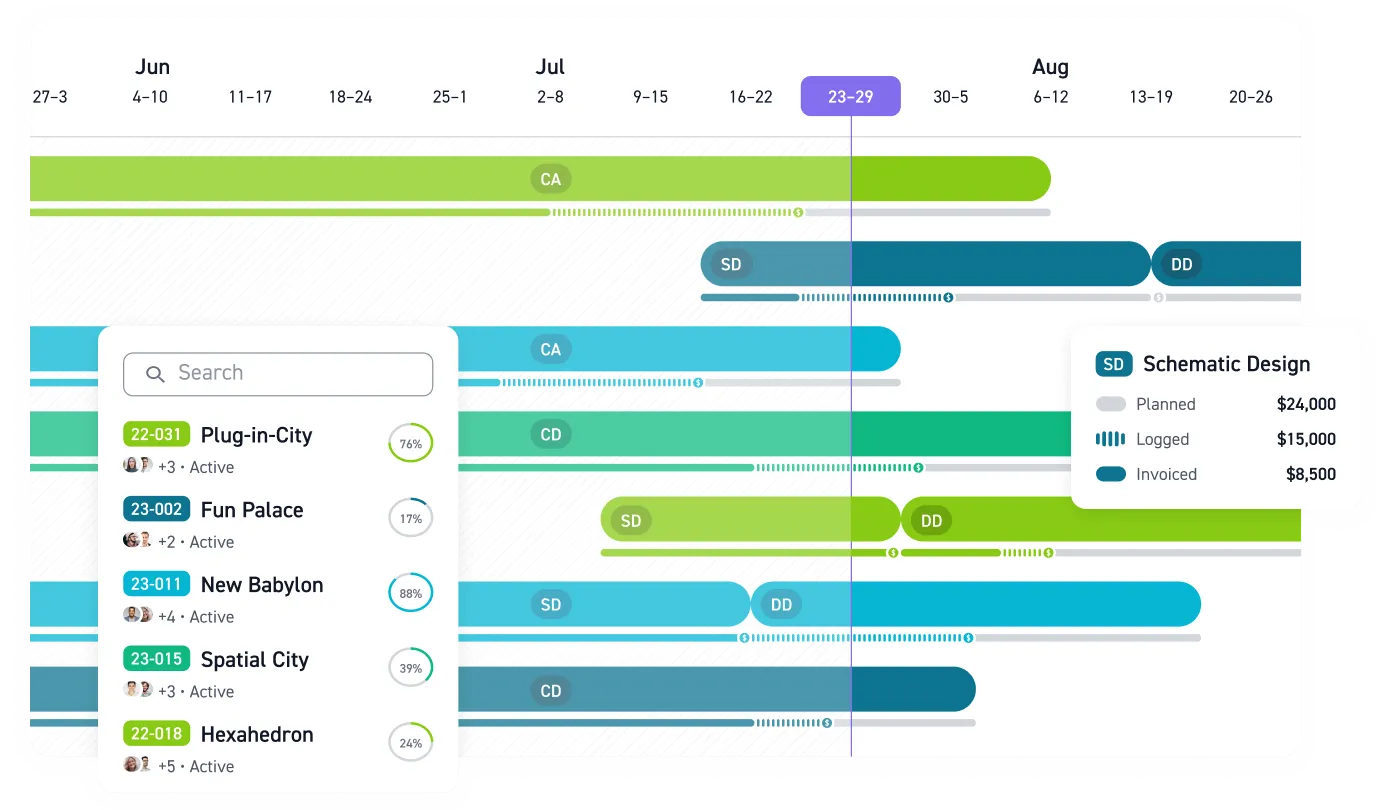
Purpose-built software removes manual re-entry. Monograph generates draft invoices from approved timesheets, pulls in phase percentages and consultant costs, and syncs completed invoices to QuickBooks Online. Project managers review drafts inside the project workspace instead of reconstructing context from email chains. Monograph's MoneyGantt™ view shows phase fee against actual spend, so reviewers spot unbilled WIP and overruns before invoices go out.
Garrison Architects, for example, bills 1.5x faster and gets paid 2.5x faster after moving to Monograph. Monograph works with 13,000+ architects and engineers across 1,800+ firms. For a finance manager, that speed compounds every month: each day trimmed from the internal cycle is working capital sitting in the firm's account instead of the client's.
The workflow itself costs nothing to design. Pick the hard-stop dates, name an owner for each stage, set the principal's dollar threshold, and run the first full cycle next month.
Get Invoices Out Before Cash Gets Tight
A better billing calendar works only when time, expenses, budgets, and approvals stay connected.
Monograph turns approved timesheets, consultant costs, phase budgets, and draft invoices into one billing workflow built for A&E firms. Project managers review invoices with project context in front of them, finance reduces re-entry, and principals focus approval time where it matters.
Cash does not wait for a cleaner month-end. Take control of the approval cycle now. Book a demo with Monograph.
Frequently Asked Questions
Who should own the invoice approval workflow in an A&E firm?
Finance should usually own the billing calendar and final invoice production, while project managers own project-level review. Finance controls dates, formats, and billing status; PMs confirm scope, phase progress, billability, and client context.
How do we get project managers to approve invoices on time?
Give them a fixed review window and the project context they need: hours, expenses, phase budgets, percent complete, and billing questions in one place. If they have to rebuild the story from email, spreadsheets, and QuickBooks, approvals will keep slipping.
Should principals approve every invoice?
No. Principal review should be reserved for invoice batches above a set dollar threshold, unusual write-offs, sensitive clients, or contracts with special risk. Routine invoices should move through finance and PM review.
How often should A&E firms invoice clients?
Monthly should be the minimum for most firms. Twice a month can work when contracts allow it and project activity supports it. The goal is to keep WIP from aging quietly while payroll, overhead, and consultant costs keep moving.