



Firm management made easy

What a three-site Tuesday loses by Wednesday morning
An engineer who covers three sites on Tuesday and logs it Wednesday morning is rebuilding the day from memory. The 40-minute conversation with the contractor about a footing that doesn't match the drawings becomes "site visit, 2 hrs." The punch-list walk that ran long gets rounded down. The drive between Harbor Rd and the treatment plant disappears entirely.
Workers reconstructing a week from memory overestimate their hours by 5–10% against one-day time diaries. Firms are also collecting timesheets less often. Zweig Group's 2025 policies survey puts weekly collection down from 82% to 73% while bi-weekly collection nearly doubled.
Construction administration is where this hurts most. Most contracts are lump sum overall, but CA most often reverts to hourly or not-to-exceed billing because field conditions can't be priced in advance. Hourly billing pays out exactly what gets logged, and only if it lands in the right phase.
The two most common causes of unbilled extra work are time held too long waiting for approval and time logged against the base contract instead of the change order. Both mistakes happen at entry, which means both happen in the truck or not at all. Monograph's 2026 Architecture & Engineering Business Benchmarks Report puts a 29% realization gap between low performers at 83% and top firms at 107%, a $24K spread on a $100K project.
Logging from the truck before you leave
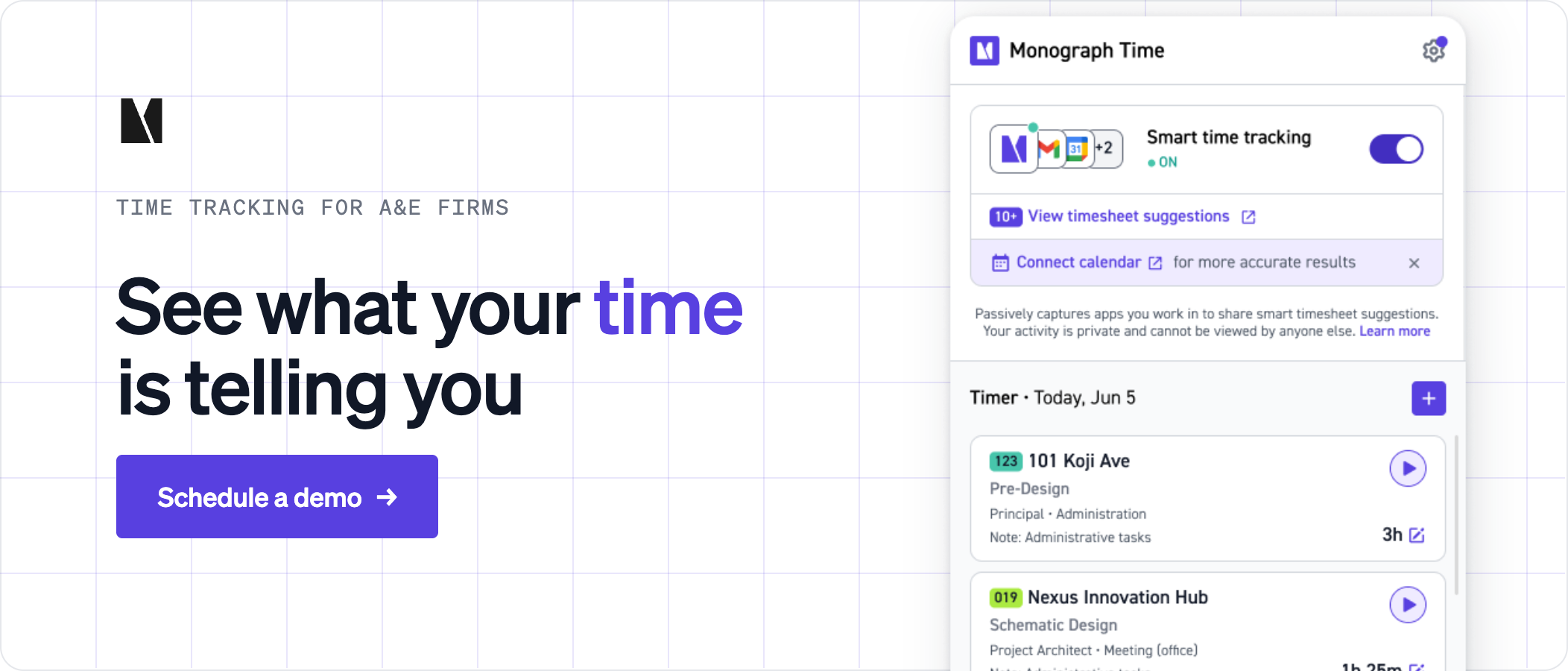
Monograph's mobile time tracking app accepts time entries in plain language. Type or dictate "2 hrs Harbor Rd site visit" and Monograph turns the phrase into a logged entry. For a useful field record, include these details when they apply:
- Duration
- Project
- Phase
- Activity
- Notes
- Approximate time worked (when possible)
Keep each phrase focused on one project and activity so the resulting timesheet entry reflects the work clearly.
Examples of field time entries
Dictation matters on a jobsite because thumbs on a phone keyboard are slow. Speech input runs about 161 words per minute against 53 for phone typing, with fewer entry errors. Voice dictation on iOS lets you speak the entry instead of typing it.
Wording can be free-form or command-style. Short entries keep the project, duration, and activity clear:
- "1 hour Midtown Office structural drawing review."
- "Log 45 minutes to Project Atlas for client coordination."
- "2 hrs Harbor Rd site visit."
- "Two hours at the Elm Street site this morning for a substantial completion walk."
- "Log 30 minutes to Riverside Pump Station for RFI 14 response."
- "45 minutes Harbor Rd travel."
For a full day, log each project, phase, activity, and travel period as a separate natural-language entry while the details are fresh.
What to log on site: a CA-phase checklist
Field time falls into a handful of buckets, and AIA B101-2017 pays for each one differently. Engineering agreement scopes assign engineers periodic site visits, submittal review, and RFI responses, so the same categories apply. Log a visit to the wrong bucket and an Additional Service hides inside the base fee, or reimbursable travel sits in overhead.
Each entry from the field should name one of these:
- Site observation visits. Basic services under §3.6.2.1, but §4.2.3 requires the parties to insert an agreed-upon number of visits, beyond which services are treated as Additional Services; one executed contract capped them at 30. Log every visit so you know when you cross into Additional Services.
- Substantial and final completion inspections. These inspections can also be capped under the same clause. The punch-list walk is a separate entry from a progress visit.
- Submittal and shop drawing review done in the field. That clause also caps reviews per item, so log them by item where you can. RFI responses fall under whatever your negotiated scope says.
- Contractor and owner conversations. The 40-minute footing discussion is CA time. Note who, what, and the decision reached; it doubles as your field report record.
- Travel time. B101 §11.8.1 treats transportation as a reimbursable, and firms apply their own billing policies to drive time. Log it to the destination project so the drive shows up on that project's invoice.
- Anything beyond the contracted limits. Log it to the Additional Services or change-order code the same day.
Same-day entry also protects you in a dispute. A field report describing a site conversation written days later can be excluded from evidence, and the AIA Trust's contract administration guide calls for a site observation report with every visit. The time entry and the field note are complementary records; create them together.
Why a GPS crew clock-in app answers the wrong question
Construction crew apps capture where a worker is. Geofencing confirms a clock-in happened within range of the jobsite, GPS route tracking shows the path between sites, and a foreman assigns cost codes to the verified hours. The design goal is preventing time theft on hourly crews. None of that tells you which phase a PE's afternoon belongs to or whether it's billable.
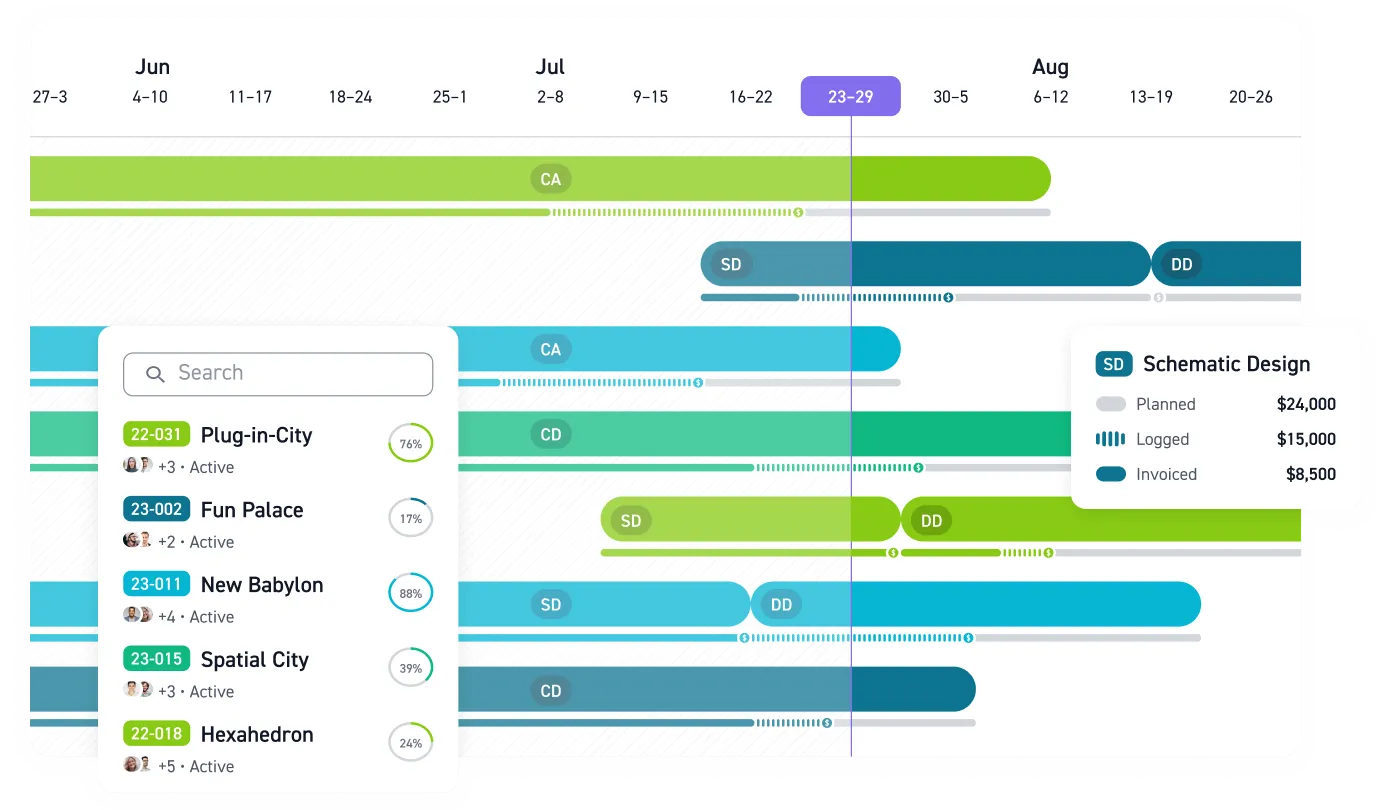
An A&E timesheet captures what a professional worked on. Monograph's mobile workflow turns natural-language input into a logged time entry, while its broader time log can be filtered or grouped by project, phase, people, and categories. Those records connect with invoicing and phase budgets. That is the information a PM needs on Friday to see whether the CA phase still has fee left before approving next week's visits.
Surveillance also carries a measured cost with salaried staff. Electronic monitoring lowered job satisfaction and raised stress across 70 samples in a 2022 meta-analysis, with no relationship to performance, and monitoring may reduce productivity among workers who don't feel trusted. California requires explicit consent for tracking even in company vehicles, and Washington's 2025 HB 1672 bars requiring tracking apps on personal devices.
What the entry feeds after you leave the parking lot
A natural-language time entry logged from the truck connects the field record to the rest of the practice-management workflow, so nobody has to chase it on Friday. It shows up against the CA phase budget the same day, so a PM can flag the eighth extra site visit as Additional Services instead of discovering it at invoicing. Without logged field time, there is nothing to connect to billing or phase tracking, so the work remains invisible to the client and to your fee.
That connection between time capture and billing has measurable consequences. Workbench cut unbilled fees by 75% and now bills four times faster after connecting field entries to invoicing.
Monograph's AI tools also support project setup, proposal building, budget recommendations, and staffing allocation. These workflows connect project information with the time, budget, and staffing data firms already manage.
Monograph's time tracking page shows how each entry connects to budgets, staffing, and invoicing. Log the drive before you pull out of the lot, and the CA phase budget updates before you reach the next site.
Capture Field Time Before It Disappears
Waiting until Friday leaves PMs approving incomplete time, operations leaders chasing corrections, and principals reviewing CA budgets after the fee has already moved. The practical fix starts with a consistent field-entry habit.
PMs can standardize categories for visits, inspections, travel, conversations, and Additional Services. Operations leaders can connect those mobile entries to billing, while principals review their effect on CA-phase budgets before approving more fieldwork.
Field time disappears fast. Capture it while the work is fresh and see how Monograph connects each entry to phases, budgets, and invoices. Book a demo.
Frequently Asked Questions
Should engineers bill travel time between sites?
Check the contract and your firm's billing policy. Log the travel to the destination project even when its final billing treatment still needs review.
Does mobile time entry require GPS tracking?
Monograph's documented mobile time-entry workflow is based on natural-language input. The entry records what matters for an A&E timesheet, including the project, phase, activity, and hours, rather than using location as proof of the work performed.
How should I split one day across multiple projects and phases?
Log each project's duration, phase, activity, and travel time as a separate natural-language entry. Keeping each phrase focused on one project and activity makes the resulting timesheet record clear.
What should a natural-language time entry include?
Include the duration, project, phase, activity, and any notes needed to explain the work. A short phrase such as "2 hrs Harbor Rd site visit" can become a logged entry without reconstructing the details later.
Can a time entry replace a formal site observation report?
No. The AIA Trust's contract administration guidance calls for a site observation report with every visit. Create the time entry and field note together so the hours, conversation, decision, and formal project record stay aligned.
Data was collected as of April 2026.