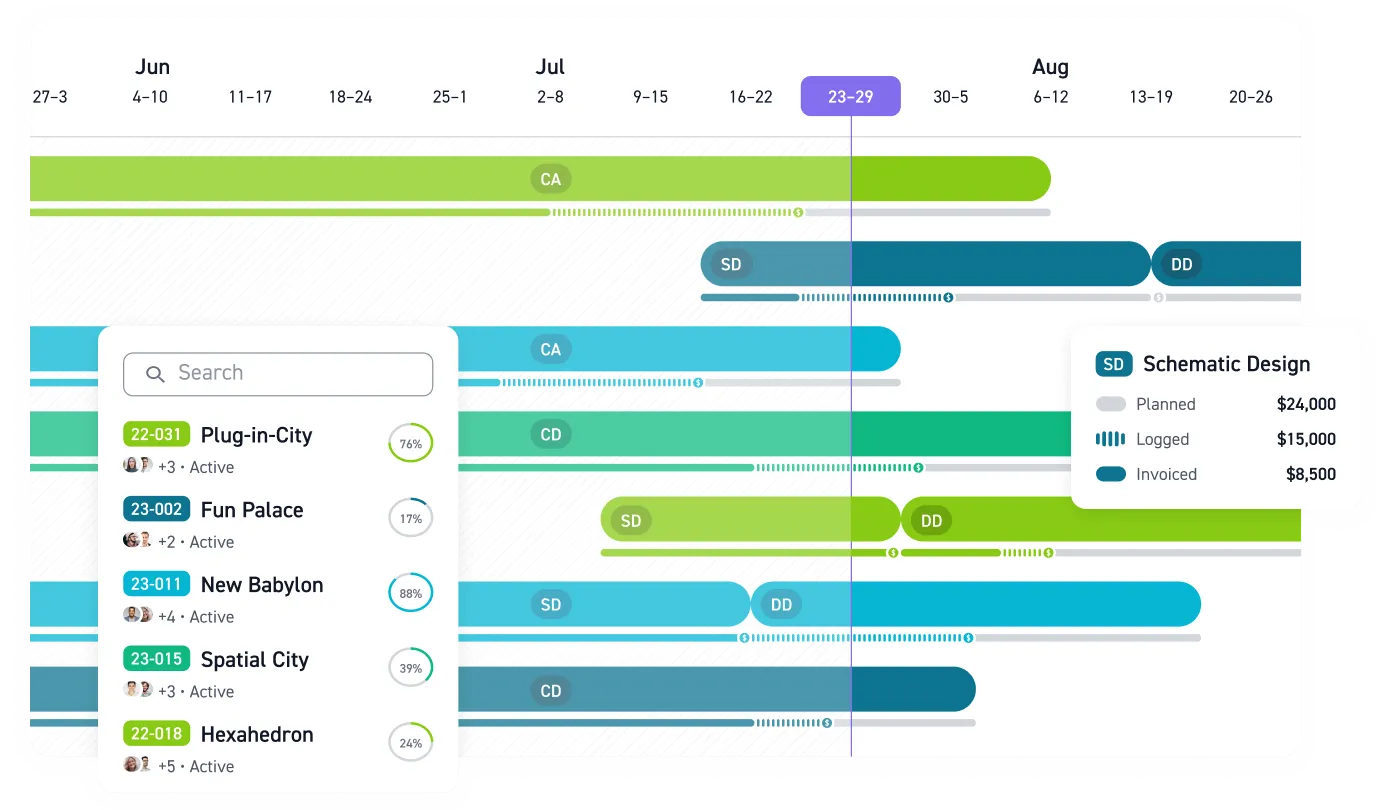




Completed work is not cash. Between a logged timesheet and a bank deposit, an earned fee clears a series of handoffs, and it can stall at every one. The median A&E firm is sitting on 19 days of gross revenue in finished work that has not yet been invoiced. Payroll still clears on schedule.
The Handoffs Between a Timesheet and a Bank Deposit
Labor is the largest expense for most A&E firms, and salaries leave the account long before a client approves anything. Each handoff has its own failure mode:
- From labor logged to fee earned. Under percentage-of-completion accounting, revenue books as work is performed. Late timesheets stall that process and become less reliable.
- From fee earned to unbilled WIP. Month-end billing batches, paused projects, and percent-complete estimates that do not match field reality park earned fees here.
- From WIP to invoice. Calendar-based billing and principal review bottlenecks add delays.
- From invoice to receivable. Client AP approval cycles, scope disputes, and retainage hold dollars here.
- From receivable to cash. Follow-up cadence decides how long the last leg takes.
Each handoff needs its own metric; DSO covers only the later links. WIP days plus AR days is total lockup. Unbilled fees sit outside DSO. Timestamp one recent project: when labor was logged, when the invoice went out, and when cash landed. Start with the longest gap.
Unbilled WIP: The Stall Most Firms Never Report On
Firms watch AR aging and ignore WIP aging, though unbilled fees are the same exposure one step earlier. In December 2025, 84% of firms reported projects on hold or indefinitely stalled over the prior six months.
Consider a billable team with late time entry. Several business days of delay can create a substantial backlog in unbilled WIP. A project can also stall waiting on permits while a principal holds the invoice. Months later, the client's memory has faded and collection becomes harder. Low performers realize 82% of billable value against 108% at high performers, where efficient fixed-fee work can bill above the hours logged.
Age unbilled fees like receivables and assign each bracket an owner:
- 0–30 days: healthy; review for billing eligibility.
- 31–60 days: escalate to a principal.
- 61–90 days: at risk; a client conversation is required.
- 90+ days: a paused or troubled project with high write-off risk.
Billing timeliness and WIP management carry 1.7 points of margin impact. A monthly WIP review, project by project, is where firms pull those days back.
What Accounts Receivable Aging Actually Tells You
Most controllers read the aging report as one number: total past due. Read column by column, it separates process failures from client payment behavior:
- 0–30 days (current): the standard cycle. Anything that slides out needs a reason.
- 31–60 days past due: often a firm-side signal. Billing errors, missing backup, and incorrect invoice formats land here. The same bracket filling across many clients is an invoicing problem.
- 61–90 days past due: the signal shifts client-side. Cash stress, disputes, or a multi-party payment chain may be responsible. Concentration in a few clients is a solvency question.
- 90+ days past due: deeper client trouble, an unresolved dispute, or unreleased retainage. Collection becomes harder as the balance ages.
Receivables three months past their due date collect at 68.9%, falling to 51.3% by six months. Many firms still wait too long to escalate.
Review aging by client monthly and check invoices approaching 30 days each week. Fix the 31–60 column first by supplying missing backup, correcting project numbers, or reissuing invoices. A 61–90 balance goes to the relationship owner, who returns with a payment date or a named dispute.
What the Faster-Collecting Firms Do Differently
AR collection across A&E firms averages 62 days, and the top-performing firms collect in 52. Nineteen unbilled days on top of a 62-day cycle means a firm may fund months of payroll before cash lands. The figures use different denominators, so treat that comparison as directional.
Fast-collecting firms set terms before the project starts:
- Payment schedule: timing and frequency of invoices.
- Question window: how long the client has to dispute an invoice, with unquestioned amounts still due.
- Interest on late payment: plus reimbursement of collection costs.
- Right to stop work: a stated consequence of nonpayment.
- Retainer: one sized to cover the first full billing cycle and credited against the final invoice.
Set billing triggers around milestone completion and run a fixed escalation ladder: reminder before the due date, automated notice at 15 days past due, finance call at 30, principal follow-up at 45, and formal collections at 60+ days.
Interest terms generally cannot be added mid-project without an agreed contract amendment. You can still ask the client's AP contact which invoice format and approval calendar they use. Engineering sub-consultants should align invoice dates with the prime's expected payment cycle.
Where Automation Removes the Stalls
Monograph automatically creates an invoice draft from project data on a configurable monthly schedule. Eligible expenses and consultant bills are included, safeguards prevent duplicate drafts, and the team is notified to review each draft before issuance. This reduces aging unbilled WIP without removing billing controls.
After moving from BQE Core to Monograph, Workbench reported a 4x faster billing process and 75% fewer unbilled fees.
Monograph Payments, powered by Stripe, adds a "Pay Now" link so clients can pay by ACH or credit card. Firms using it collect over twice as fast as firms using manual invoicing.
Calendar a monthly project-by-project WIP review and a weekly AR check. Then use accounts receivable automation so billing runs from project data rather than someone's memory at month-end.
Get Earned Revenue Out of Limbo
Earned revenue should not sit still. Project managers should confirm billing readiness, operations leaders should run WIP and AR reviews, and principals should handle escalated client conversations before balances become collection problems.
Monograph connects time, project data, invoice generation, payment processing, and follow-up in one A&E practice management workflow. Every owner gets a clear next step without losing the review points that protect client relationships.
See where your firm's cash is getting stuck. Book a demo with Monograph.
Frequently Asked Questions
What is the difference between WIP days and DSO?
WIP days measure earned fees not yet invoiced. DSO covers the invoice-to-cash stages, so review WIP days and AR days together to see total lockup.
Should we invoice work on a paused project?
Review the earned fee for billing eligibility. Follow the signed payment schedule and escalate WIP older than 31 days to a principal. By 61 days, start a direct client conversation.
Does faster billing mean principals lose review control?
No. Keep principal review, but give it a fixed deadline. Generate the draft from current project data and escalate only genuine scope or approval questions.
What should we do when a client disputes only part of an invoice?
Separate the named dispute from the unquestioned amount. Follow the signed question window and assign the disputed balance to the person who owns the client relationship.