

An engineering firm can have staff bill most of their available time and miss revenue targets. The cause usually sits in a metric most principals check less often: realization rate, which tracks how billable value moves into invoices and ultimately cash. Billing realization measures invoiced revenue, while collection realization measures how much of that revenue is collected. Work that fails either conversion still represents real salaries and delivered effort.
Realization Rate vs. Billable-Time Share
Billable-time share measures how much of your staff's available time goes to billable work. Realization measures what happens to that billable work after it is logged. A high billable-time share cannot protect revenue when firms absorb scope, write down fees, or fail to collect invoices.
Revenue passes through distinct conversions, and each one leaks in a different place:
- Billable-time share: available hours become billable hours. Non-billable time reduces it.
- Billing realization: billable hours become invoiced fees. Write-downs and absorbed scope reduce it before the invoice goes out.
- Collection realization: invoiced fees become cash. Disputed invoices, partial payments, and aged receivables reduce it after.
Too many firm leaders focus on billable time alone. A dashboard showing a high share of billable time says nothing about whether those hours ever turned into deposits. Adding staff to a firm in that condition buys more hours that are written down or left unbilled.
Where A&E Firms Actually Stand
Data from Monograph's 2026 Architecture & Engineering Business Benchmarks Report reveals a baseline average of 96%, which is 4 cents lost on every dollar of logged billable value. Firms investing in AI tools average 100% realization, capturing the full value of every hour worked. The sample includes 16,000+ architects and engineers.
Low performers realize 83% while top performers reach 107%, a gap worth $24K on a $100,000 project. Realization above 100% means a firm invoiced more than the billable value of the time it logged, typically on fixed-fee work delivered inside the hour budget. The shortfall at the low end comes straight out of profit because the salaries are already paid and the work delivered.
Calculate billing realization by dividing invoiced fees by the billable value of logged hours. Run it on closed jobs so write-downs taken at final billing are included. Start with your lowest-realization projects.
Why Billable Hours Never Reach the Invoice
Realization loss accumulates through small leaks that each look defensible on their own:
- Absorbed scope. Scope creep destroys profitability across A&E practice, and every unbilled extra teaches the client to expect more work at the same fee.
- Timesheet drift. Hours that get rounded, delayed, or dumped into the wrong phase corrupt project history. Time logged against the base contract instead of a change order cannot be billed as extra services.
- Change orders that never become invoices. Uninvoiced change orders are a common culprit when a firm's multiplier lands under target.
- Reflexive write-downs. Courtesy discounts at bill review add up and quietly make write-offs routine.
- Slow invoicing. Project managers are busy with delivery, so invoices sit. Older time is harder to collect.
Across concurrent projects, dozens of small concessions add up to the gap between tiers.
When the share of billable time is high and realization is low, pull recent write-down logs and change-order lists. Sort them by client, PM, and project type to reveal whether the fix belongs in the contract, the bill review, or a conversation with a specific project manager.
Closing the Gap
The firms that recover this revenue treat realization the way engineers treat tolerances: defined up front, checked continuously.
- Write the scope like a spec. Define deliverables by phase, assign hours to each, and document exclusions before kickoff. A precise written scope is a firm's cheapest protection against scope disputes.
- Gate phases and paper every change immediately. For architecture-led work, AIA B101-2017 requires written authorization before additional services proceed. Engineering firms should follow the written-authorization requirements in their own agreements. Do not advance a phase or charge hours to a new phase code until authorization lands.
- Require daily time entry. Same-day logging reduces forgotten hours and misassigned time. End-of-week reconstruction produces bad data that compounds into underpriced proposals.
- Approve every write-down. Senior sign-off plus a logged reason code turns reflexive concessions into deliberate decisions and exposes patterns by client and project type.
Take a client who revises a floor loading halfway through construction documents, requiring new framing calculations and updated sheets. The PM opens a change-order phase code when the revision arrives, and the added hours book against that code instead of disappearing into the base contract. The change order invoices in the same billing cycle.
Review phase budgets weekly. Monthly reviews catch problems too late to act on them.
HDG Architecture is a 13-person firm managing 50 monthly active projects. The team reported 25% less overtime and 25% less administrative time with Monograph.
Seeing the Leak Before Month-End
When project numbers live in separate spreadsheets, the gap only shows up after the damage is done. Real-time tracking flags earned revenue lagging plan while there is still time to issue the change order or adjust the fee.
Put these items at the top of the weekly review:
- Phase burn. Any phase tracking under or over its hour budget, so the fee conversation happens mid-phase.
- Approved but uninvoiced change orders. Authorized extras that have not gone onto an invoice this billing cycle.
- Aged work in progress. Hours logged in earlier billing cycles that still have not appeared on an invoice.
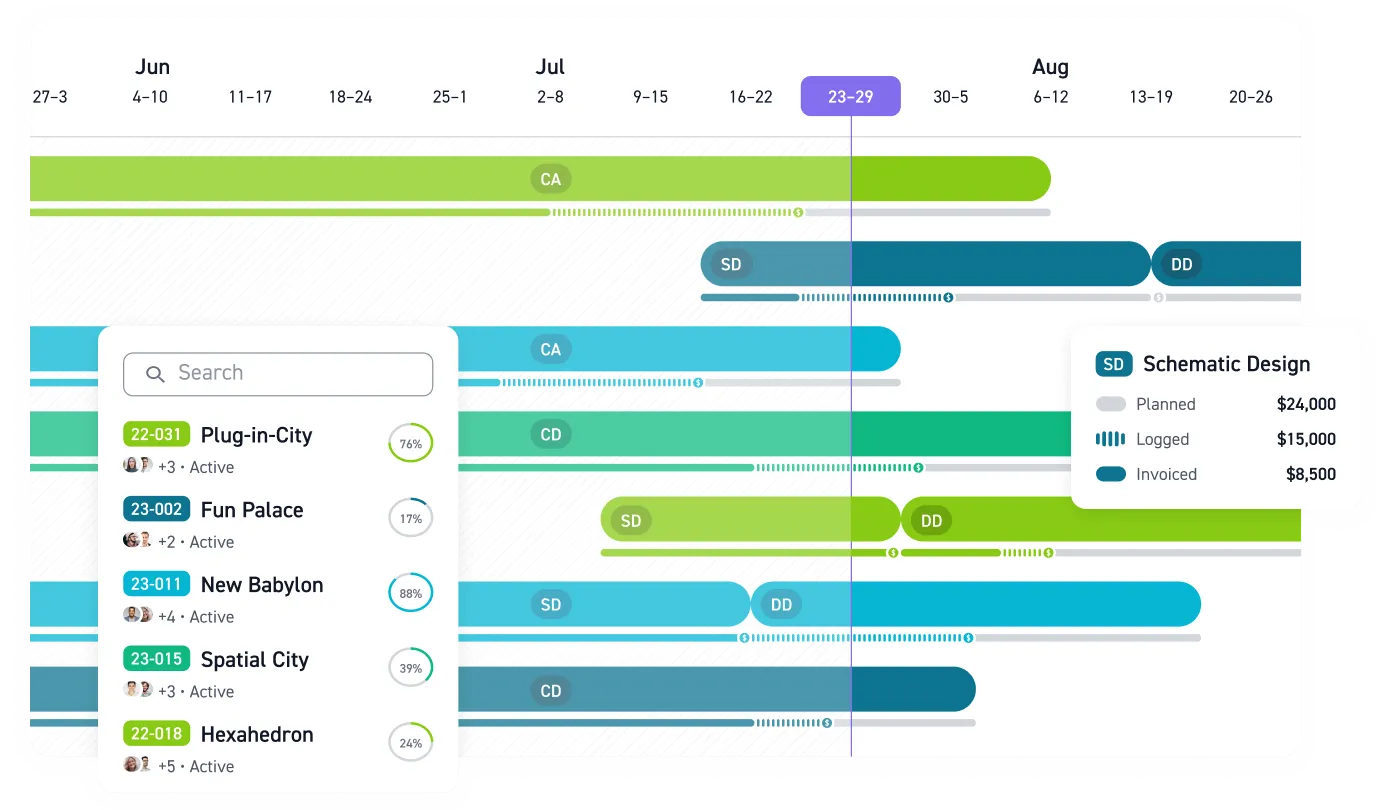
Monograph's MoneyGantt™ connects planned fees to logged hours by role in real time, so a principal sees phase budget against effort without waiting on a report. Dynamic Engineering is a 10-person firm that reported 2x efficiency gains with Monograph.
Stop Letting Billable Work Disappear
Start with recent closed projects. Project managers should review phase burn and uninvoiced change orders, operations leaders should inspect aged work in progress and invoice timing, and principals should sort write-downs by client, PM, and project type.
Monograph connects planned fees, logged time, invoices, and payments in one A&E practice management system. Monograph's MoneyGantt™ provides a real-time view of planned, logged, invoiced, and paid fees, making realization leakage visible before project close-out.
Revenue is leaking now. See where it goes before the next billing cycle. Book a demo with Monograph.
Frequently Asked Questions
What realization rate should an engineering firm target?
Use the 96% baseline average as a starting point, then compare results by client, PM, and project type. Start with your lowest-realization closed jobs and investigate the write-downs, absorbed scope, and missed change orders behind them.
Should realization include unpaid invoices?
Track billing realization and collection realization separately. Unpaid invoices reduce collection realization rather than billing realization.
Why can fixed-fee realization exceed 100%?
Rates above 100% are legitimate when a firm invoices more than the billable value of the time logged, typically because fixed-fee work was delivered inside the hour budget. Confirm that hours are complete and accurately assigned.
Should open projects be included in the calculation?
Use closed projects for final realization comparisons so final write-downs are included. For open projects, review phase burn, aged work in progress, and approved but uninvoiced change orders every week.
Data was collected as of April 2026.