

Your income statement says the quarter was profitable. Your bank balance disagrees. For most engineering firms, the difference sits in work in progress: hours your team has logged and earned that nobody has invoiced yet. A WIP report measures that gap, and for a finance manager it is the most direct map of where profit is stuck on its way to becoming cash.
The stakes are structural. In the design profession, average collection periods are commonly reported around 65 to 73 days, with some firms, especially subconsultants, seeing cycles stretch to 120 days or more, and labor accounts for 60 to 70% of expenses at A&E firms. Every week of unbilled work is payroll you have already funded out of your own pocket.
What a WIP Report Measures
WIP is the value of completed, unbilled work: earned value minus billed to date. On the balance sheet it sits as unbilled receivables or contract assets under ASC, which means it is an asset the firm cannot spend. A project with verified progress has earned the same share of its fee; subtract billed-to-date to calculate WIP.
A useful WIP report goes beyond a single unbilled total. Project by project, it should show:
- Percent complete and earned revenue, tracked by phase rather than by whole project
- Billed-to-date and the over/under billing position
- WIP aging by bracket
- Realization rate, among the least-tracked metrics in A&E firms
- Subconsultant costs, which sit inside both your WIP position and your cash exposure
The over/under column deserves the most scrutiny. A positive WIP balance is work your firm is financing; an overbilled project is a liability, because the firm owes the client work it has not yet delivered. One caution applies to the inputs. Percent spent tracks budget consumption, while percent complete measures actual progress, and a team whose budget consumption runs ahead of completed work overstates earned revenue if it recognizes revenue based on spending. Treat percent complete like a design calculation: verify the input against deliverables before you trust the output.
Unbilled Work Decays While You Wait
Aged WIP shrinks. Advisory estimates from professional services CFOs put realization by age on a steep curve:
- 0–30 days unbilled: 85–95% realization
- 31–60 days: 70–85%
- 61–90 days: 50–70%
- Beyond 90 days: 30–50%, when it is collected at all
The mechanism is human rather than mathematical. Clients mentally move on from work performed months ago, project managers hesitate to send a large invoice for work completed months earlier, and time entries reconstructed from memory are hard to defend in a fee dispute.
Zweig Group identifies WIP as one of the largest sources of silent revenue loss in AEC firms, and its firm comparison model credits billing timeliness and WIP management with 1.7 points of added profitability. Every dollar written off cuts realization without cutting the direct labor cost you already paid.
How Your Numbers Compare
Benchmark data confirms the industry is billing faster. Median WIP turnover improved to 18 days in the latest fiscal year, down from 22. A parallel survey puts average WIP at 15.3 days, down from 17.9. If your firm carries 30 or 45 days of unbilled work, you are financing projects your peers have already invoiced.
Collection speed separates firms even more sharply. Data from Monograph's 2026 Architecture & Engineering Business Benchmarks Report reveals that top-performing firms get paid in 22 days. Low performers wait 42, nearly a full extra invoice cycle on every bill they send.
Realization tells the same story from the write-off side. Baseline firms in the 2026 Architecture & Engineering Business Benchmarks Report average 96% realization. They lose 4 cents of every billable dollar to write-offs and scope creep. On a $100K project, the spread between low and top performers is $24K in fees.
The Monthly WIP Review That Moves the Numbers
A WIP report only converts profit to cash if someone acts on it, on a schedule. Practice leaders have found that firms running a monthly WIP review meeting cut WIP days by 15 to 25 within six months. The agenda is short: for each project, the total WIP balance, its age, the reason it has not been billed, and the person responsible.
Work the four aging brackets with assigned ownership:
- 0–30 days: healthy; confirm billing eligibility this cycle
- 31–60 days: escalate to a principal
- 61–90 days: at risk; schedule the client conversation now
- 90+ days: high write-off risk, usually a paused or troubled project; bill it or write it off
Fold this review into billing preparation rather than running it as a standalone exercise. Before each cycle, project managers confirm percent complete by phase, flag unbilled WIP, and document any billing they defer; that paper trail protects the firm when deferred WIP becomes a write-off conversation. The cheapest fix is speed. Zweig Group's cash flow guidance is blunt: bill the moment work is finished, because monthly invoicing is good and twice a month is better.
One System from Timesheet to Cash
Most WIP problems start upstream, with hours in one tool, costs in another, and billing in a third. Monograph's project accounting tracks budgets, actual costs, billable hours, invoicing, and profitability at the project level. Its QuickBooks Online integration connects client contacts, consultant vendors, invoices, payment status, and accounting costs.
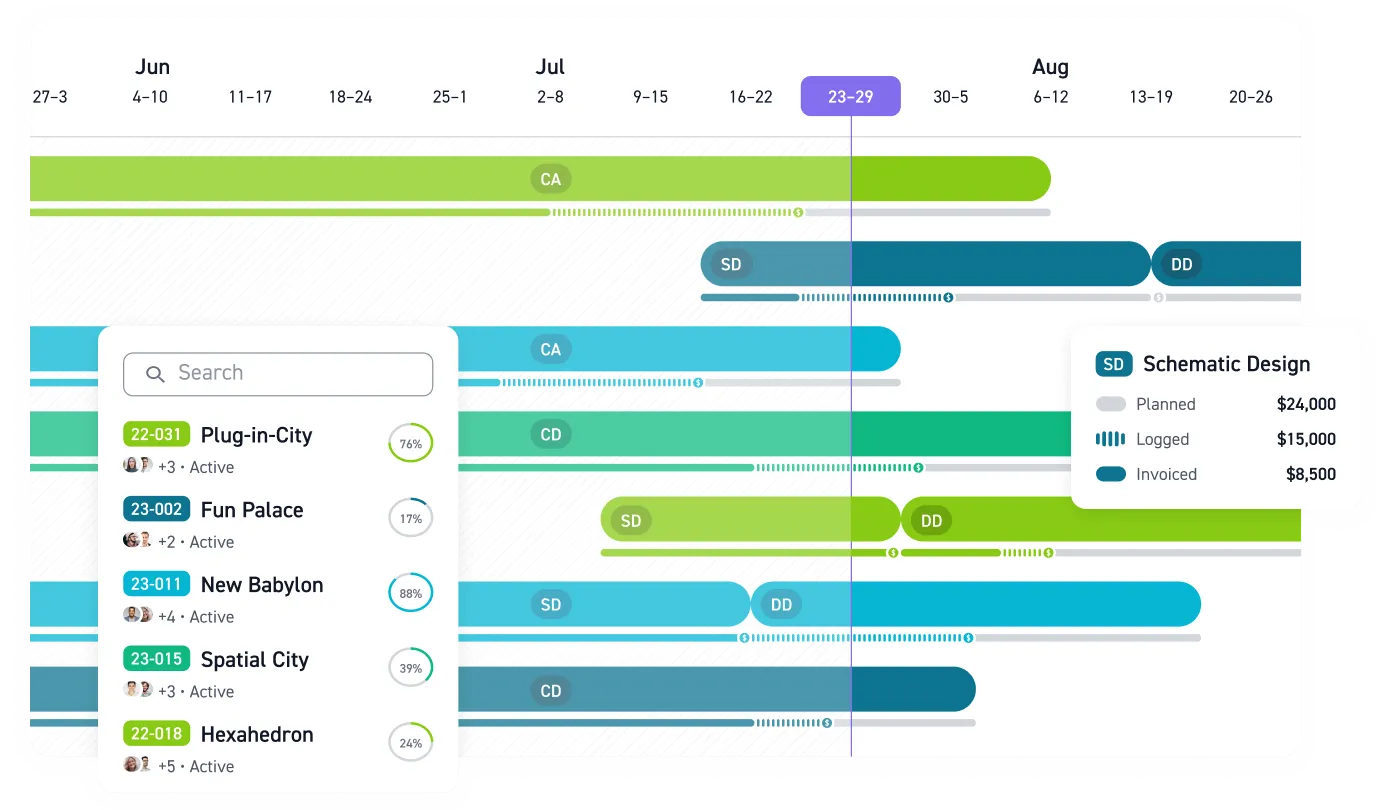
Monograph's MoneyGantt™ shows the full budget-to-cash progression. It tracks revenue through these stages on the project timeline itself:
- Planned
- Logged
- Invoiced
- Paid
Billable hours pull straight from timesheets into the invoice builder with no re-entry, and engineering firm invoicing tools can help prepare bills across projects.
The operational priorities are specific: keep DSO low, prevent WIP from aging, and convert WIP to invoices promptly after milestone completion. Woodhull, a 25-person architecture firm, made its billing process 50% faster after adopting Monograph. Start with this month's WIP aging report; the 90-day bucket will show you exactly where your profit stopped becoming cash.
Turn This Month's WIP Into Next Month's Cash
Unbilled work ties up cash your firm has already earned. Operations leaders should pull the aging report, project managers should verify percent complete by phase, and principals or owners should assign an owner and deadline to every balance older than 30 days.
Monograph connects timesheets, WIP visibility, and invoicing in one A&E workflow. That connection helps your team resolve billing blockers and move completed work onto an invoice without hunting through disconnected systems.
WIP gets harder to collect every day. See how your firm can move earned work from timesheet to invoice faster. Book a demo with Monograph.
Frequently Asked Questions
Is WIP the same as accounts receivable?
No. WIP is completed work your firm has earned but has not invoiced. Accounts receivable begins after that work appears on an invoice and remains there until the client pays it. Both affect cash flow, but WIP requires billing action before collection can begin.
How should we estimate percent complete on a fixed-fee project?
Estimate it by phase and verify it against completed deliverables. Do not substitute percent spent for percent complete. If the team has consumed more of the budget than the share of work it has completed, recognizing revenue based on spending overstates earned revenue.
What should we do with WIP on a paused project?
Document the last completed deliverable, confirm the current percent complete, and identify any work eligible for billing. Assign an owner to the balance and set a date for the client conversation. If the WIP reaches the 90+ day bucket, make a clear bill-or-write-off decision rather than letting it sit indefinitely.
Do small engineering firms need a formal monthly WIP review?
Yes. The meeting can be short, but it needs a regular schedule and clear ownership. Review each project's WIP balance, age, billing blocker, and responsible person, then fold those decisions into billing preparation. Small firms have less room to finance unbilled payroll or absorb avoidable write-offs.
Data was collected as of April 2026.