

This month's invoice was $15,000, while the work completed says the team earned $42,000. The percentage of completion method closes that gap. Fixed-fee, multi-phase contracts get uncomfortable. Recognize revenue off the billing schedule and your income statement reports what you invoiced, not what you earned.
What ASC 606 requires before you recognize over time
Revenue is recognized over time when a contract meets any one of three criteria:
- The client simultaneously receives and consumes the benefit as you perform.
- Your work creates or enhances an asset the client controls as it is created.
- Your work creates no asset with an alternative use to you, and you hold an enforceable right to payment for performance completed to date.
For contracts relying on the third criterion, the right to payment clause is the load-bearing element. Read that clause. If a client can terminate for convenience without owing for completed work plus a reasonable margin, over-time treatment gets shaky.
Billing does not establish progress. For example, a contract that bills 30% at kickoff has not earned that share if the hypothetical project is only 10% complete.
Percent spent measures burn; percent complete measures progress
Percent spent tracks how much of the budget the team has consumed, counted in dollars or hours. Percent complete measures physical progress on the contracted work. An earned value framework built for design firms keeps them apart.
Consider a hypothetical $50,000 job that is 20% physically complete. It has earned $10,000, whatever has been spent or billed. If the team burns 60% of the budget while completing 40% of the work and recognizes revenue at 60%, it overstates earned revenue by 20% of contract value. Re-estimating phase by phase surfaces the gap while there is still fee left. A project reported at a hypothetical 90% complete can still absorb a disproportionate share of labor in its final 10%.
ASC 606 permits both input and output methods. The right choice follows contract structure. Once chosen, the method has to be applied consistently to similar performance obligations across contracts.
- Cost-to-cost (input). Costs incurred to date divided by total estimated costs. The usual choice for fixed-fee work. Watch subconsultant costs in the numerator.
- Labor hours (input). Hours expended divided by total estimated hours. Fits labor-dominant design contracts with daily time tracking. Exclude inefficient or reworked hours that do not depict progress.
- Milestone or phase (output). Fits contracts where milestones faithfully depict performance. Differently weighted phases need corresponding weighting.
- Right-to-invoice expedient. Revenue equals the amount invoiced, allowed only when the invoice matches value delivered, as with qualifying hourly-rate contracts.
When a contract carries more than one performance obligation, run the percentage against the fee allocated to each obligation, not the contract total. Allocation follows the relative standalone selling price of each obligation. If progress cannot be measured reasonably, recognition is limited to recoverable costs incurred without recognizing margin.
A worked example: $120,000 fixed fee, month three
Consider a hypothetical $120,000 full-service project with this illustrative phase split: 15% schematic design, 20% design development, 40% construction documents, 5% bidding, and 20% construction administration. The firm uses the labor-hours input method, with 800 budgeted hours. Schematic design and design development end with formal owner review or approval, which supports the progress estimates.
Through the hypothetical third month, the team has logged 280 hours, so 280 ÷ 800 = 35% complete. Earned revenue to date is $120,000 × 35% = $42,000. The firm recognized $24,000 in the first two months, so it books $18,000 this period.
The invoice represents cumulative billings through month three. The milestone invoice was $15,000, leaving $27,000 of earned-but-unbilled work as a contract asset, assuming the right to consideration remains conditional. An unconditional amount is a receivable. Had the firm invoiced $50,000, the hypothetical $8,000 excess would be a contract liability. Before close, the controller confirms the 35% is backed by deliverables actually issued rather than hours alone.
WIP, paused projects, and the monthly close
Underbilled work means the firm is financing the project owner while its own payroll runs. Overbilling becomes dangerous when owners treat the excess cash as profit and fund distributions from money that still has work attached. Unbilled work that ages can become a write-off. Whether reimbursed subconsultant costs count as gross revenue or only the net amount depends on whether the firm controls the service before transfer to the client. Either way, pass-through dollars can distort a cost-to-cost measure if they do not depict the firm's progress.
A WIP schedule that supports recognition carries seven columns per project:
- contract value
- costs incurred to date
- revised estimated cost at completion
- percent complete
- earned revenue to date
- billings to date
- over/under, the earned-versus-billed gap
Paused projects need a standing rule. A pause generally does not reverse recognized revenue if the contract remains in force with an enforceable right to payment. Stop recognizing new revenue when no measurable progress is being made or the contract no longer meets the criteria. Reassess the balance, client collectibility, and cost-to-complete estimate before work restarts.
Monthly close checklist
A monthly close routine keeps the system honest. The percent-complete number is only as current as the current timesheets behind it. Set a hard cutoff before close and follow up on missing entries.
- Have project managers confirm percent complete by phase, tied to issued deliverables.
- Compare earned revenue to billings on every active project and flag the gaps.
- Invoice amounts currently billable under the contract, or document why billing is deferred.
- Update estimated cost at completion and record any anticipated loss in full when identified.
Together, these checks keep earned revenue tied to current project evidence before close.
See Earned Revenue Before Month-End
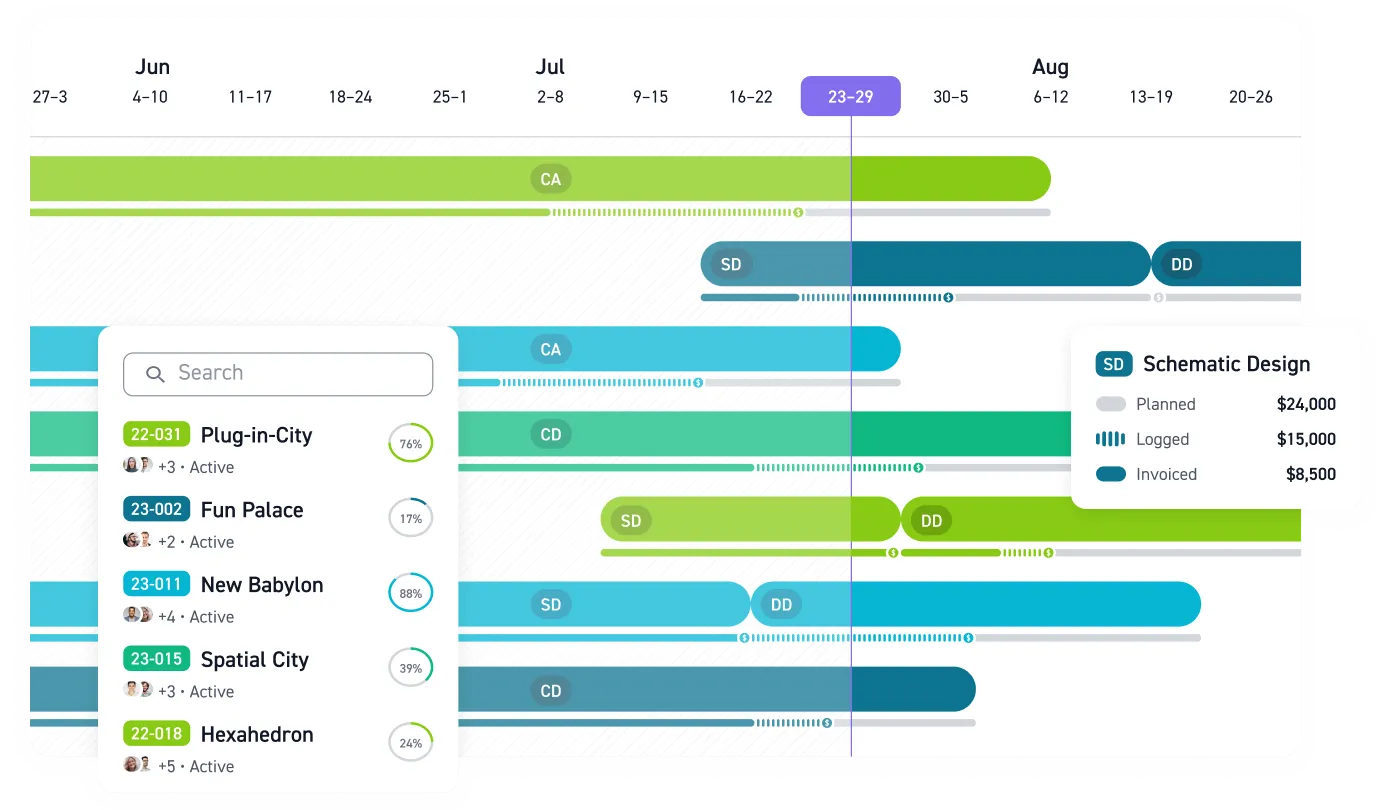
Monograph connects phase budgets, logged time, and invoicing status. Firms set phase budgets, project managers log time against each phase, and finance teams can track fees planned, logged, and issued. Automated draft invoices can be created on a configurable monthly schedule for team review.
The connection between project tracking and billing can have a measurable effect. Workbench reported a 4x faster billing process and 75% fewer unbilled fees after adopting Monograph.
Monograph's signature MoneyGantt™ combines project timelines with planned, logged, invoiced, and paid fees so teams can spot off-track phases quickly. Connect phase budgets, time, and invoicing before close. Book a demo with Monograph.
Frequently Asked Questions
Can we use percent spent as percent complete?
Only when cost or labor consumption faithfully depicts progress. Rework, inefficiency, and consultant costs can distort it, so confirm the percentage against deliverables.
What happens when billings differ from earned revenue?
Earned revenue above conditional billings is a contract asset; an unconditional amount is a receivable. Billings above earned revenue are a contract liability.
How should we treat a paused A&E project?
Stop new recognition when no measurable progress occurs or the contract no longer qualifies. Reassess the balance, collectibility, and cost-to-complete estimate.
Can we change progress methods between phases or projects?
Apply the selected method consistently to similar performance obligations. For multiple obligations, calculate progress against the fee allocated to each one.