



Firm management made easy

At firms that run mechanical, electrical, and plumbing as separate cost centers, each discipline has its own lead, billable-hours target, and schedule. The project has one fee and one deadline. Each lead protects their own number, and the overrun surfaces on a fee nobody owns alone. MEP coordination fails on the fee before it fails on the drawings.
Build the Fee Split from Task-Level Hours
Nobody publishes a reliable M/E/P split benchmark, so build your own from hours. Some practitioners fold plumbing into mechanical when checking the overall split, but plumbing still needs a visible project budget.
Build a task-level WBS by discipline, estimating hours for each task and including an allowance for small changes. Build each discipline's share the same way:
- Have the M, E, and P leads estimate hours at the task level from project scope and past projects. Give plumbing its own WBS branch, hours, and rate.
- Apply discipline-specific billing rates built from raw labor cost times your target multiplier.
- Create a dedicated project-management allowance. Those hours are already being worked; they have not been named in the budget.
- Reconcile the total against fee-estimating guidance and market rates, then distribute each discipline's fee by phase, including construction documents.
Add the three totals. That's your split. Nothing sours a plumbing lead faster than learning midway through CDs that their hours were never broken out of mechanical's share. The best-run firms won't issue a job number without a complete budget and schedule the team can see.
Discipline leads estimate the hours. The PM judges what the fee can afford. When the client's fee comes back under the built-up number, hold the WBS as the record of what the fee bought.
Sequence by Dependency
Mechanical goes first when its model provides the spatial and equipment inputs other services need. In coordinated BIM workflows, electrical and plumbing enter after mechanical equipment, ductwork, and piping reach coordination readiness. Pushing electrical design ahead of actual mechanical equipment data creates rework.
Map handoffs backward from each project milestone and deliver design in 2-3 week cycles. Four gates carry most of the load:
- Release mechanical equipment selections for electrical load calculations and cable sizing.
- Release mechanical routing for plumbing clearance checks.
- Hold formal cross-discipline reviews during early, middle, and late design.
- Check the ceiling plenum at the midpoint of construction documents.
Release work only when the downstream discipline can use it. Name an owner for each release, and open the weekly meeting with the blocked list.
Recover Deliberately When a Discipline Slips
When plumbing is coordination-ready while electrical remains at an earlier level of development waiting on inputs, every recovery move buys schedule with something else.
- Crashing: add staff to critical-path tasks, accounting for onboarding time.
- Fast-tracking: start downstream work on preliminary backgrounds. It is the riskiest MEP option because final electrical calculations need actual equipment data.
- Resequencing: advance downstream tasks least coupled to the lagging discipline.
- Scope deferral: push non-critical project deliverables past the milestone only when they are off the critical path.
Most recovery plans combine schedule-compression guidance, trading money against rework exposure. Sharing issues promptly costs one uncomfortable call; a snowballed delay can cost the relationship.
Catch the Discipline Burning Its Share Early
The signal is percent spent pulling ahead of percent complete, tracked per discipline. In an earned-value comparison, if mechanical has spent 55% of its share to reach 40% of its work, the project total may still look healthy because the other disciplines net out the gap. Divide earned value by actual cost to calculate the cost performance index.
Wire these thresholds into the weekly review:
- Investigate when a discipline's CPI drops below your firm's approved threshold.
- Start reading CPI as soon as progress can be measured credibly.
- Update the forecast instead of assuming performance will recover on its own.
- Adopt 30%, 60%, and 90% fee-spend review triggers as your firm's internal policy.
The intervention window is early. Using the earned-value method, a discipline at CPI 0.80 after spending 30% of its budget has earned 24% of its planned value. Completing the remaining 76% of planned work at CPI 1.0 would bring total cost to 106% of the original budget. If the team instead stops at the original budget, it will have completed only 94% of the planned work.
Woodhull, a 25-person firm, cut budget overage by 66% and completed billing 50% faster after gaining clearer project-financial visibility with Monograph.
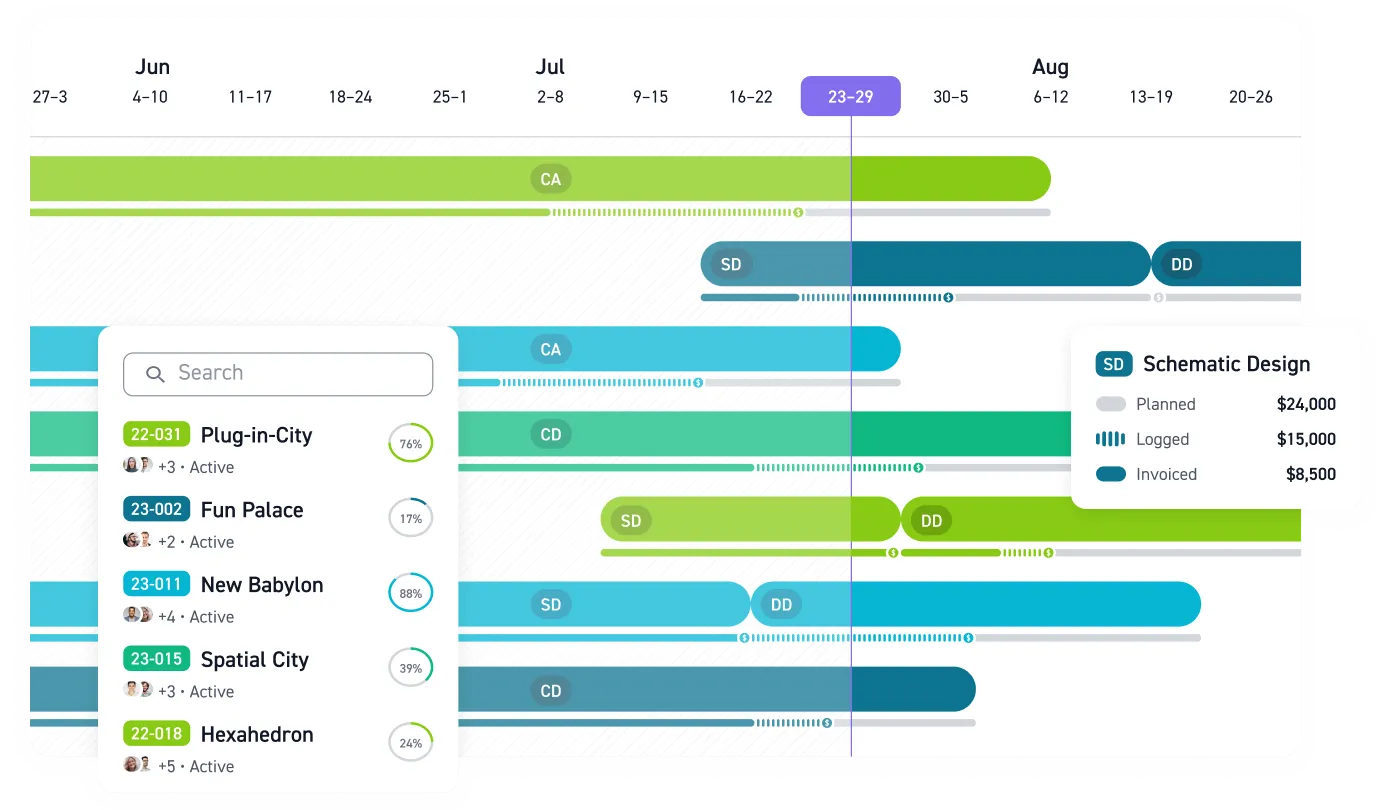
Monograph recommends a weekly PM routine that includes approving staffing-plan timesheets, reviewing budget performance, and rescheduling slipped work. Use Monograph to compare planned and logged fees by phase, person, and category, then calculate discipline-level CPI in your reporting process where needed.
Fix the Incentives Behind the Numbers
Discipline-level billable-hours targets work against a shared fixed fee. Push staff on billable hours alone and they can hit the target while it hurts fixed-fee work. Hours can make a department look busy while weakening the project's margin.
No published standard covers moving fee between disciplines mid-project, so set the rule internally. The PM reallocates remaining fee at burn reviews, with all three discipline leads signing off.
Track billable hours and realization together. When a department's logged billable hours look excellent on a lump-sum job, ask what those hours bought before rewarding the number.
The absence of real-time visibility into billable hours and project-margin visibility is a financial blind spot for A&E firms. Firms that close it report 15-20% performance gains in the first year.
See the Overrun Before It Crosses Disciplines
The PM needs to see which discipline is burning ahead, which handoff is blocked, and which recovery move the fee can afford. Firm leaders need the same visibility to set job-number, reporting, and fee-reallocation rules.
Monograph connects timesheets, budgets, and project reporting so teams can review planned and logged fees by phase, person, and category in the same workflow. Firms can use those views to maintain discipline-level reporting without claiming that Monograph calculates discipline CPI natively.
The fee is already burning. Separate the discipline budgets, review performance weekly, and correct schedule slips while there is still room to act. Book a demo.
Frequently Asked Questions
Should plumbing have its own fee even when it reports through mechanical?
Yes. Give plumbing its own WBS branch, hours, rate, and phase distribution so its burn remains visible, even if departmental reporting rolls it into mechanical.
Does mechanical always have to go first?
Sequence by dependency. Mechanical goes first when its equipment, ductwork, piping, or routing provides inputs electrical and plumbing need.
What should the PM do when electrical is waiting on mechanical equipment selections?
Put the blocked release first in the weekly meeting. Resequence independent electrical work, then decide whether staffing the mechanical critical path is worth the onboarding cost.
How should fee move between disciplines without rewarding an overrun?
Investigate the variance, update the forecast, preserve the original WBS, and require the PM plus all three discipline leads to approve the transfer.