
Plenty of A&E firms only find out a project lost money when the final invoice goes out. By then, the fee is spent, and the only decision is how much to write off. A project controls engineer moves that discovery forward by months. Across a 136-country database of capital projects, 91.5% went over budget, over schedule, or both.
Employers are paying for the fix. Indeed lists 2,163 openings for project controls engineers, and Bechtel alone has 91 active openings in project controls. If you're a CFO hiring one, or a PM already doing the job, the role deserves a precise definition.
What a Project Controls Engineer Does
A project controls engineer (PCE) plans, measures, and forecasts cost, schedule, and risk so the PM can act before a variance becomes a loss. AACE's Total Cost Management Framework treats project control as a subset of project management, which is why the two roles get confused.
A PMI-published paper describes the planner-controller's job as maintaining project data systems, calculating variances, and reporting status to stakeholders. The PCE recommends; the project manager decides and owns the outcome. That makes the function decision support, and it covers far more than schedule-building.
On smaller projects the architect, engineer, or PM runs project control; large programs staff planners, schedulers, and cost controllers. IPA found small plant-based projects under US$10 million are often less successful than larger ones at the same firm.
Core Responsibilities and Deliverables
On design projects, four documents answer one question: how long and how much, against plan? Together they work like a coordinated drawing set: each document covers a different control, and gaps between them expose risk.
- Cost baseline by phase. A&E fees split 15–18% to Schematic Design, 15–20% to Design Development, 35–50% to Construction Documents, and 25–30% to Construction Administration. The PCE tracks hours budgeted, burned, and earned per phase.
- Baseline schedule and updates. The approved schedule from design through construction completion, plus milestone updates with corrective actions.
- Earned value and variance reports. Cost Performance Index (EV ÷ AC), Schedule Performance Index (EV ÷ PV), and an Estimate at Completion. A CPI of 0.83 means each dollar spent bought 83 cents of planned work.
- Risk register and change log. AACE defines the risk register and requires a change management procedure alongside it; CII classifies change management as a best practice.
A phase review turns these documents into action. If Construction Documents are burning hours faster than the drawing set is advancing, the PCE can trace the mismatch to staffing, scope, or schedule before the phase fee is gone. The PM then decides whether to reassign work, reset a milestone, or address a change with the client.
Closeout adds an as-built schedule, a final variance report, and lessons learned. The as-built schedule records what happened, while the final variance report explains where cost and schedule moved. Lessons learned keep the next proposal honest.
Skills and Tools That Matter
Earned value and critical path scheduling are the entry ticket. CPM and EVM work best when both draw on the same data. Primavera P6 is the standard scheduling tool in construction and energy work, with Microsoft Project and advanced Excel commonly listed alongside it in project controls postings.
Soft skills are where careers stall. An analysis of 392,608 job postings found communication in 55% of them, ahead of management (50%) and leadership (34%). AACE's CCP guidance says senior cost engineers catch disconnects: a forecast that ignores a scope change, a risk register never priced into contingency.
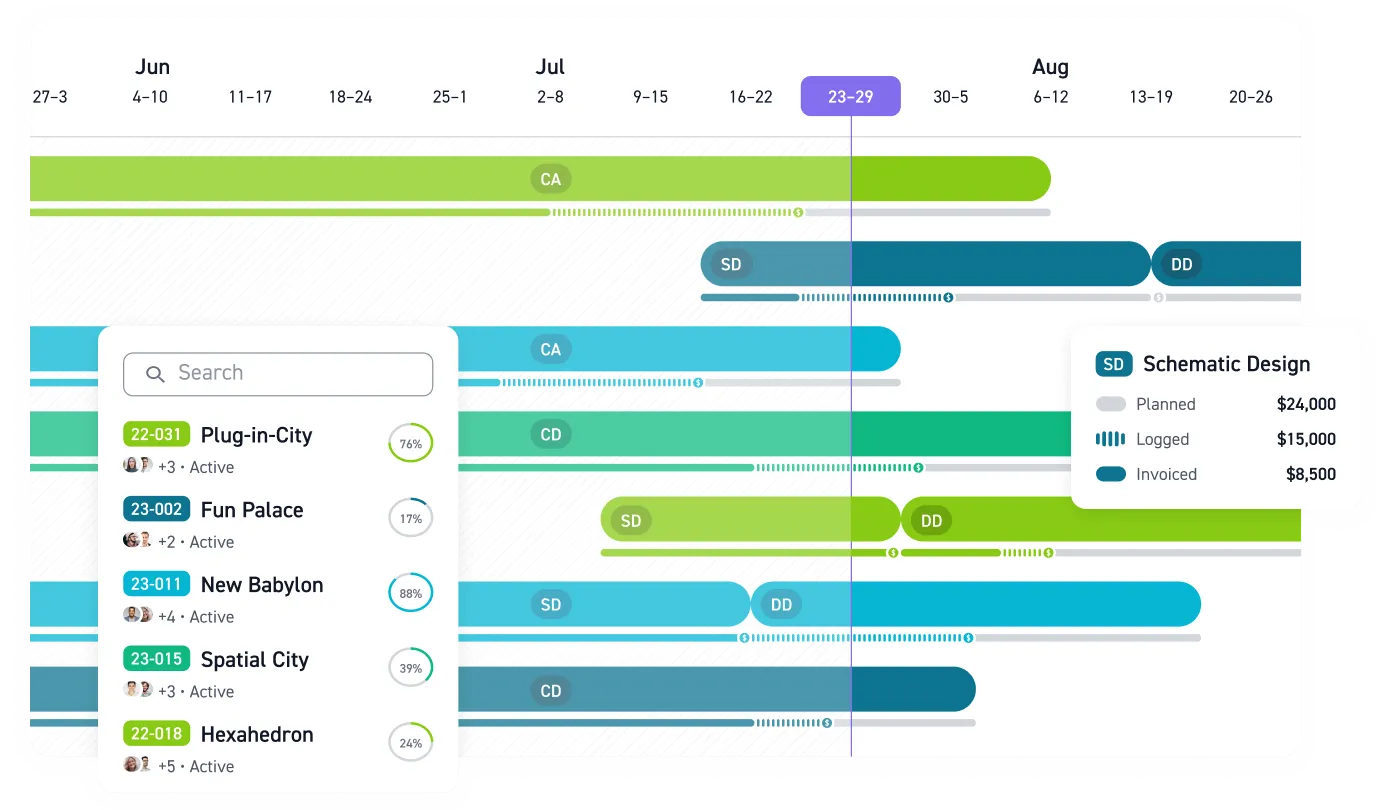
Small and mid-size A&E firms rarely need P6. They need phase-level budgets connected to time entry, billing, and profitability in one place instead of three spreadsheets, which is what Monograph is built for. Monograph's MoneyGantt™ view puts that budget-to-cash picture on the project timeline, so a PM sees which phases are burning fee faster than they earn it. That visibility improves project control. Woodhull, an architecture firm using Monograph, reduced budget overage by 66%, saved 66% of admin time, and cut billing time in half.
How Controls Keep Projects on Budget
Cost performance at the 15% completion mark predicts the final result. With Schematic Design typically carrying 15–18% of the fee, the 15% completion mark often falls near the SD-to-DD handoff. Actual timing depends on the project's baseline and earned-value method, but that handoff remains the most valuable budget review of the project. The workflow is the same at any scale.
- Baseline: fee by phase, milestone dates, and documented scope.
- Measure monthly, weekly on fast jobs: percent complete times the approved labor-cost budget gives earned value; compare earned value against actual labor cost.
- Correct: reallocate staff, crash critical-path tasks with added resources (which raises cost), or fast-track sequential work in parallel (which raises risk).
As an illustrative calculation, on a $100K budget at week 20, a CPI of 0.67 and an SPI of 0.80 forecast a $150K Estimate at Completion. Act in that week, while reallocating staff and renegotiating scope are still live options. Earned value locates the variance; the PM still has to diagnose and fix it.
The payoff shows up in realization. According to Monograph's 2026 Architecture & Engineering Business Benchmarks Report, baseline firms average 96% realization, losing 4 cents on every dollar of billable time to write-offs and scope creep. The gap between low performers (83%) and top firms (107%) is 24 percentage points, which on a $100K project is $24K in fee that one firm keeps and another gives away. Rates above 100% come from fixed-fee work delivered efficiently.
Career Path, Certifications, and Pay
The ladder runs from analyst through engineer or specialist to manager and director. Titles blur between firms, but experience bands cluster in predictable ranges across postings. The practical progression is simple: first track the numbers, then connect cost and schedule, and eventually own the controls framework.
- Project controls analyst: entry level to about five years; reviews financial reports and tracks deviations in spending from the forecasted budget, providing insights into areas where cost overruns might occur so the team can take proactive action.
- Project controls engineer or specialist: two to five years with a degree. One Bechtel posting lists $89,444–$121,012 for that band.
- Senior PCE: eight to twelve years; broader scope and mentoring, with experience in cost management, scheduling, and risk assessment on large-scale projects.
- Project controls manager or director: owns the controls framework and team.
What you own, cost plus schedule, matters more than the title on the offer letter, and certification is how you prove you own it. AACE's CCP, PSP, and EVP require eight years of experience, or four years plus a four-year degree, and the CCP exam runs $525 for members and $690 for non-members, with a resit fee of $260. AACE's January 2025 salary survey found certificants earn $18,000 more than uncertified peers. Aim for the CCP by year five.
BLS has no code for the role, so use a proxy. Project management specialists earn a $102,320 median with 7% projected growth through 2035, and 80% of construction firms report difficulty filling salaried openings.
Sorting Out Related Titles
"Project controller" means two different jobs. In construction and infrastructure, it's a controls professional advising the PM on cost and schedule deviations. In a design firm's finance department, it's an accountant reporting to the CFO on billing, revenue recognition, and profitability.
A cost engineer works cost first and schedule second. A scheduler builds the CPM network without connecting cost to it. A project controls engineer connects cost and schedule so the PM can act on both.
Check which competency set a candidate actually holds before the interview. Ask who maintained the cost baseline, schedule, earned-value reports, risk register, and change log. The answer shows whether the candidate tracked one discipline or connected the full controls framework.
What to Do Next
Pick the items that match your seat.
- Build one dashboard showing CPI, SPI, and EAC for every active project, and refresh it on a fixed day each week.
- Automate the weekly cost-and-schedule review so the numbers arrive before the PM meeting, not after it.
- Start logging hours toward AACE's CCP now, and add a Primavera P6 course if you work construction or energy; in design, phase budgets matter more than a CPM network.
- If you run the firm, standardize KPI reporting on one platform so every PM reads the same phase budgets, and join AACE International or PMI for the competency standards and the local hiring pool.
Start with the reporting habit that gives your team the earliest useful warning.
For deeper reading: AACE's CCP and PSP study guides, PMI's Practice Standard for Scheduling, Monograph's MoneyGantt™ guide, and Wayne Del Pico's Project Control: Integrating Cost and Schedule.
Catch Project Variances Before the Fee Is Gone
Disconnected spreadsheets delay the moment when a project manager sees a phase burning through its fee. By the time operations leaders, principals, or owners get the report, the practical options may already be gone.
Monograph connects phase budgets, time entries, billing, and profitability in one place. Monograph's MoneyGantt™ view helps PMs catch overruns, operations leaders standardize reporting, and firm leaders protect realization without building a full controls department.
Budget surprises compound fast. See project performance while there is still time to act. Book a demo with Monograph.
Frequently Asked Questions
Does a small A&E firm need a dedicated project controls engineer?
Usually not. On smaller projects, an architect, engineer, or PM can run project control by maintaining phase budgets, milestone dates, variance reports, and a change log. Add dedicated controls staff when project scale or volume makes that work too large for the PM to manage consistently.
Can a project manager handle project controls?
Yes, especially on smaller design projects. Keep the responsibilities clear: project controls maintains the data, calculates variances, and recommends corrective action, while the PM decides what to do and owns the outcome.
Do design firms need Primavera P6?
Most small and mid-size A&E firms do not. P6 matters more in construction, energy, and large programs built around critical-path schedules. Design firms usually get more value from phase-level budgets connected to time entry, billing, and profitability.
When should I pursue an AACE certification?
Start documenting qualifying experience now and aim for the CCP around year five if you have a four-year degree. AACE requires eight years of experience, or four years plus a four-year degree, for the CCP, PSP, and EVP credentials. Choose the credential that matches the work you own: broad cost control, planning and scheduling, or earned value.
Data was collected as of April 2026.