

Most small firms hand one person both titles and only find out what that costs when an invoice goes out late. In a typical role split, the project engineer leads technical delivery for the client. The project manager makes sure that work turns a profit for the firm.
The Project Engineer Owns the Technical Layer
The project engineer runs the day-to-day operations, keeping work on schedule, meeting regulations, and acting as liaison between contractors and other professionals. The project engineer typically reports to the project manager and serves as the technical contact for the design team and consultants.
A project engineer handles:
- Technical implementation: making sure plans and designs are executed accurately
- Blueprint interpretation: translating drawings into actionable instructions
- Quality control: checking workmanship and materials against specifications
- Documentation and compliance: maintaining records and confirming work meets safety codes
In an engineering design firm, the project engineer often does the design work too, including analysis, calculations, the drawing set, and building department responses.
In firms that reserve fee authority for the PM, that work counts as design and construction administration, but carries no fee authority. The project engineer can identify additional hours; the PM handles the commercial conversation.
The Project Manager Owns the Business Layer
In firms that separate the roles, project managers hold overall responsibility for project success, with authority across scope, resources, and stakeholder communication. The PM typically writes the proposals, budgets, and contracts and answers for performance and client satisfaction.
Four responsibility areas sit squarely with the PM in that structure:
- Budget: preparing fee proposals, tracking expenses, forecasting, and answering for profitability
- Client relationship: serving as the primary contact from kickoff through closeout
- Master schedule: developing, owning, and reporting against it
- Risk and scope: controlling scope creep and managing change orders before they erode the fee
All four run on fee math. The PM divides the fee across phases, calculates the hours each phase can afford, and checks burn against the phase budget before invoicing.
A Monograph customer case study shows Brunton Architects & Engineers, an 18-person firm, cut budget overages by 25%, doubled billing speed, and reduced administrative time by 25% after adopting Monograph.
Licensure: Where the Line Is Legally Fixed
Credentials split the roles harder than job descriptions do. Licensure determines who can take responsible charge and sign and seal documents, not who can manage the project:
- Engineering license: an EAC/ABET-accredited engineering degree, the FE and PE exams, and, in most states, four years of progressive experience
- Architect's license: a NAAB-accredited degree in 36 of 55 jurisdictions, 3,740 documented hours of experience, and the ARE
- PMP: no technical degree required
That gap matters because of responsible charge, meaning direct control and personal supervision of engineering work.
A project manager without an engineering or architect's license cannot sign and seal documents, though the management role itself needs no license.
How the Two Roles Work Together Day to Day
In a common role split, the project engineer produces the technical record, and the PM acts on it. The handoff appears in four places:
- RFIs: the project engineer logs and tracks the RFI. The PM routes it to the engineer or architect of record, distributes the answer, and decides whether a change order is warranted
- Technical QA: the project engineer checks design assumptions and drawing sets before senior QC review
- Submittals: the project engineer checks shop drawings and submittals before review by the engineer or architect of record. The PM logs the schedule impact
- Change and cost tracking: the project engineer creates, forecasts, and tracks the change record
An overage can sit in a timesheet until the PM sees it. The two reconcile logged hours against planned hours by phase every week so the number is current on the invoice date.
When a Small Firm Should Split the Roles
At small-firm scale, the principal is the PM by default, and PSMJ tells firms to lean on their project and operations teams for business development as well. A dedicated PM makes sense once project volume outpaces what the principal can absorb.
The warning signs are delayed budget calls, client decisions, and invoice reviews. Creating the title without transferring authority leaves the project management process one in name only. A PM who needs permission for every budget call is a coordinator with a bigger business card.
Moving from Project Engineer to Project Manager
The standard civil construction-track career ladder runs entry-level engineer, project engineer, assistant project manager, project manager, then operations leadership. The bar for the project manager title in architecture is eight or more years of experience, with licensure preferred but not required. Among A&E firms, 76% rely on on-the-job learning. ACEC's curriculum covers the scoping, budgeting, and risk work a new PM must learn. Financial fluency remains the most consistently identified gap.
Data from Monograph's 2026 Architecture & Engineering Business Benchmarks Report reveals a 29% realization gap between low-performing firms at 83% and top firms at 107%, equal to $24K on a $100K project. Realization above 100% means a firm invoiced more than the billable value of hours logged, typically by completing fixed-fee work efficiently. High performers bill 34% more hours than low performers, and the utilization sweet spot is 75-90%.
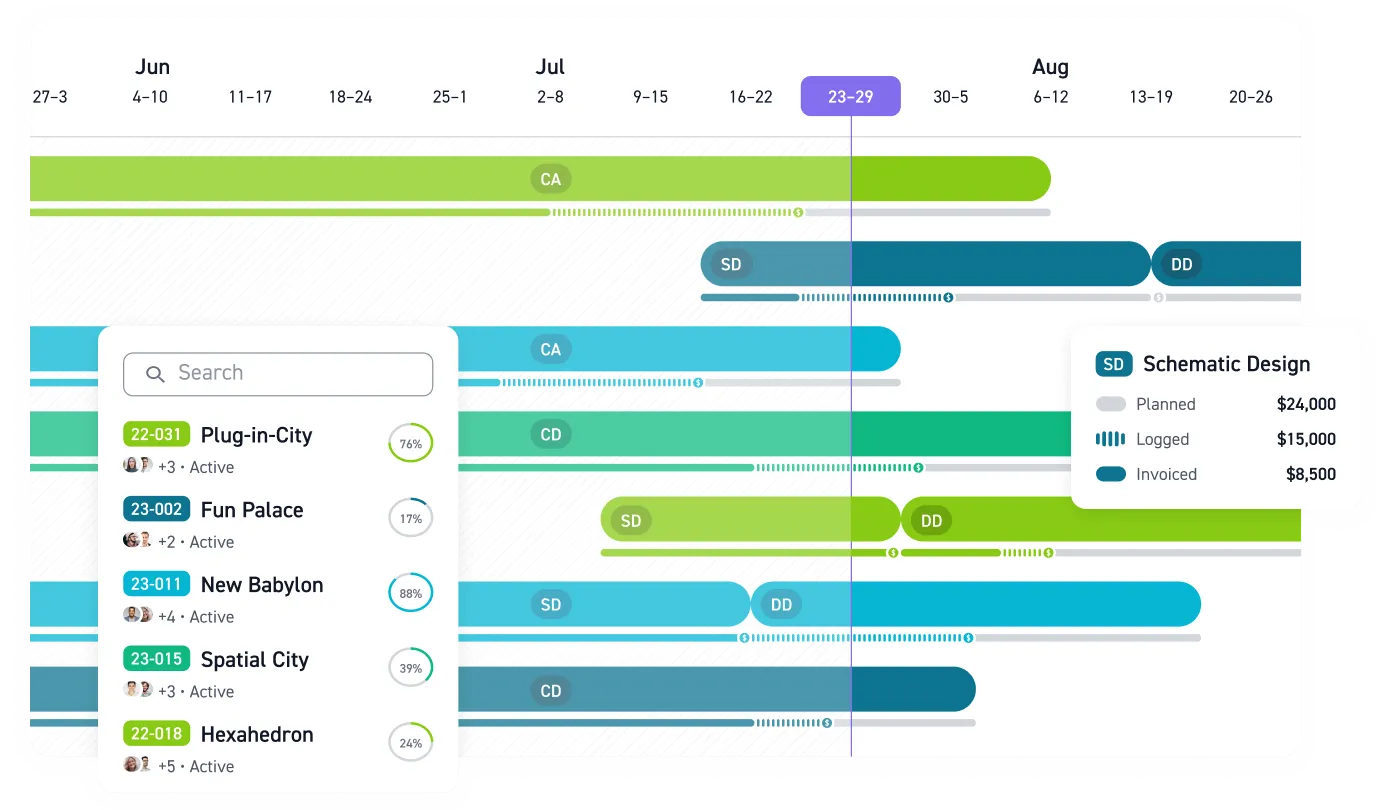
A new PM cannot manage those targets from a spreadsheet reconciled after the phase is spent. Monograph tracks phase-level fees, from planned and logged through invoiced and paid. Divide logged hours by planned hours phase by phase, flag overruns while work remains open, and reforecast or bill for the additional scope. If you're promoting your best project engineer, give them the numbers before the title.
Give Every PM the Numbers Behind the Title
Principals, owners, and operations leaders need to define who controls the fee, scope, schedule, and client relationship. Project managers need live phase data to use that authority before an overage reaches the invoice.
Monograph connects project budgets, timesheets, and invoicing so PMs can review performance while the team can still adjust the work.
Define the handoff before the next project starts. Book a demo.
Frequently Asked Questions
Does a small A&E firm need separate project manager and project engineer roles?
Not immediately. The principal can serve as PM while project volume is manageable. Split the roles when budget calls, client requests, schedule decisions, and invoice reviews routing through one person begin delaying work or making growth fragile.
Does a project manager need a PE or architecture license?
The management role itself needs no license. An unlicensed PM can manage scope, fees, schedules, and client communication but cannot sign and seal documents. Work requiring responsible charge must remain under the licensed professional's direct control and personal supervision.
What decisions should a newly promoted project manager be allowed to make?
Give the PM authority over the budget, master schedule, client relationship, scope changes, and change orders. Keep technical design, QA, and documentation with the project engineer, and route sealed work through the licensed professional. Review logged hours against planned hours by phase every week so the PM can act before the fee is gone.
Data was collected as of April 2026.