
This guide compares six CRM platforms against the way A&E pursuits actually run, from go/no-go through award, for principals, project managers, and operations leaders at 5–50 person firms. Only 48% of firms run a defined business development process and nearly a quarter run no CRM at all. The harder problem often comes at award, when pursuit data stays in the CRM and someone re-keys it into accounting and staffing. You'll get six options in three categories: purpose-built A&E CRMs, all-in-one practice management platforms, and general-purpose sales CRMs.
Every pick was scored on pursuit-workflow fit, feature depth, connections to accounting and delivery, and published pricing, plus practitioner feedback from A&E subreddits where it exists. A feature-and-pricing table and a four-question vendor checklist follow the six reviews.
How We Selected and Ranked the Tools
An A&E pursuit moves through Identified, Go/No-Go, Teaming, Proposal, Interview, and Award. We scored each tool on four criteria:
- Fit with the A&E pursuit workflow: go/no-go, teaming, repeat clients
- Connection to accounting and project delivery, so won-pursuit data isn't re-keyed
- Pricing transparency, official pages first
- Practitioner feedback from r/Architects, r/architecture, r/civilengineering
These criteria favor tools that match A&E pursuits and reduce handoff work without hiding cost or practitioner tradeoffs. ManyRequests has no deal pipeline, monday CRM and EngageBay appear only in general roundups and one A&E forum discussion, and BQE CORE documents a CRM and proposal module but no go/no-go or SF-330 workflow.
Best All-in-One for 5–50 Person Firms: Monograph
Monograph combines project budgets, phase-based time tracking, staffing, and invoicing for 5–50 person A&E firms on QuickBooks Online. Monograph's Pipeline module tracks leads by stage and owner. Its Proposal Builder prices new work from past project data and turns a signed proposal into a live project with no double entry.
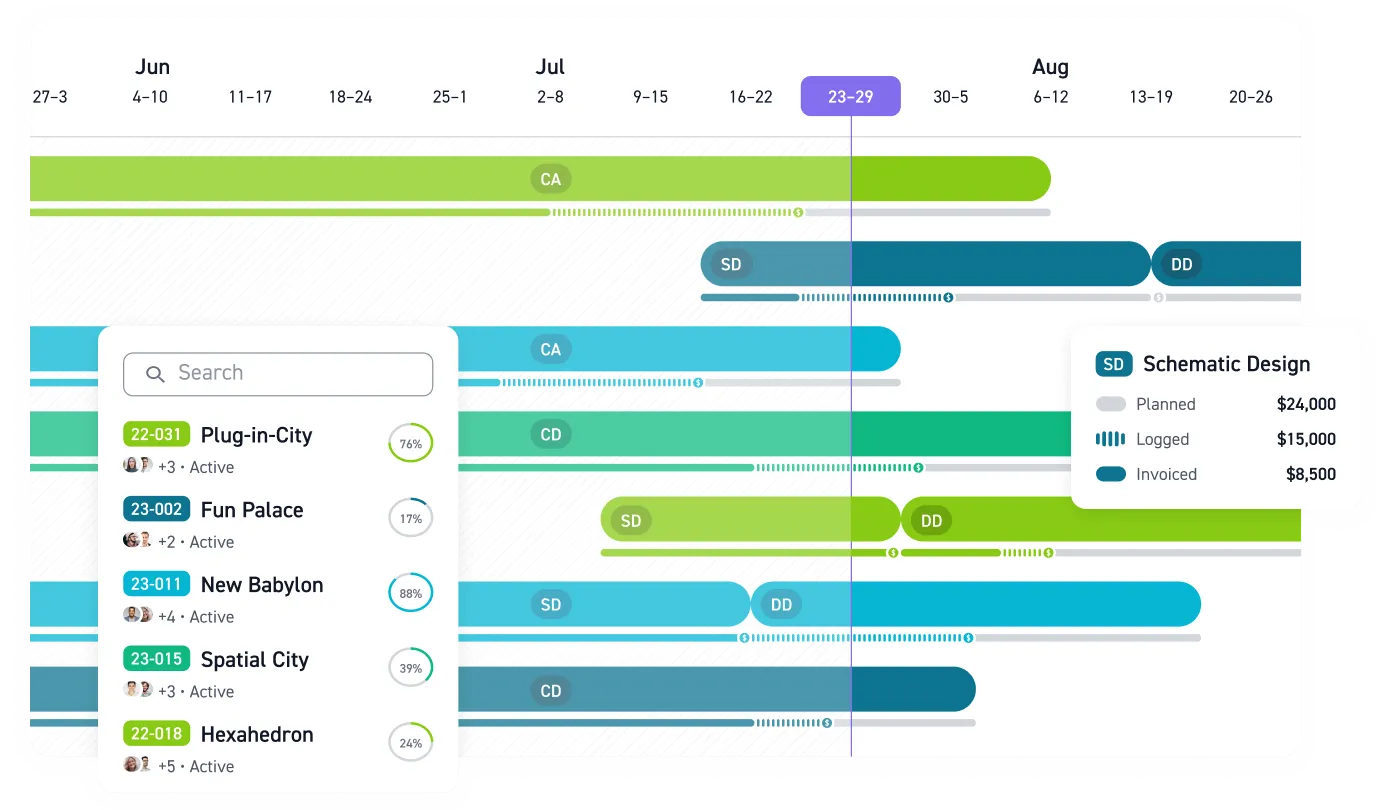
Monograph's MoneyGantt™ combines scope and project timelines with budget-to-cash progression on one chart, so fee burn sits next to the phase it belongs to. If you are the PM who re-keys a won pursuit into three systems on a Friday afternoon, the proposal-to-project handoff is the feature that matters. Brunton Architects & Engineers, an 18-person Minnesota firm, cut admin time 25% and billed twice as fast after moving to Monograph.
Monograph does not document go/no-go scoring or SF-330 support, and its guidance points firms with government work toward pairing Pipeline with a dedicated A&E CRM. Monograph publishes pricing through a calculator.
Best for Public-Sector Pursuits: Unanet CRM by Cosential
Unanet CRM by Cosential, built only for architecture, engineering, and construction firms, is the one tool with documented SF-330 and RFP compliance support, through its ProposalAI add-on. Opportunity records carry stages, teaming partners, submittal deadlines, and win probability. The go/no-go form uses configurable, weighted scoring. Two-way connections to Procore, OpenAsset, and Viewpoint arrived in November 2024. No QuickBooks Online connection is documented in the sources reviewed, so a QBO-based firm runs bookkeeping in a separate system.
Unanet publishes no list price; a third-party listing estimates about $50 per month for a Sales User. Firms pursuing work awarded under qualifications-based selection get the most from it.
Best for Large Firms with Heavy Compliance: Deltek Vantagepoint
Deltek does not sell the Vantagepoint CRM separately from its ERP. Pursuit data flows into the project record when work is won. Its configurable go/no-go workflow closes out unscored proposals. The vendor publishes no pricing. Vantagepoint fits larger firms with federal or multi-entity compliance. For smaller firms, cost and rigidity outweigh the payoff.
Practitioner feedback points to the tradeoff. A 45-person firm on r/Architects says it works for PMs but is rough for forecasting, and describes glitchy annual updates.
General-Purpose CRMs Adapted for A&E: HubSpot, Salesforce, Pipedrive
SMPS recommends HubSpot for firms not yet ready to invest in industry-specific CRM. Its strength is low-cost entry: the free tier supports two seats, and Starter lists at $20 per seat per month. Its limitation is no go/no-go or SF-330 support at any tier.
Salesforce lists Starter at $25 and Enterprise at $175 per user per month. Its strength is the widest set of connections. Its limitation is that A&E workflows require customization or a TrebleHook layer. r/Architects users place Salesforce mostly at 50–70+ person firms, and describe using it reluctantly.
Pipedrive maintains an architect-specific CRM features page, and plans run $19 to $89 per seat per month on annual billing. Its strength is Smart Docs proposals. Its limitation is no documented SF-330 support.
All three give you a visible pipeline but require customization for deeper pursuit work. "Not specified" in the table below means the vendor does not document the feature.
Feature and Pricing Comparison
| Tool | Go/No-Go | SF-330 / SOQ | Client Portal | Reporting Depth | Workflow Automation | Meeting Scheduling | Connections | Pricing Disclosed |
|---|---|---|---|---|---|---|---|---|
| Monograph | Not specified | Not specified | Not specified | Fee-based pipeline and Monograph's MoneyGantt™ reporting | Next-step tracking | Not specified | QuickBooks Online, Google Calendar, Gmail, Stripe | Partial (calculator) |
| Unanet CRM by Cosential | AI-scored | ProposalAI add-on | Not specified | Pipeline reporting and forecasting | AI-scored go/no-go | Not specified | Procore, OpenAsset, Viewpoint Vista | No |
| Deltek Vantagepoint | Configurable | Proposal support only | Not specified | Opportunity win-rate analytics | Configurable workflows | Not specified | Outlook, QuickBooks Online | No |
| HubSpot | Not specified | Not specified | Service Hub only | Yes (Professional) | Yes (Starter and up) | Yes (Starter and up) | QuickBooks Online, Outlook, native apps | Yes |
| Salesforce | Via customization | Not specified | Not specified | Limited (Starter); full (Pro) | Limited on Starter | Not specified | Thousands of systems | Yes |
| Pipedrive | Not specified | Smart Docs proposals only | Not specified | Reporting limits vary by plan | Yes (Growth plan) | Yes (Growth and up) | Marketplace apps | Yes |
How to Choose the Best CRM for Architects and Engineers
Monograph's 2026 Architecture & Engineering Business Benchmarks Report found that architect clients supply 18% of engineering firm revenue versus 6% at architecture firms, while architecture firms earn 19% of revenue from individual clients against 9% for engineers. So engineers need referral tracking, and architects need clean handling of individual clients.
Four questions separate a CRM for architects and engineers from a generic pipeline tool:
- Will a principal update it on a phone after a client lunch? Feature depth is irrelevant if leadership won't log in.
- Does it support a structured go/no-go? Leading that discussion is a core marketing competency in SMPS's Domains of Practice.
- Does won-pursuit data flow into staffing and invoicing, or does someone re-key it?
- Does it claim to connect to Revit or AutoCAD? The Autodesk App Store lists no CRM-to-Revit connector.
Run a pilot around one real pursuit and judge the outcome by whether the team can maintain the workflow without falling back to inboxes and spreadsheets.
Connect Your Pipeline to Project Delivery
Monograph puts pipeline, proposals, and delivery in one system, with its strength being the handoff from a signed proposal into project delivery. Pick Unanet CRM by Cosential if SF-330s and SOQs pay the bills. Deltek Vantagepoint suits larger firms with federal compliance. HubSpot, Salesforce, and Pipedrive work for firms that need a pipeline and nothing more.
Won work should not create more admin. Shortlist two or three vendors, run one real pursuit through each system, and ask each vendor what happens to client, fee, proposal, staffing, and invoicing data the day a pursuit becomes a project. Firms with heavy SF-330 and SOQ requirements may still need a dedicated A&E CRM, while firms focused on connecting proposals to project delivery can evaluate Monograph.
Stop re-keying won work. Book a demo.
Frequently Asked Questions
Does a 5–10 person A&E firm need a CRM?
Yes, if leads, next steps, and proposal status currently live in inboxes or one principal's memory. Start with a defined pursuit process and a tool leadership will actually update. A lightweight pipeline may be enough, but check what happens at award before adding another disconnected system.
Can Monograph replace a dedicated A&E CRM?
Monograph can cover lead tracking, proposals, revenue forecasting, and the proposal-to-project handoff for many 5–50 person firms. It does not document go/no-go scoring or SF-330 support, so firms pursuing substantial government work may need to pair Pipeline with a dedicated A&E CRM.
Should we choose a general-purpose CRM or an A&E-specific tool?
Choose around the pursuits you actually run. HubSpot, Salesforce, and Pipedrive provide visible pipelines but require customization for A&E workflows. Firms that depend on weighted go/no-go scoring, teaming records, SF-330s, or SOQs should prioritize an A&E-specific tool; firms focused on QuickBooks Online and project delivery should test that connection directly.
How should we test a CRM before committing?
Run a pilot with one real pursuit:
- Confirm who owns data entry.
- Ask a principal to update it from a phone.
- Follow the opportunity from Identified through Award.
Require the vendor to demonstrate what happens to client, fee, proposal, staffing, and invoicing data when the pursuit becomes a project.
Data was collected as of April 2026.