

Many A&E principals can't see their staffing needs clearly. Staffing decisions get made from scattered spreadsheets, so the firm can't see how busy it really is until someone is already working weekends or sitting on the bench.
Engineering capacity planning fixes that visibility problem. It compares the hours your team can actually deliver against the work sitting in your backlog and pipeline, then acts on the gap before it turns into missed deadlines, burnout, or idle payroll.
Capacity Planning Sets the Limits, Resource Planning Fills Them
The terms get used interchangeably, but they answer different questions at different levels. Keeping them straight determines whether your plan drives decisions or just documents them:
- Capacity planning guides firm-level decisions. It asks whether the firm has enough total hours to meet demand, and it drives hiring, subcontracting, and go/no-go decisions on new pursuits.
- Resource planning handles project-level assignments. Once capacity exists, it assigns specific people to specific projects based on skills, availability, and current workload.
- Workforce planning is the long-horizon HR layer, aligning skills and staff composition with strategy over years rather than quarters.
The sequence matters. Capacity planning happens first to confirm the hours exist; resource planning then puts names on the work. For engineering firms running high project volumes, skipping the first step turns the second into a weekly scramble.
Forecast Demand in Three Layers
Backlog alone is an unreliable demand signal. Engineering firms carry a median backlog of 11 months, yet contracted work rarely converts to billable hours on schedule: 55% of firms cite client delays and indecision as a factor in projects stalling. Treat every contracted dollar as imminent work and you'll staff up for projects that never start on time.
Build the forecast in three layers instead:
- Committed work. Signed contracts and active projects with high confidence. Pull this weekly from your project system.
- Pipeline work. Proposals sent and deals in negotiation. Assign each a planning probability and weight the hours accordingly.
- Seasonal baseline. Layer in your firm's recurring annual demand pattern so predictable busy and slow stretches are visible before specific projects fill the calendar.
That seasonal layer matters more than most PMs expect. Once you know your firm's annual curve, you can schedule business development and training into the slow stretch instead of scrambling through the peak.
Calculate Supply and Set Utilization Targets
Supply is a straightforward calculation. Start with each person's working hours for the period, subtract planned leave and holidays, then separate billable from non-billable time. Utilization rate is billable hours divided by total available hours, times 100. Roll individual rates up by discipline and firm-wide.
One caution before you benchmark: definitions differ. Cost-based industry studies report firm-wide utilization near 60%, while the hours-based sweet spot for technical staff sits higher. Those numbers describe the same healthy firm. Pick one definition and compare only against benchmarks that use it.
The healthy hours-based sweet spot is 75-85%: enough billable work to stay profitable, with room left for business development and training. Above 85%, firms sacrifice training and long-term investment. Below 75%, firms start losing profitability.
Utilization also drives the hiring call. When a discipline runs at or above the top of the sweet spot for a sustained period and the pipeline is healthy, that signals a hiring need.
Rebalance Weekly and Plan for Pauses
Top-performing A&E project managers recalibrate resources weekly, not monthly. A weekly review catches conflicts while they can still be solved by moving hours instead of moving deadlines, and it keeps capacity views current across both active and pipeline projects. A monthly cadence leaves too much drift between the plan and reality.
Paused projects deserve their own protocol, written before you need it. When a client puts work on hold, the firms that recover fastest already know the answers to these questions:
- How resource reallocation, budget tracking, and restart procedures will be handled
- Which tasks are quick-resume and which need full re-mobilization, flagged while the work is fresh
- Where idle hours move immediately, so staff aren't waiting on client decisions
- Who is cross-trained on low-risk tasks, widening the pool available when work shifts
When the client calls to restart, the plan already says who comes back and when. Without it, every restart is a re-staffing negotiation on someone else's timeline.
Connect the Plan to Live Project Data
Spreadsheet capacity plans go stale the moment a deadline moves. The staffing plan lives in one file, the project schedule in another, and PMs burn hours reconciling the two instead of making decisions.
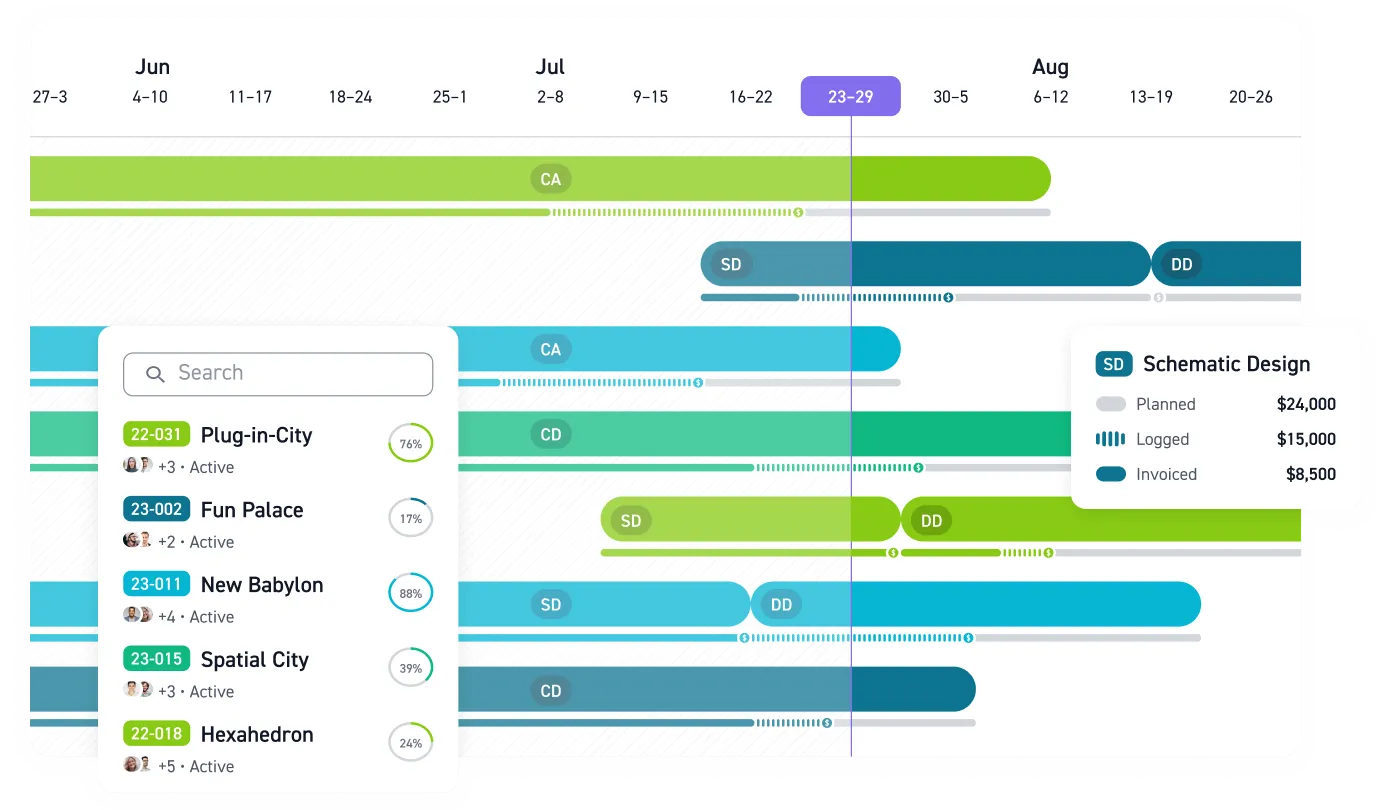
Monograph closes that gap by putting capacity, budgets, and time tracking in one system used by 13,000+ architects and engineers across 1,800+ firms. Its dashboard shows budget and capacity problems, weekly staffing plans rebalance hours, and pipeline forecasting connects future work to staffing, timing, and revenue signals. Budget forecasting answers Monday questions, like whether the team can absorb a scope increase without overtime. Monograph's signature MoneyGantt™ shows planned, logged, invoiced, and paid hours in one view, so a phase drifting past its fee surfaces while there's time to rebalance.
Workbench, a 30-person firm, staffs projects 8x faster with that visibility. Monograph puts your firm's utilization and capacity in one view, so you can compare against the benchmark without reconciling spreadsheets.
Stop Staffing From Spreadsheets
Your next staffing problem is already visible. Capacity gaps, over-allocation, and delayed hiring decisions show up in the data before weekend work.
Monograph gives principals, operations leaders, and PMs one real-time view of utilization, staffing, budgets, and pipeline. Use it to see overloaded disciplines, movable idle hours, and whether the next proposal fits the team you have.
See the staffing risk before it becomes overtime. Book a demo.
Frequently Asked Questions
How far ahead should an engineering firm plan capacity?
Look beyond the current week: active work, weighted pipeline, and annual demand pattern. That gives principals and PMs enough visibility to schedule hiring, subcontracting, business development, and training before the calendar fills.
What utilization target should engineering teams use?
Use one definition first, then benchmark against that same definition. For hours-based planning, the healthy target for technical staff is 75-85%. Above that range, training and long-term investment get squeezed. Below it, profitability suffers.
How should we account for projects that are likely to pause?
Do not treat every contracted dollar as immediate work. Keep paused or delay-prone projects separate from active committed work, and define a restart protocol before the pause happens. Decide who can move immediately, which tasks can resume quickly, and who needs full re-mobilization.
When does high utilization mean we should hire?
One busy stretch is not a hiring signal. When a discipline runs at or above the top of the healthy range for a sustained period and the pipeline is healthy, the staffing problem is no longer temporary. Compare hiring, subcontracting, and go/no-go choices before the team absorbs the gap through overtime.
Can a small firm do capacity planning without dedicated operations staff?
Yes. Start with a simple weekly view of available hours, committed work, and likely pipeline. You need one shared source of truth that shows whether each discipline has enough hours for promised work.