

Harvest pricing structure tracks time cleanly, which is why many small A&E firms start there. But engineering fees live in lump-sum milestone allocations, and architecture fees run through schematic design, design development, construction documents, procurement, and construction administration. Harvest budgets only at the project level, so a principal cannot see which phase is burning past its fee.
The 2026 pricing restructuring added usage-based charges for active projects, clients, tasks, and invoicing on top of per-seat rates. That change is pushing 5–50 person firms to shop for time-tracking alternatives.
Why A&E Firms Outgrow Harvest
The core mismatch is contractual. Firms on fixed fees bill against phase or milestone allocations, and standard phase compensation sets percentages across schematic design through construction administration. Lump-sum contract prevalence ranges from 20% to 80% of engineering firms' business, with smaller regional firms at the higher end. Every hour logged over a phase budget comes straight out of margin.
Structural and MEP firms running concurrent lump-sum jobs feel this at the task level first. An overrun inside construction documents eats the fee before it appears in the project total. Multi-discipline work adds another risk because consultant costs must land against the correct phase. The gaps firms hit most often:
- Fee allocations by discipline live in a side spreadsheet
- No comparison of hours against contracted fee progress or percent-complete milestones
- Profitability reporting reserved for higher tiers, Enterprise and above, per Harvest's pricing page
- No consultant pass-through billing or NTE enforcement, and minimal WIP and earned-revenue visibility
- Time and expenses can't sync to QuickBooks Online; they copy only as invoice line items
The five tools below close most of these gaps, with trade-offs noted.
1. Monograph
Monograph is built exclusively for A&E practice management, targeting A&E firms of 5 to 50 people. It replaces the Harvest-plus-spreadsheet pairing with a system where the budget structure matches the contract structure.
The platform covers the full fee lifecycle:
- Phase-based budgets supporting fixed-fee, hourly, and hybrid structures, with time entries hitting phase budgets when logged
- Budget tracking by phase or person
- Resource planning tools tied to phase schedules
- Phase-based invoices, consultant-bill tracking, and invoice export to QuickBooks Online
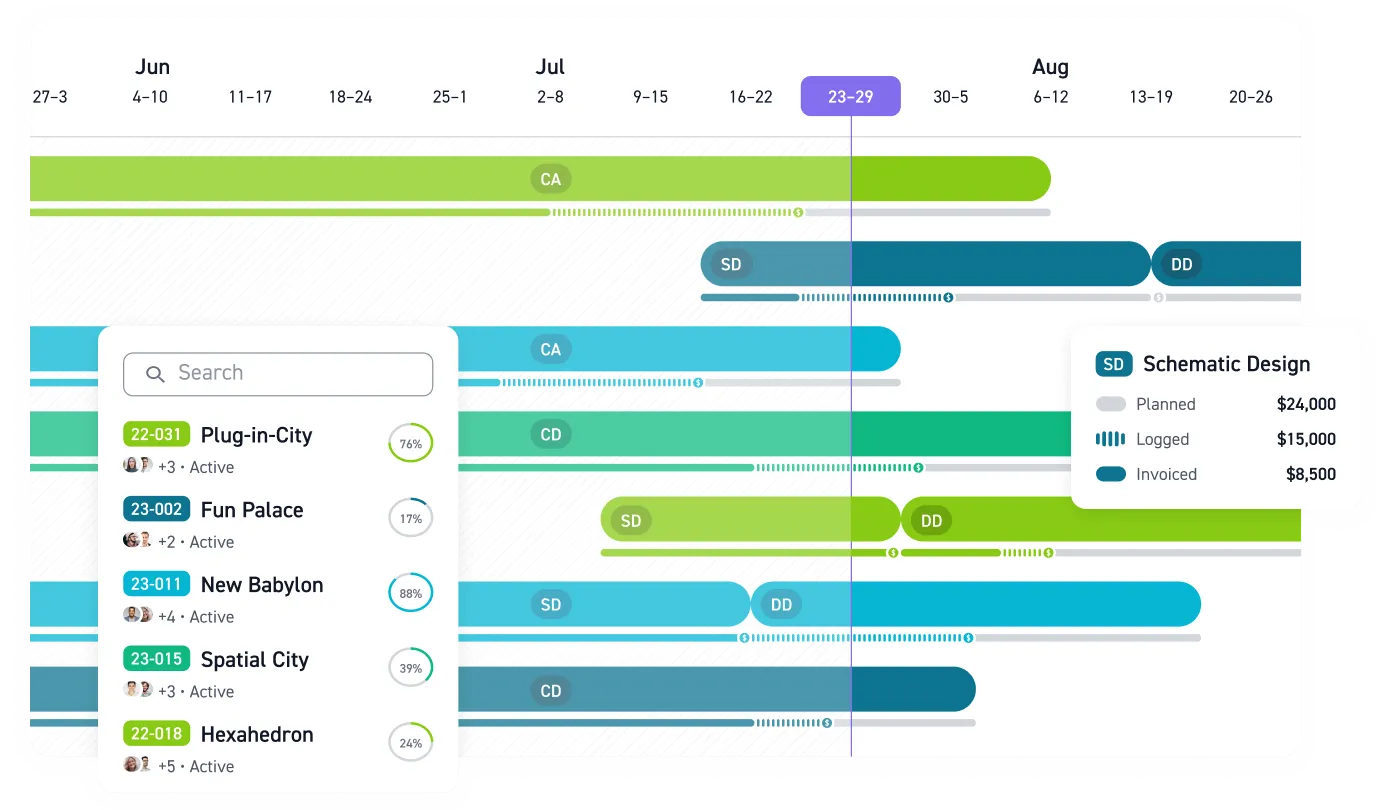
Monograph's MoneyGantt™, its signature view, shows budget-to-cash progression across planned, logged, invoiced, and paid stages. Dorman Associates, an 18-person California architecture firm that moved off Harvest, reported 2x faster billing and 25% fewer budget overages after the switch. Workbench, a 30-person California firm, cut unbilled fees by 75% on the same platform.
Monograph does not produce G702/G703 native pay applications, and its QuickBooks Online sync works under US QuickBooks requirements. Pair accordingly on public work or non-US books.
2. BQE Core
BQE Core directly addresses the billing paperwork public owners often require. It offers:
- Native G702/G703 billing with Schedule of Values continuation sheets
- Percent-complete invoicing for phased projects
- DCAA-compliant time tracking
Built-in accounting can replace QuickBooks for core workflows, though BQE Core does not include payroll features. This makes it a fit for firms that want public-work billing and accounting in one system.
The interface is dense, project management sits secondary to billing, and setup is harder than with lighter tools. Pricing uses modular pricing details, and third-party figures vary widely.
3. Deltek Ajera
Deltek's A&E accounting platform has been purpose-built for A&E firms since 2004. It connects project management and project-based accounting with a built-in general ledger, AP, and AR.
Phase-based budgets, staff utilization forecasting, and real-time dashboards are native. Ajera replaces QuickBooks rather than syncing with it.
It fits multi-discipline firms that want the ledger, phase budgets, and utilization forecast in one place. The trade-offs are legacy UX, heavier setup, and costs that climb as modules stack. Pricing is not published; Deltek quotes directly.
4. BigTime
BigTime serves professional services broadly. Its strengths are entry pricing and a direct QuickBooks Online connection.
Invoices, customers, time entries, expenses, and labor costs sync bidirectionally with QBO in real time. Invoicing supports time-and-materials, fixed-fee, milestone, and retainer formats.
Essentials starts at $20 per user per month. AIA billing isn't listed among its features, and project budgeting sits on higher tiers. It fits firms that prioritize QuickBooks Online sync and flexible invoicing over A&E-specific features.
5. Factor AE
Factor AE is A&E-specific, with subconsultant management for contracts, budgets, invoices, and pay-when-paid workflows. That supports architecture firms passing structural and MEP costs to clients and engineering firms managing sub agreements across disciplines.
It pairs a real-time two-way QuickBooks sync with phase-based project structures. During a trial, test consultant costs spread across more than one phase and confirm each bill reaches the right budget and client invoice line.
Factor AE is less established than the other tools here. It doesn't publish resource planning or G702/G703 support, so keep existing staffing forecasts and confirm AIA billing before invoicing a public owner.
How to Choose
Match the tool to your contracts before comparing feature lists.
- Contract structure: Do phase budgets and percent-complete tracking exist natively?
- Accounting model: Keep QBO with Monograph, BigTime, or Factor AE, or replace it with BQE Core or Ajera?
- Billing formats: Public work requiring G702/G703 points to BQE Core. Ajera is listed as AIA-capable, so confirm the output with Deltek.
- Setup time: Monograph and Factor AE position themselves as faster to set up than Ajera.
The best fit should mirror how fees, consultant costs, and invoices move through an actual project. A longer feature list does not make up for a budget structure that fails to match the contract. Test one active project before your next invoicing cycle.
See Which Phase Is Burning Through Its Fee
A fixed-fee phase can lose margin before the project total looks wrong. Principals need phase-level margin visibility, operations leaders need cleaner billing, and project managers need early warnings when hours or consultant costs exceed the fee.
If those gaps are pushing your firm beyond Harvest, evaluate Monograph with one active project. Its A&E-specific workflow connects phase budgets, time entries, consultant costs, Monograph's MoneyGantt™ visibility, and invoices without rebuilding the fee structure in a spreadsheet. Book a demo.
Frequently Asked Questions
Use one active project and the billing format your clients already expect to test each tool.
Is phase-level tracking necessary for a small A&E firm?
Yes, especially for fixed-fee work. Every hour over a phase budget reduces margin, while a project total can hide the loss for months. Phase tracking gives the team time to adjust staffing or scope.
Can we keep QuickBooks Online after leaving Harvest?
Yes, depending on the tool. Monograph, BigTime, and Factor AE pair with QuickBooks Online, while BQE Core and Ajera replace it for core accounting workflows. Decide whether you want project management around QBO or a new accounting system.
Which Harvest alternative is best for G702/G703 billing?
BQE Core is the clearest fit because it produces native G702/G703 billing with Schedule of Values continuation sheets. Ajera is listed as AIA-capable, but confirm the exact output with Deltek. Monograph does not produce those pay applications natively.
How should we test phase budgeting before switching from Harvest?
Run one active project through the trial. Confirm that each logged hour reaches the correct phase budget, consultant costs appear on the right fee line, and the invoice matches the client's expected format.
Choose the system that reveals phase performance early enough for the team to protect fixed-fee margin.