



Firm management made easy

The client asks for one more equipment layout option on a Thursday call. Your electrical lead spends the next week reworking panel schedules. Mechanical, electrical, and plumbing run as separate cost centers with separate leads and utilization targets. The contract is one number against one deadline.
When disciplines are run as profit centers, they compete for the same fee. Once one burns past its share, the firm absorbs the overspend or bills it as additional services. Catching that extra work the day it lands, and getting it authorized before the hours are spent, is what keeps A&E firms from doing additional services for free.
Splitting the fee when no published benchmark exists
Benchmark publishers may separate mechanical and electrical engineering, but they generally don't break MEP fees into distinct percentages. The splits PMs use often come from firm history. ACEC's lump-sum guidance describes estimating effort by discipline as if billing cost-plus, then rounding phase totals. A work breakdown structure pays for itself on any project over $25,000, with 10% of hours added per task to absorb small changes. Build the split in three moves:
- Estimate hours per task per discipline and apply each role's charge rate
- Keep project management and coordination as a separate line item based on your firm's history
- Reconcile against the fee; if tasks total $180K against a $150K fee, reduce scope, accept the thinner margin, or decline
That reconciled number is the split you measure each discipline against.
Sequencing the handoffs by output availability
One deadline binds three disciplines that cannot all start at once. Electrical needs equipment schedules with minimum circuit ampacity and maximum overcurrent protection values before it can size electrical systems. Late input can stop plumbing short of the 30% preliminary design milestone.
Natural gas piping is the contested boundary; the discipline with the largest gas load owns the system. Four handoffs hold the sequence together:
- Mechanical to electrical: equipment schedules with nameplate MCA/MOCP and preliminary locations
- Mechanical to plumbing: boiler information, gas loads, and operating pressures
- Architect and process engineer to plumbing: fixture and drainage requirements
- Team to electrical: estimated backup-power loads for the UPS and generator before distribution sizing
Total float is shared. When an output slips, move the downstream lead to independent tasks, re-baseline the handoff date in the log, and raise it at that week's review. The PM owns the log.
Catching a discipline that is burning its share early
The signal is percent spent diverging from percent complete by discipline and phase. Review burn rate with two separate measures. Compare percent of fee spent with physical percent complete. Separately, compare logged hours with planned hours for the phase. Review both weekly against documented thresholds:
- Choose a firm threshold, such as when logged hours divided by planned hours exceeds 110%
- Set intervention triggers at 30%, 60%, and 90% of fee burn, as high-performing firms do
- Use a firm-selected variance, such as a gap over 10%, as a phase-review trigger
Phase-level books show which phase went wrong. Discipline tracking shows which lead to question.
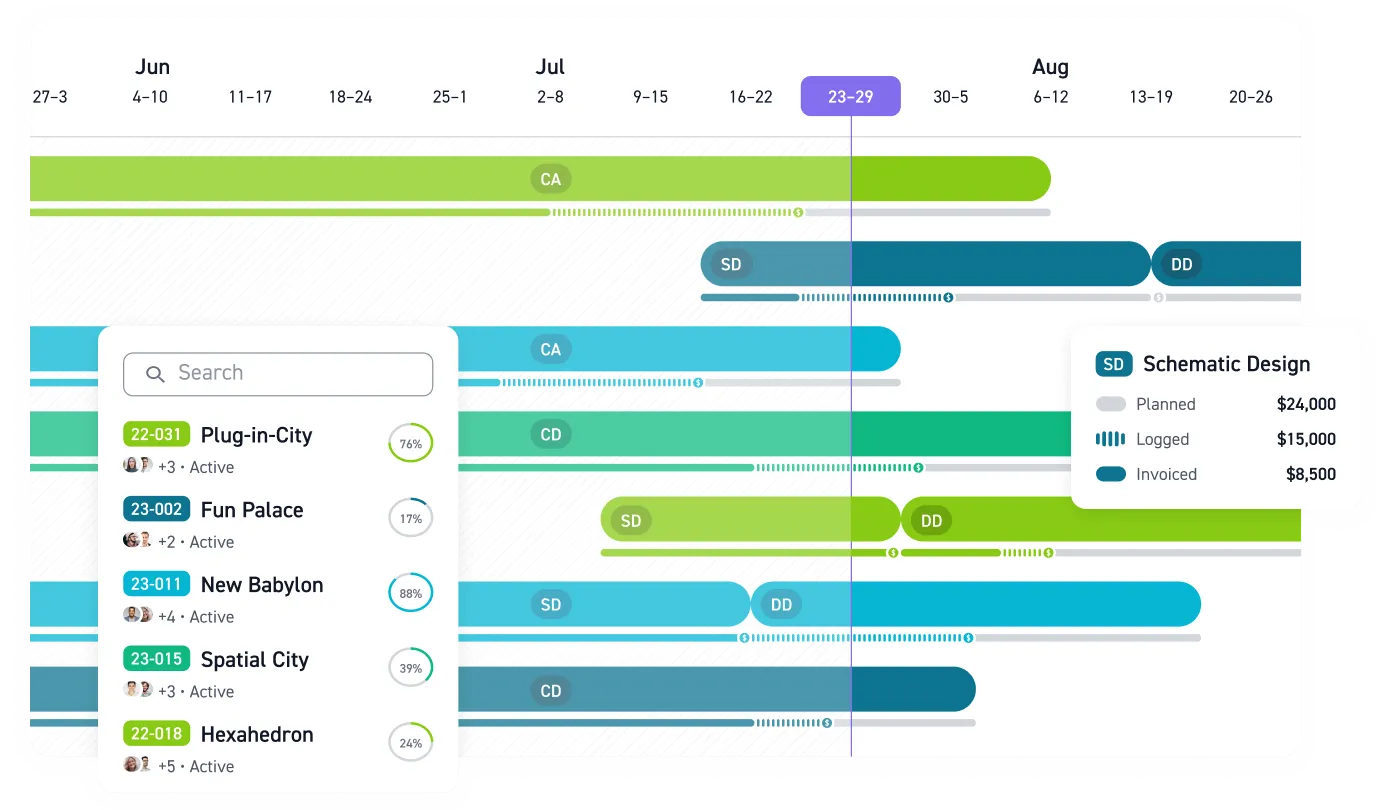
The utilization sweet spot is 75–90%. A lead with hours to hit and no scope left stretches the work over budget. Monograph surfaces phase and project budget risk through visual financial tracking and alerts. Monograph's MoneyGantt™ plots the schedule alongside budget-to-cash progression: planned, logged, invoiced, and paid, so a discipline running hot becomes visible mid-phase.
Classifying the request the day it arrives
Before absorbing an overrun, check what caused it. The owner-architect agreement lists triggers such as a change in Initial Information, previous instructions or approvals, or project size, quality, complexity, schedule, or budget. Electrical running hot because the client changed the program is additional services the client owes for.
The agreement requires prompt notice and written authorization. Under EJCDC E-500, the owner pays authorized additional services at standard hourly rates. EJCDC E-570 requires consultants to correct their own technical deficiencies without extra compensation unless bad supplied information caused them. Ask whose decision created the hours, not which discipline logged them.
Raising it with the client without spending the relationship
Anchor the ask to the client's approved instruction and raise it before spending the hours. Quantify hours before dollars and keep it to one page, without blame or another scope negotiation:
"The equipment layout change you approved on the 14th adds roughly 26 hours of electrical rework. That sits outside the schematic design scope, so I'm sending a one-page authorization today with the cost and schedule impact. Once it's signed, those hours go on the next invoice."
Do not present it as a budget complaint or ask the client to approve hours already burned. Both turn routine authorization into a negotiation.
From the log entry to the invoice line
Write the entry when the instruction lands. Five fields are enough:
- Date of the client instruction
- Who gave it
- Discipline affected
- Hours it adds
- Phase the hours get charged to
Those fields let you rebuild the request. The change-order form should carry the change description, cost impact, and time impact. Put authorized hours on their own additional-services line. Carry the authorization date and phase from the log onto that line, and bill them in the same cycle. Billing in cycle keeps fee burn, accounts receivable, and margin reporting on the same hours. Do not invoice the work as an additional service until you have the authorization required by your contract.
A&E firms with disciplined change order processes capture 95% more additional services revenue than firms relying on informal arrangements. Change orders fail when they are never raised, raised too late, or documented too thinly. Monograph's project planner supports staff and consultant budgets by phase, while time tracking and invoice workflow stay in the same platform. That connection has practical results: Brunton Architects & Engineers reported a 2x faster billing process and 25% less budget overage after adopting Monograph.
Stop doing extra work for free
Set discipline-level phase budgets, review burn against scope weekly, keep one change log, and carry each signed authorization to its own invoice line. That gives the firm one path from scope trigger to payment. Catch the extra work before the fee absorbs it, and A&E firms stop delivering additional services for free.
Monograph connects phase budgets, logged hours, and invoicing in one A&E workflow, making separately authorized work easier to track and bill. Book a demo to see how it fits your firm.
Frequently Asked Questions
How should we split an MEP fee when the contract gives one lump sum?
Estimate hours by task, discipline, and role. Keep coordination separate, then reconcile discipline budgets against the contracted fee.
What should the PM do when a mechanical handoff delays electrical or plumbing?
Move the downstream team to independent work, re-baseline the handoff date, and raise the slip at that week's review.
When does discipline over-burn become an additional service in A&E?
Trace the hours to their cause. Client instructions and material scope changes support a request; correcting your firm's technical deficiency generally stays inside the fee.
What if work has started before the client signs the authorization?
Pause where possible, document the instruction and hours, and get written direction. Do not bury unsigned hours in the base phase or invoice them.
Data was collected as of April 2026.