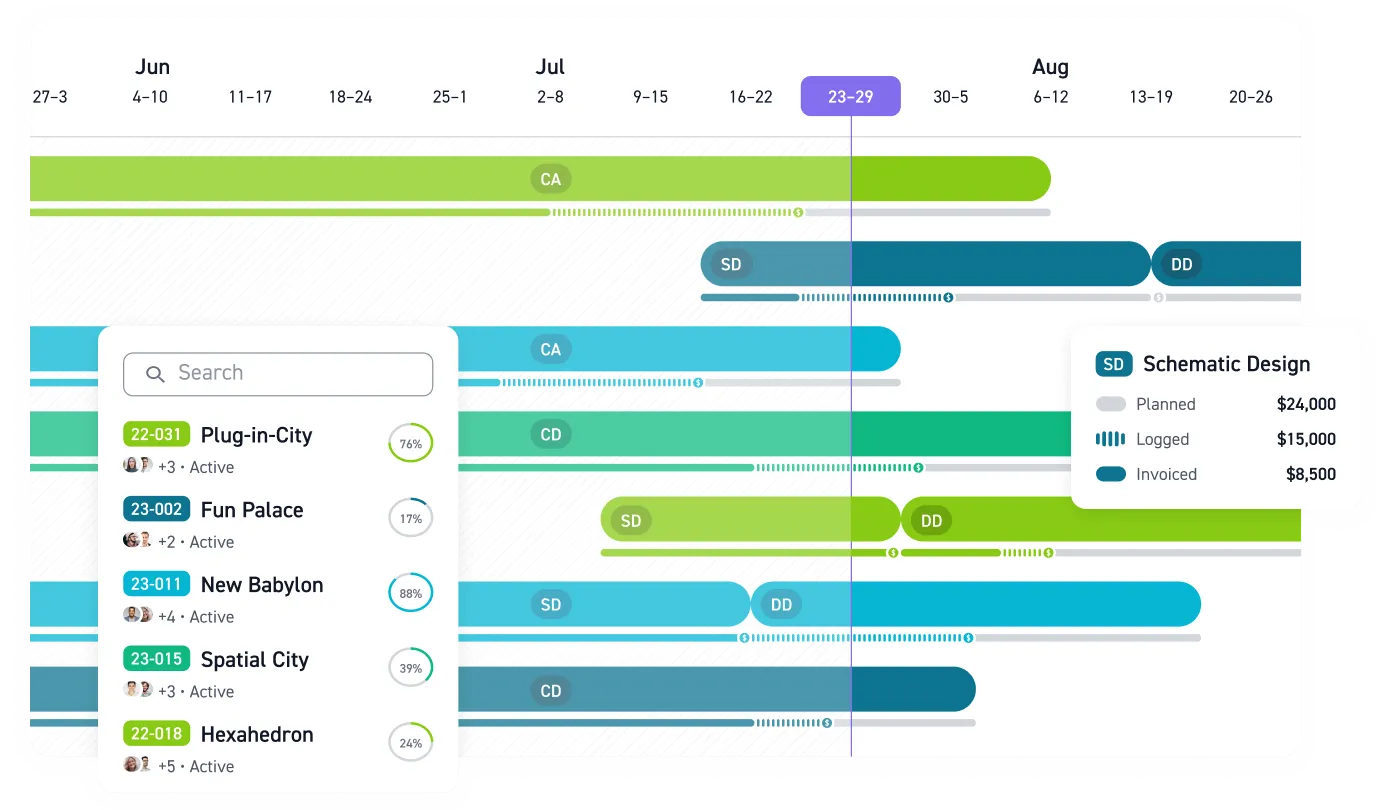




Firm management made easy

A structural engineer spends Tuesday on a client call about revised column loads, a 40-minute MEP coordination meeting, three RFI responses, and two hours of framing calculations. On Friday the timesheet shows eight hours of design against the base contract. The calculations made it in; the call, the meeting, and the RFIs did not, and none of them will reach an invoice. Monograph's 2026 Architecture & Engineering Business Benchmarks Report puts baseline realization at 96%, meaning firms lose 4 cents on every dollar of billable time to write-offs and scope creep. Some of that loss starts before the invoice exists, in hours nobody recorded.
Why coordination work never reaches the timesheet
Zweig Group's advice to A&E firms is blunt. Nobody can remember last Friday in 15-minute increments. Daily entry is the only route to accurate timesheets, and more accurate timesheets mean more revenue.
Engineering work is also unusually fragmented. Information workers last about 11 minutes on one thread before switching. An RFI landing mid-calculation or a ten-minute check with the civil consultant is exactly the interval a Friday reconstruction drops or miscodes. When an engineer fills in a week at once, hours flow to familiar codes like design and drafting, and the coordination work that filled the gaps vanishes.
The cost lands on the firm's P&L. For a 100-person A&E firm, one point of utilization is worth about $225,000 a year. A 12-person structural practice runs the same arithmetic at smaller scale.
What time tracking software for consultants has to do
Generic time trackers record hours against a project name and stop. Consulting engineering bills against a fee structure, so the timesheet has to mirror it. Whether the contract follows standard engineering phases (Study and Report through Post-Construction) or architect-led phase percentages, every hour needs a phase to land in.
Four capabilities separate software that supports engineering billing from software that creates a spreadsheet running beside it:
- Hours tied to a phase budget. Under EJCDC lump-sum terms, each invoice reflects the engineer's estimate of percentage complete for the period, and phase-coded hours are the evidence behind that estimate.
- Multiple billing rates per person. PM billing rates alone run from $136 to $360 per hour; the same engineer may carry different rates on different projects, and the invoice has to apply each without manual edits.
- Subconsultant hours kept separate. Median markup on subconsultants is 10%. On federally funded transportation work, state DOTs follow federal cost principles, so subconsultant pass-throughs have to be tracked separately from direct labor, or the overhead rate comes out distorted.
- Timesheets that feed the invoice. Approved entries become invoice lines without anyone rebuilding them in Excel.
Harvest, Clockify, and Toggl Track each cover part of this list, and none of them budgets at the phase level A&E billing requires. Our time-billing software comparison has the tool-by-tool detail. The rest of this piece covers running the process well once the structure exists.
Give every hour a code before the work starts
Consider a client who revises floor loading halfway through construction documents: the PM opens a change-order phase code the day the revision arrives, the new framing calculations book against it, and the change order invoices in the same billing cycle. Hours logged to the base contract instead can never be billed as extra services.
You priced the CA fee once. RFI responses, submittal resubmittals, and extra site visits spend it one at a time, and each belongs on an additional-services code rather than the base CA phase. Public-sector work adds codified rules: the AASHTO audit guide adopted by state DOTs requires supervisor approval of every timecard and labor reconciliation at least every 30 days, and daily timekeeping requirements require daily entry with a specific project code on each line.
A workable policy for a 10 to 30 person firm has three parts:
- Enter time daily, classified billable or non-billable at the moment of entry.
- Open change-order and additional-services codes the day the request arrives, and gate new phases on written authorization.
- Review phase burn weekly in a 15-minute PM pass before anything goes to invoicing.
NSPE's Board of Ethical Review has ruled that charging one client's hours to another's budget is misrepresentation. Accurate codes protect your professional standing. They protect your margin as well.
Rebuild the week from the calendar
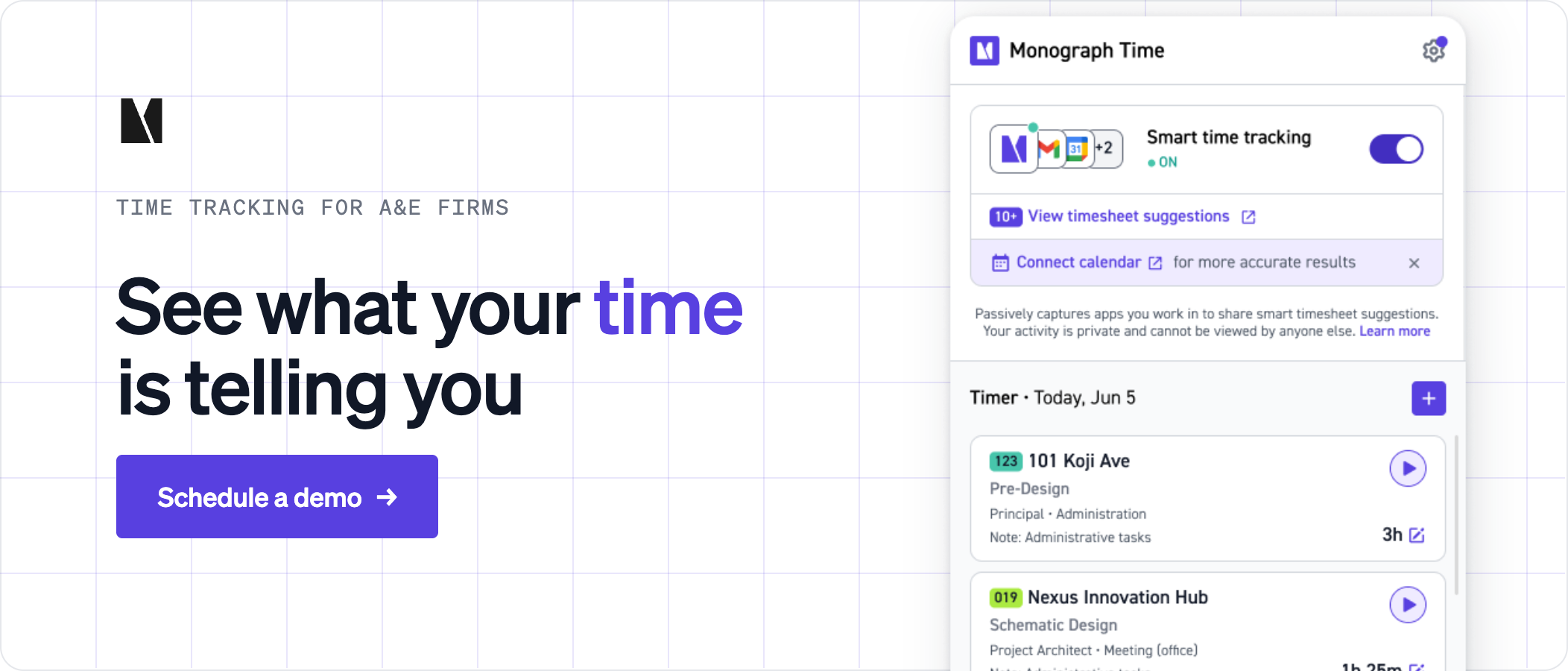
Daily entry is the policy, the calendar is the backup. Smart Time Suggestions read Google or Outlook Calendar activity and propose entries for the week's timesheet. That 2pm coordination call with the mechanical engineer comes back as a suggested timesheet entry for review, whether or not anyone remembered it.
Before using a suggestion, check the fields a consulting timesheet needs. Each field ties the calendar activity to the work performed. Review all three:
- Project name and phase name
- Activity
- Suggested hours
Treat every suggestion as a starting point, then verify the project, phase, activity, and duration against the work performed. This review keeps responsibility for the timesheet with the engineer while reducing the need to reconstruct the week from memory. Monograph connects phase budgets and invoicing, so accepted entries carry into the billing cycle without a spreadsheet step. Learn more about Monograph's time tracking software for architects & engineers.
What accurate hours feed downstream
Every captured hour moves two numbers finance already watches. Realization tracks how much logged billable value reaches the invoice; our guide to engineering realization rates names timesheet drift, hours rounded, delayed, or dumped in the wrong phase, as one of five causes of leakage. Utilization tracks the share of hours that were billable to begin with, and our utilization tracking guide argues for reading it alongside realization, gross margin, and client satisfaction rather than alone.
According to Monograph's 2026 Architecture & Engineering Business Benchmarks Report, high-performing firms bill roughly 10 more hours per person per week than low performers. On a $100K project, the realization gap between low performers at 83% and top firms at 107% comes to $24K. Firms investing in AI tools average 100% realization, capturing the full value of every hour worked.
HDG Architecture, a 13-person firm managing 50 active projects a month, cut administrative time by 25% and reduced overtime by 25% after adopting Monograph. Start smaller this week. Connect the calendar, review Monday's suggestions Tuesday morning, and compare the coded hours against what the manual timesheet would have shown.
Capture the Hours You Already Earned
Missed coordination calls, RFIs, and site visits become lost revenue when they never reach the right phase. A daily process gives project managers time to review phase burn before invoicing. It also gives operations leaders approved entries they can carry directly into billing.
Monograph is a natural next step for firms ready to connect daily time entry, phase budgets, and invoicing. Principals can compare realization before and after the change. PMs can keep additional services from disappearing into the base contract.
Unrecorded hours disappear fast. See how the workflow fits your engineering practice. Book a demo.
Frequently Asked Questions
Does time tracking matter on fixed-fee engineering projects?
Yes. Phase-coded hours show how quickly the fee is being spent and support the engineer's estimate of percentage complete. They also give the firm better evidence for pricing future work and identifying additional services before those hours disappear into the base contract.
How do we get engineers to enter time daily?
Create the project and phase codes before work starts. Then keep entry simple enough to complete at the end of each day. Use the calendar as a backup and have PMs review phase burn weekly so staff can see that accurate entries guide real project decisions rather than simply satisfy an administrative rule.
Can calendar suggestions create inaccurate time entries?
Suggestions are proposed entries that the engineer reviews before using them. This preserves human review without requiring the week to be reconstructed from memory.
How should we handle extra services before a change order is signed?
Keeping the request separate prevents revised calculations, extra RFIs, and additional site visits from being buried in the base phase. The commercial terms can be resolved separately.
Data was collected as of April 2026.