
Most A&E firms track project expenses in a spreadsheet that one person understands. Consultant invoices sit in email, mileage receipts sit in a project manager's glovebox, and hours get reconstructed on Friday afternoon. Then month-end arrives and the finance manager starts stitching it all together.
The math is against that workflow. Audits of operational spreadsheets found that 94% of spreadsheets contain at least one error, and a June 2026 industry benchmark found that 42% of A&E firms cannot report their own net profit margin. Both problems come from the same gap: costs recorded late, in the wrong place, or not at all.
Phase-based tracking closes that gap, and every step below runs on the fee structure you already sign in your contracts. Each one works in Monograph, but the discipline holds whether you run a five-person structural practice or a thirty-person architecture studio.
Step 1: Build a Phase-Based Baseline
A project-level budget cannot diagnose an overrun; a phase-level budget can. Start with the signed fee and the phase split written into B101 §11.5 of your contract, which for private work usually lands near the 15/20/40/5/20 standard across Schematic Design, Design Development, Construction Documents, Procurement, and Construction Administration. The AIA's fee guidance directs project managers to carve out consultant fees and contingency first, then divide the net fee among phases and convert each phase into available hours.
Inside each phase, sort costs into three buckets that match how your income statement already works:
- Direct labor: hours at each person's raw salary cost, logged to a specific phase.
- Reimbursable expenses: the items B101 §11.8.1 lists as billable beyond fees, including travel, permitting fees, printing and plots, and site office costs.
- Consultants: pass-through fees that count in gross revenue but not in net service revenue.
Consultant weight differs sharply by discipline. Monograph's 2026 Architecture & Engineering Business Benchmarks Report found that consultant costs take 17% of an architecture firm's budget and 5% of an engineering firm's, so an architecture principal who skips consultant tracking is blind to a sixth of project cost. In Monograph, Project Planning holds each phase with its own fee type, cap, markups, and staffing rates, and the AI Budget Builder turns a signed contract into a phased budget you can adjust by hours or by percentage.
Step 2: Capture Costs the Day They Happen
Timekeeping treated as busywork produces rounded hours and misallocated phases. PSMJ names inaccurate time entry as one of the top financial blind spots in A&E firms because leaders then price the next job on bad history. Daily entry is the fix. In Monograph, timesheets arrive pre-assigned with project phases and budgeted hours, so the person logging time sees the budget they are drawing down.
Reimbursables need the same immediacy, and the IRS sets the floor. Documentary evidence is required for any expense of $75 or more and for all lodging regardless of amount, with the amount, date, place, and business purpose recorded. Under an accountable plan's fixed-date safe harbor, employees must substantiate expenses within 60 days; miss it and the reimbursement becomes taxable wages on the W-2. Mobile receipt capture in Monograph lets a project manager photograph the receipt on site, attach it to the project with auto-filled details, and move on.
Consultant bills arrive on the consultant's schedule, not yours. Upload them as they land; Monograph reconciles each invoice against the budgeted consultant fee and updates project profitability in real time, and Monograph keeps consultant vendor records aligned with QuickBooks Online.
Step 3: Compare Budget to Actuals Every Week
Weekly reviews catch problems while a scope conversation is still possible; monthly reviews on a fixed-fee project mostly document losses. Research shows a project's cumulative cost performance index stabilizes around 20% completion: a project running a CPI of 0.80 at 30% complete will finish at least 13.6% over budget under the best realistic outcome.
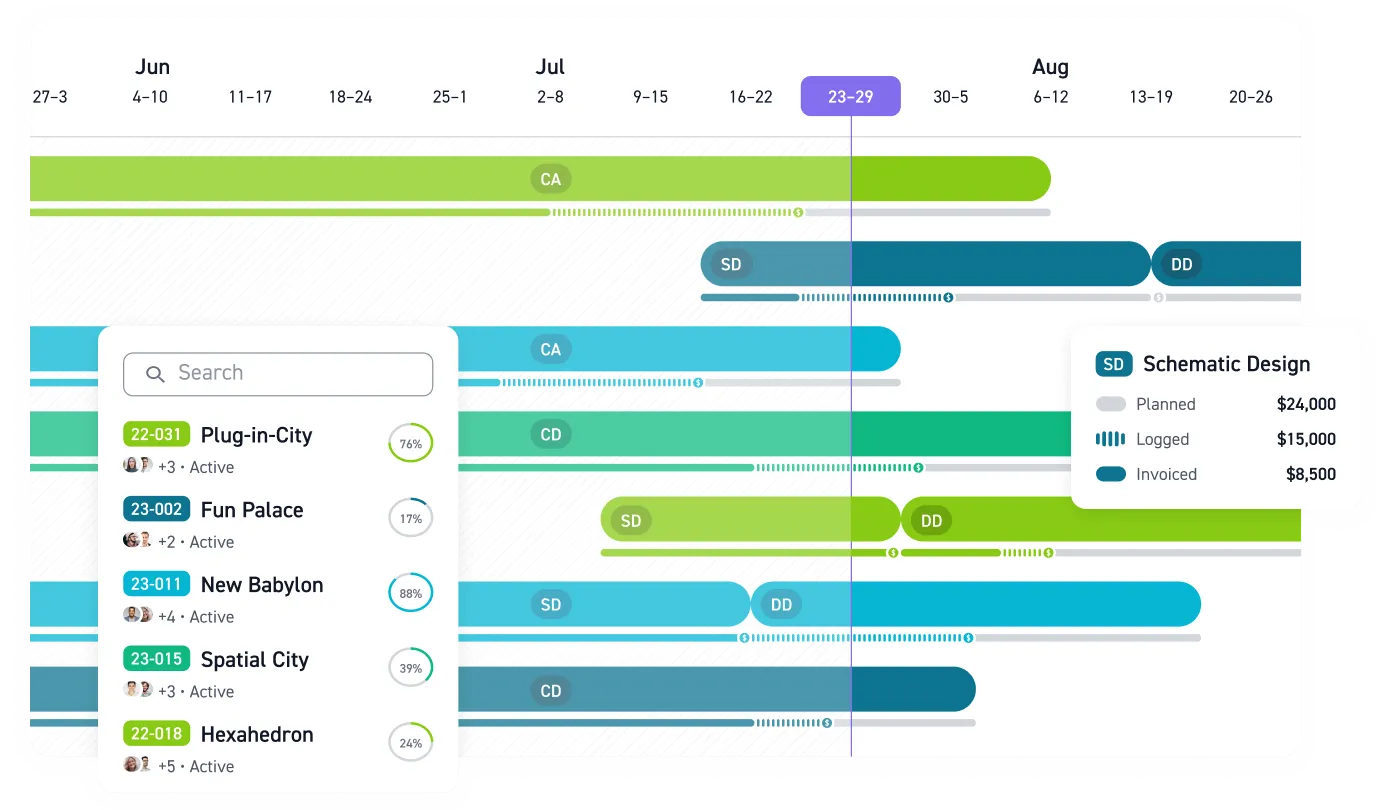
Monograph's MoneyGantt™, the platform's signature view, overlays each phase's budget against budget-to-cash tracking and shows budget-to-cash progression from planned to logged to invoiced to paid, with no formulas or lookups. A quick scan of each active project every week surfaces the patterns that precede an overrun:
- Percent spent running ahead of percent complete on a phase.
- Consultant invoices arriving larger or earlier than the phase budget assumed.
- Staff utilization drifting well above target on one project, which usually means unbilled scope.
- Unbilled work-in-progress aging beyond the firm's billing window; if it remains unresolved, escalate to a principal.
Write-offs and scope creep are where these red flags end up if nobody acts. Benchmark realization data puts baseline firm realization at 96%, meaning the average firm loses 4 cents of every dollar of billable time it logs; top-performing firms reach 107%, mostly on fixed-fee work finished under budget.
Step 4: Report, Reconcile, and Correct Course
By month-end, a finance manager can confirm numbers project managers reviewed in Monograph's MoneyGantt™. Phase-level financial data breaks each project down phase by phase across budgets, billing, expenses, consultant costs, and profitability, while reimbursable expense detail isolates reimbursables for client billing. Because Monograph exports invoices to QuickBooks Online without double entry, synchronizes client and vendor records, and imports real costs for project forecasting, manual reconciliation takes less work.
Use that month-end read to make three decisions:
- Bill what is earned. Reimbursables belong on the next invoice with receipts attached; B101 §11.10.2.3 requires expense-record access for the owner.
- Paper the scope change. Industry guidance recommends a formal change order that documents the requested modification's impact on schedule and cost, and B101 §4.2.1 requires the architect to obtain the owner's written authorization before proceeding with additional services.
- Write off what won't bill. Once a phase closes over budget with fees above the contracted cap, write the excess off immediately instead of carrying it as WIP.
Practice leaders have found that firms which implement even simple tracking systems improve performance 15–20% within the first year. The report's realization gap between low performers at 83% and top firms at 107% works out to $24K on a single $100K project, which is the fee you either invoice or absorb.
Replace the Spreadsheet Tab
Monograph brings budgeting, staffing, invoicing, and expense tracking into one platform built by architects and engineers who managed these budgets themselves. Woodhull, a 25-person firm in Maine, reports 66% less budget overage since running its practice on Monograph. Dynamic Engineering, a 10-person structural firm in Florida, grew profit 25% after leaving Excel behind.
Catch the overrun this week. Your consultant invoices, receipts, and timesheets already exist. The question is whether they land in a shared phase budget this week or in a spreadsheet nobody reconciles until quarter-end. Book a demo to watch Monograph's MoneyGantt™ carry a phase budget from planned to paid.
Frequently Asked Questions
Is phase-level expense tracking worth the effort for a small firm?
Yes. A five-person practice has less room to absorb an overrun, and a project-level total cannot show which phase is consuming the fee. Start with active fixed-fee projects and divide each signed fee into phase budgets, direct labor, reimbursables, and consultant costs.
What if staff consistently code expenses to the wrong phase?
Make the correct choice visible before approval. Pre-assign timesheets to project phases and require every expense to include a project, phase, vendor, category, and date. Review the entries weekly so errors are corrected while the work is still fresh.
How should we track consultant costs when invoices arrive months later?
Put the consultant fee in the phase budget when the project is set up, then upload each bill as it arrives. Compare consultant costs against that budget every week so a delayed invoice does not create a surprise after the phase has closed.
How do we keep reimbursables aligned with client invoices and QuickBooks Online?
Capture receipts when the expense happens, attach them to the project, and review reimbursables during the weekly budget check. At month-end, isolate those expenses for client billing and confirm that invoices, expenses, and consultant bills agree with QuickBooks Online.
Data was collected as of April 2026.