



Firm management made easy

A structural design development package can burn 140% of its budget while the project dashboard reads green. Say the structural scope on a mixed-use project carries a 1,000-hour fee split by phase: 150 hours for schematic design, 150 for design development, 450 for construction documents, 50 for bidding, and 200 for construction administration. SD closed at 140 hours. DD closed at 210 hours, 140% of its phase budget. CD and CA have not started, so the project total shows 350 hours logged against 1,000 budgeted, and nobody flags it.
Those 60 hours do not come back. PSMJ's 2022 fee survey found that 72% of engineering subconsultants bill lump sum or fixed fee, so a DD overrun comes straight out of margin. The PM finds out at close-out, after CD has quietly spent the cushion that was supposed to absorb it.
Most project management time tracking tools would have logged those 210 hours correctly against the project. The project was the wrong unit of measure.
Fees are structured by phase, so budgets have to be
Standard architect-owner contracts define Basic Services as five phases: SD, DD, CD, procurement/bidding, and CA. In the AIA B101-2017 form, Section 11.5 includes a compensation table where the parties assign a share of the fee to each phase, summing to 100%. Engineering subconsultants typically inherit that same breakdown as a negotiated slice of the prime's fee.
The exact percentages depend on the owner and the market, but the shape holds. Three published splits show the range:
- The traditional 15/20/40/5/20 baseline for SD, DD, CD, bidding, and CA
- Washington State's 2025–27 public works guidelines for combined A&E teams including subconsultants: 18% SD, 20% DD, 31% CD, 2% bidding, 27% construction, 2% closeout
- Practical full-service ranges of SD 10–25%, DD 10–25%, CD 35–50%, and CA 20–30%
Each of those slices is a separate budget with its own start date and its own close-out. PMI's earned value guidance treats labor hours as the unit on labor-intensive projects and states that spending does not enter into percent complete, because money spent does not guarantee progress. A phase that closes at 140% of its hours has a locked-in efficiency you cannot fix. The project total hides it by averaging against phases that have spent nothing yet.
Your finance manager needs the same split. Cost-to-cost revenue recognition divides costs incurred by total estimated costs, and phase-level hours are what keep that denominator honest at month end.
What a phase-level timesheet has to carry
Tracking by phase changes what a single time entry has to contain. A "Maple Street, 6 hours" entry tells the PM nothing about which budget it hit. The minimum for a consulting engineering firm is four fields:
- Project and phase on every entry, so hours roll into the right budget the day they are logged
- A billable or non-billable activity, so utilization reads true before invoicing instead of after
- The person's role and rate, since a principal's hour and a junior's hour bill differently on the same phase
- Subconsultant hours kept separate from staff labor, so pass-throughs do not distort labor metrics
That structure is also what auditors expect. The AASHTO Uniform Audit & Accounting Guide, which state DOTs apply to FAR Part 31 overhead audits, states that the nature of the work determines where hours go, never funding availability or contract type. DCAA's contractor guidance calls for daily time entry distributed by project or cost objective.
The billing consequence shows up in realization. According to Monograph's 2026 Architecture & Engineering Business Benchmarks Report, baseline firms average 96% realization, losing 4 cents on every dollar of billable time to write-offs and scope creep. The spread between low performers at 83% and top firms at 107% is worth $24K on a $100K project. Hours that never reach a phase, or reach the wrong one, sit on the losing side of that gap.
Why a PE on four projects cannot reconstruct the week
The phase model asks for precision that memory-based timesheets cannot deliver. PMI's multi-project research cites Fricke and Shenhar's finding that two to three projects is the productive ceiling for an engineering project manager. PEs in busy civil or MEP firms often carry more, and each switch between them costs something. Sophie Leroy's work on attention residue found that people who left a task unfinished performed significantly worse on the next one.
The memory problem compounds it. A BLS analysis of time diaries found that workers who estimated 50-hour weeks had actually logged 37.1 hours when tracked day by day, a 12.9-hour gap. Kahneman's Day Reconstruction Method exists because recalling the previous-day context produces more accurate recall than longer look-backs. Friday-afternoon reconstruction of Tuesday is the long look-back.
The items most likely to get assigned to a project while the phase gets guessed are:
- The RFI response
- The 2pm coordination call
- The 40 minutes of redline review
Zweig Group's cash-flow guidance is blunt about submission frequency: get timesheets in daily or at least weekly, because you cannot bill what you have not recorded. Daily entry only works if the entry itself takes seconds.
Letting the entry resolve to its phase
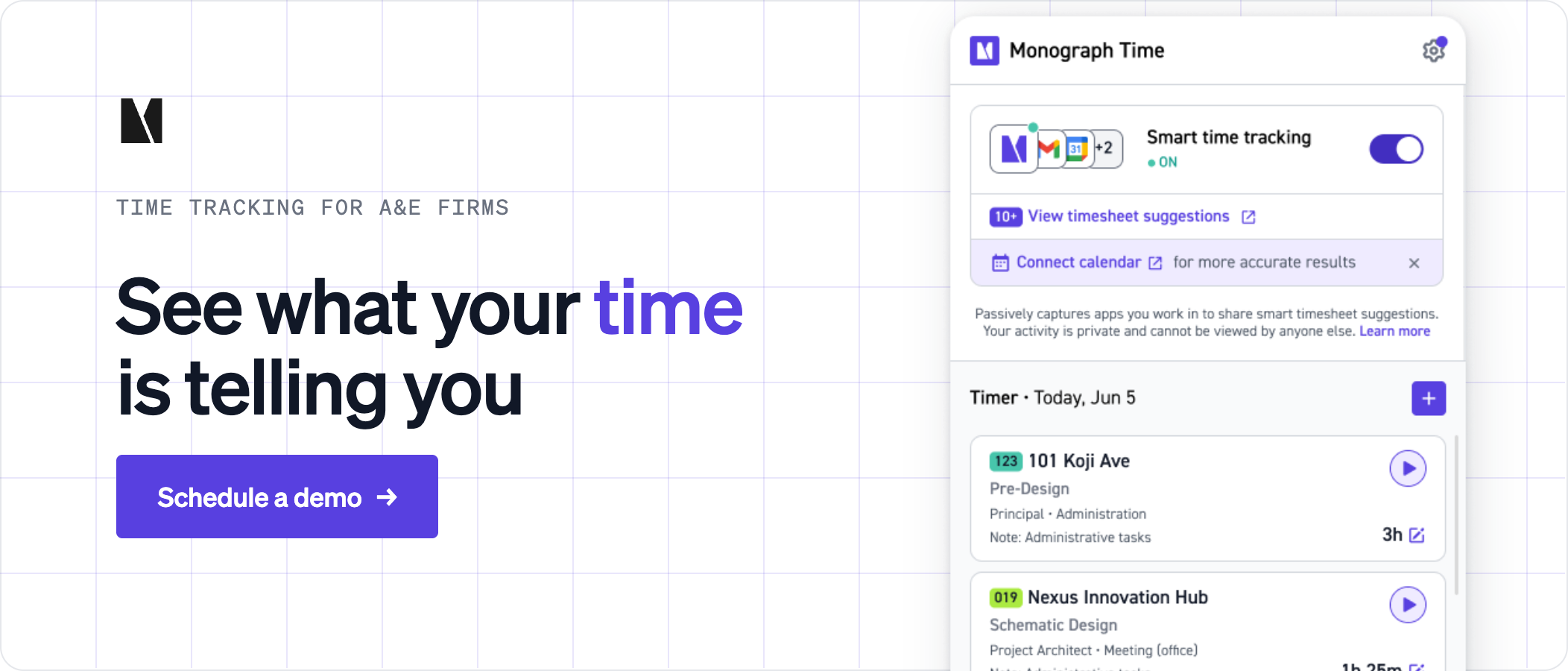
Monograph's time tracking is built around that constraint. Staffing plans can prefill timesheets with assigned project phases and planned hours, so much of the week's structure is already in place before staff enter time. On mobile, an engineer can describe the day in plain language, typed or dictated on iOS, and Monograph turns it into time entries: "I spent about an hour reviewing structural drawings for the Midtown Office project before meeting with the client," or the shorter "Log 45 minutes to Project Atlas for client coordination."
From that sentence, Monograph fills in the fields a phase budget needs:
- Duration and, when possible, approximate time worked
- Project and phase
- Activity
- Notes
With a connected calendar from Google or Microsoft 365, Smart Time Suggestions read calendar events and propose entries for the week's timesheet with project, phase, activity, and hours. That 2pm coordination call becomes a proposed entry against Maple Street CA before the engineer opens the timesheet. Every suggestion stays a draft until someone accepts it.
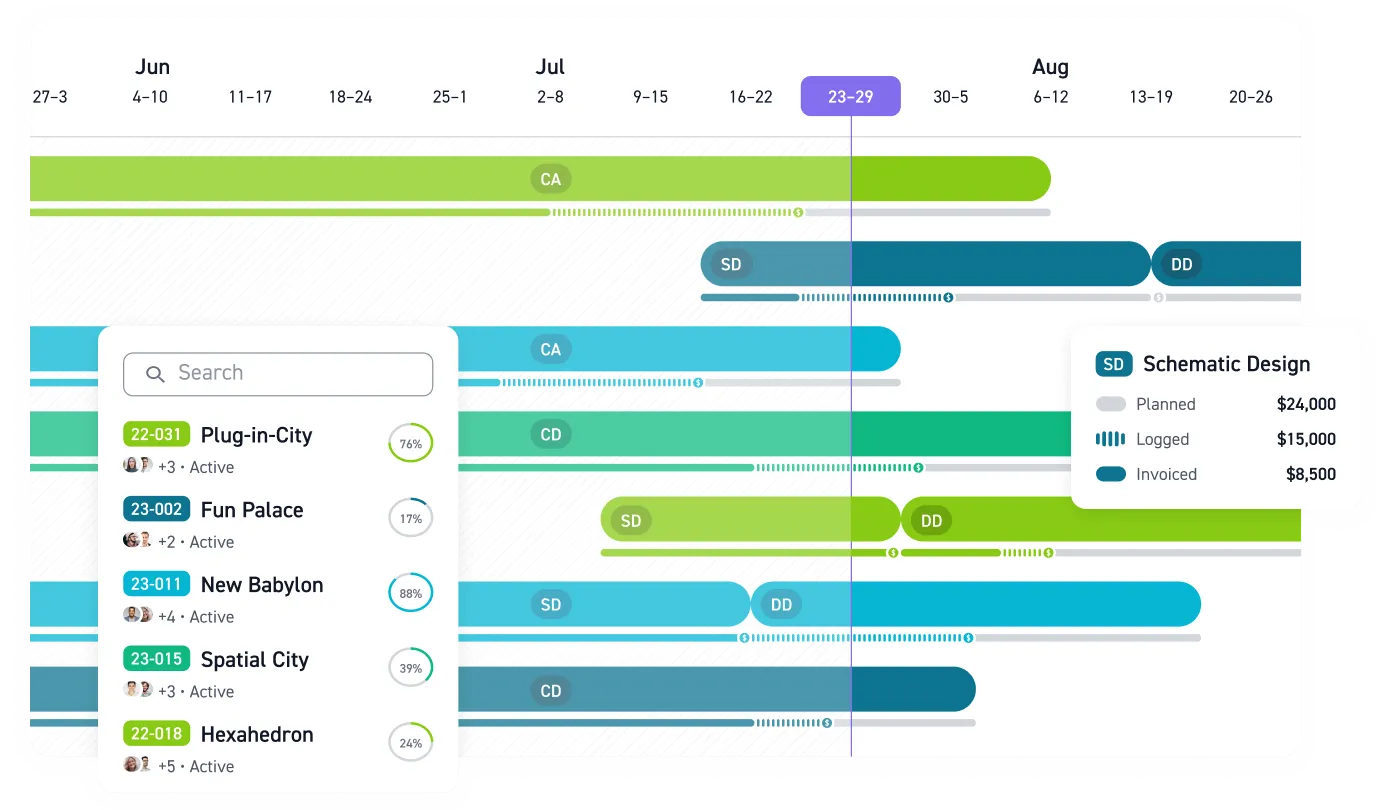
Once accepted, the hours land in phase budget burn, where dashboard alerts can surface budget overruns. Monograph's MoneyGantt™ is the signature visual tool for each phase, tracking fees through the budget-to-cash progression: planned, logged, invoiced, and paid. When DD hours start eating margin, the off-track phase becomes visible mid-phase rather than at close-out.
That visibility has practical results. Red Brick, a seven-person engineering and architecture firm, reported 25% less budget overage, 25% less administrative time, and a 2x faster billing process after adopting Monograph. Firms tracking engineering realization rates this way have the fee conversation while the phase is still open, when re-scoping or restaffing can still change the outcome.
Catch Phase Overruns Before They Become Project Losses
A green project total can hide a phase that has already spent its margin. Review your active work and confirm that every time entry maps to a phase budget rather than stopping at the project level.
Monograph connects timesheets to phase budgets so PMs, operations leaders, and principals can see where fixed-fee work is drifting while there is still time to re-scope or restaff. Monograph's MoneyGantt™ turns planned, logged, invoiced, and paid fees into one clear view of phase performance.
The next phase is already spending. See how Monograph connects engineering time entries to phase budgets and catches overruns before close-out. Book a demo.
Frequently Asked Questions
Is phase-level tracking necessary for a small engineering firm?
Yes. Small firms have less room for one overrunning phase to absorb the margin from an entire fixed-fee project. Tracking hours by phase also gives you usable historical data for staffing and pricing the next proposal instead of relying on project totals that hide where the work went.
Will phase selection make timesheets slower?
It should not. Standardize your phase names, preassign the project and phase wherever possible, and keep daily entry short. Review exceptions weekly rather than asking engineers to reconstruct phase details at the end of the month.
How should we handle one task that supports two phases?
Split the time between phases when the work clearly serves both, using the nature of the work to determine where the hours belong. If the split is unclear, have the PM resolve it while the work is still fresh rather than letting the full entry fall into a generic project bucket.
What if our contract does not use standard AIA phases?
Use the contract's actual scope, deliverables, or cost objectives as your internal phases. Assign an hours budget to each meaningful block of work and use those same names across the project plan and timesheets. The labels can vary; every hour still needs to reach the budget responsible for that work.
Data was collected as of April 2026.