
Engineering firms don't win work the way sales teams close deals. Pursuits move through RFQs, shortlists, and interviews over cycles that often run two to three years, and 80% of work comes from existing clients. Generic CRM software assumes short, transactional sales cycles, so the search for a CRM for engineering firms usually ends in one of two places: a sales tool nobody updates, or an A&E platform that connects business development to projects.
This list covers seven options across that spectrum, matched to firm size and pursuit-to-delivery fit.
What Engineering Firms Actually Need From a CRM
Two structural facts shape the requirements. First, most firms rely on the seller-doer model, where technical staff deliver projects and develop business at the same time. Systems that add non-billable data entry get abandoned. Second, engineering firms already post the industry's highest average proposal hit rate at 44.2%, which means the bigger opportunity is pursuing better-aligned work rather than chasing volume.
ACEC's guidance is blunt on this point: firms that chase fewer, better-aligned opportunities win more and waste less.
Evaluate any platform on this list against five capabilities:
- Pursuit-stage pipelines that track RFQs, RFPs, shortlist notifications, and interview dates
- Go/no-go decision support with logged rationale, so win patterns become visible
- BD-to-delivery handoff that moves won work into project planning without manual re-entry
- Win-rate reporting by client, market sector, and project type
- Project management connections and QuickBooks Online links, so pipeline data reaches the people planning staff
The last item matters because hiring decisions can't wait for a signed contract. Hire too aggressively and utilization drag follows when work slips; hire too conservatively and you scramble when it converts.
1. Monograph: Pipeline Tied Directly to Project Delivery
Monograph is firm management software built for A&E firms and used by 13,000+ architects and engineers across 1,800+ firms. It fits small to midsize practices where larger AEC ERPs carry too much setup burden.
Its Pipeline module is built for firm-wide planning shared across principals and project managers. That matters when business development lives with the same people responsible for delivery.
Pipeline covers the pursuit-to-project workflow end to end:
- Lead tracking with ownership, next steps, and firm-wide visibility
- Revenue forecasting weighted by win probability, month by month
- Capacity planning that shows staffing impact by role before you commit
- E-signatures on proposals, with status and committed work in one place
- Pipeline connections to project, financial, and staffing data when won work moves forward
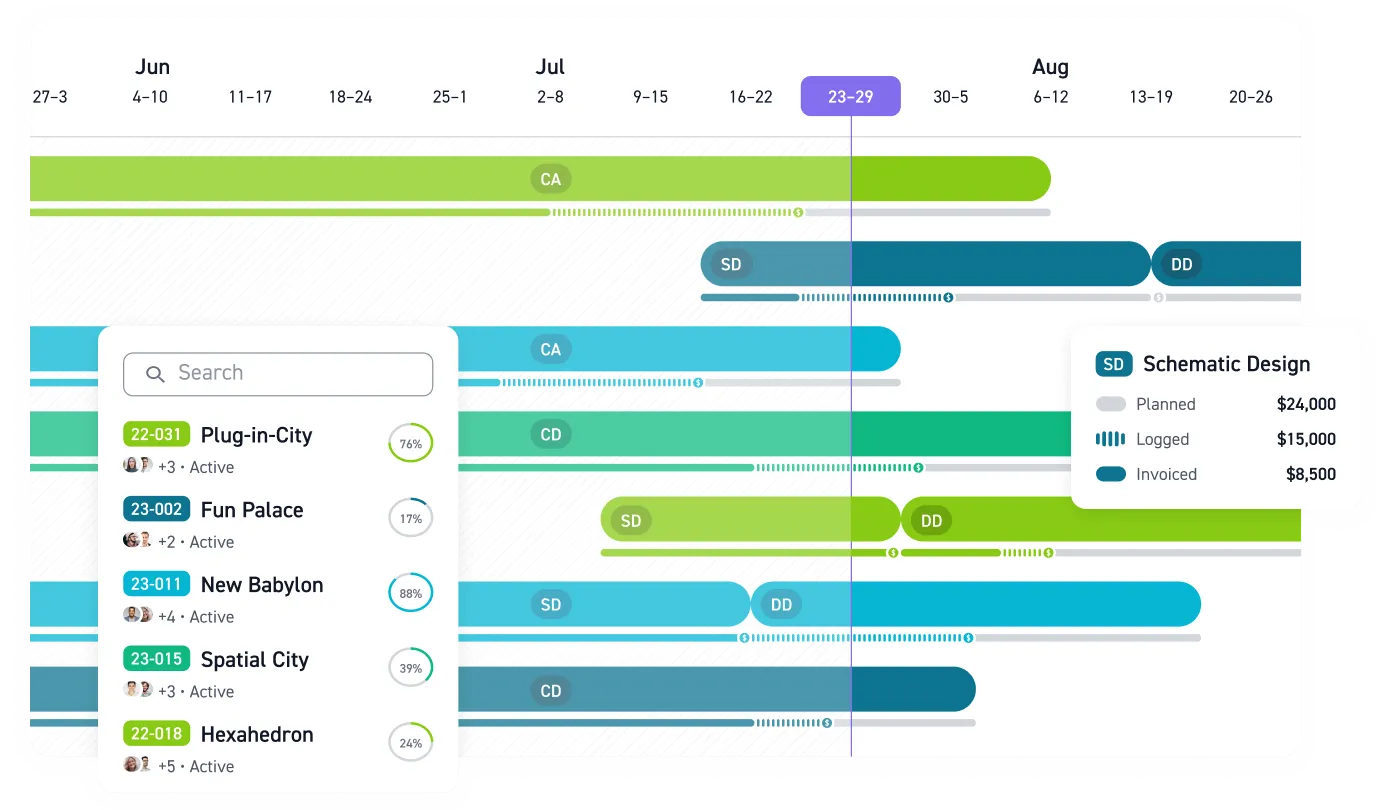
The handoff connects Pipeline to Monograph's project budgets. Monograph's MoneyGantt™ signature feature tracks planned, logged, invoiced, and paid status across each phase. Time tracking, staffing, invoicing, and QuickBooks Online sync for contacts, invoices, payments, and real cost data live in the same platform.
In one A&E case study, Brunton Architects & Engineers, a Minnesota firm previously on Deltek Ajera, reported 25% time saved on admin, a 2x faster billing process, and 25% less budget overage after moving to Monograph. Faster billing matters because invoices can sit unpaid for months.
2. Deltek Vantagepoint: Full ERP for Larger Multi-Office Firms
Deltek's A&E ERP system, successor to Deltek Vision, is built for architecture, engineering, and consulting firms. Its CRM module handles go/no-go pursuit tracking, opportunity pipelines, win/loss history, and SF330 generation.
Won opportunities transition directly into project delivery records, making Deltek a strong fit when CRM, accounting, resource planning, and project controls need to sit inside one large-firm system. Typical implementations run 6–12 months, with first-year costs commonly $50K–$500K+ for mid-size firms.
3. Unanet CRM by Cosential: AEC Depth for Complex BD Operations
Unanet CRM by Cosential is built exclusively for AEC firms. It manages the client lifecycle from pursuit through final invoicing, with strong proposal generation.
It fits larger firms with multi-office operations, public-sector BD requirements, SF330s, complex resumes, and long pursuit histories. For small-to-mid-sized practices it is likely oversized, complex, and priced beyond what the value justifies.
4. BQE CORE: All-in-One With Accounting Built In
BQE CORE, formerly BillQuick, combines CRM, project management tools, time tracking, and full project-based accounting. It was built by an architect and engineer to run their own firms.
When a client approves a proposal, CORE converts the lead into a live project environment, populating the resource plan, billing schedule, and budget. It targets small-to-mid-sized firms with a dedicated bookkeeper or controller, though modular pricing can climb once CRM and analytics add-ons stack.
5. HubSpot CRM: The Free Starting Point
HubSpot lists a free CRM tier for up to two users, with Starter at $7 per seat monthly on annual billing. It suits smaller engineering firms just starting to track pursuits.
It also pairs with HubSpot's marketing tools for inbound work. Nothing in it understands go/no-go analysis, SF330s, or proposal assembly, so growing practices outgrow it once federal or institutional pursuits enter the mix.
6. Pipedrive: Lightweight Deal Tracking
Pipedrive works for very small firms that want simple, sales-focused pipeline tracking. It handles deal tracking well, and its Projects feature can manage work after a deal is won.
The tradeoff is depth. Engineering firms still need to shape the system around RFQs, shortlist decisions, staffing forecasts, and project budgets.
7. Salesforce Sales Cloud: Maximum Customization, Maximum Configuration
Salesforce offers the deepest customization on this list, from $25 per user monthly. QuickBooks, Jira, and DocuSign connections are available through its App Exchange.
That flexibility helps firms with mature BD teams and complex reporting requirements. It also means the system rarely works well out of the box for A&E pursuit management, and setup typically requires dedicated developers and extra time.
Match the Tool to How Your Firm Wins Work
Any tracking system beats none: firms that put proper systems in place, even simple ones, consistently improve performance 15–20% within the first year. But over-building the stack carries a real price. Zweig Group documented a small firm whose planned NetSuite, BQE CORE, Salesforce, and Proposify stack would have cost $50K per year in software fees alone, before counting the IT resource to manage it.
Three moves keep a new system from becoming shelfware:
- Map your pursuit process first, then buy the tool that matches it
- Count the connections you'd have to maintain between CRM, project management workflows, time tracking, and project-based accounting; for smaller firms, one platform usually beats a stack
- Secure executive sponsorship before rollout, because adoption follows leadership
For a small to midsize engineering firm, that logic points toward a platform where pipeline, budgets, timesheets, and invoices share one dataset.
Connect Pursuits to the Work They Create
A won pursuit only helps if the project team can act on it. When RFQs, go/no-go calls, staffing forecasts, budgets, timesheets, and QuickBooks live in separate systems, principals and operations leaders make capacity decisions from stale data.
Monograph's Pipeline module connects lead tracking and proposal work to project budgets, staffing plans, time tracking, invoicing, and QuickBooks Online data. Seller-doers get a lighter way to keep the firm aligned without rebuilding the same information after every win.
Your next pursuit is already shaping your next staffing problem. See how one A&E platform connects business development to project delivery: Book a demo.
Frequently Asked Questions
Do small engineering firms really need a CRM?
Yes, once several people touch business development or pursuits stretch across months. A small firm needs one place to track RFQs, go/no-go decisions, ownership, next steps, and staffing impact.
When is HubSpot enough for an engineering firm?
HubSpot is enough for basic contact management, simple deal tracking, and light marketing support. It feels thin when your firm needs go/no-go analysis, SF330 support, proposal assembly, win-rate reporting, or pursuit-to-project handoff.
What should happen after a pursuit is won?
A won opportunity should become a project record without manual re-entry. Client details, budgets, proposal assumptions, staffing needs, and billing information should carry forward.
Should CRM data connect to QuickBooks Online?
Yes, if you use pipeline data for revenue forecasting, staffing, or billing decisions. Proposal assumptions, project budgets, timesheets, invoices, and payments need to stay close.
When do Deltek or Unanet make sense?
Deltek or Unanet make sense for larger, multi-office firms with dedicated BD staff, complex public-sector pursuit requirements, and the budget to support a longer implementation. They are usually too much system for smaller firms that need one practical workflow.